Table of Contents
ToggleIntroduction: What are the 4 Principles of AI?
What is Artificial Intelligence (AI) in simple terms?
Artificial Intelligence (AI) is very simple.
It means machines doing human work.
Like thinking, understanding, and making decisions.
AI can:
- understand words
- recognize faces
- make choices
You use AI every day.
Google Maps shows the best route.
YouTube suggests videos you like.
Your phone unlocks with your face.
For example:
When your phone understands your voice, that’s AI.
When an app suggests what to watch next, that’s AI too.
Real-life examples (easy to understand)
You already use AI daily.
- ChatGPT → answers your questions like a human
- Siri → listens and follows your voice commands
- YouTube → suggests videos you like
- Netflix → recommends movies based on your taste
Real example:
You watch one action movie on Netflix.
Next time, it shows more action movies.
That’s AI learning your choice.
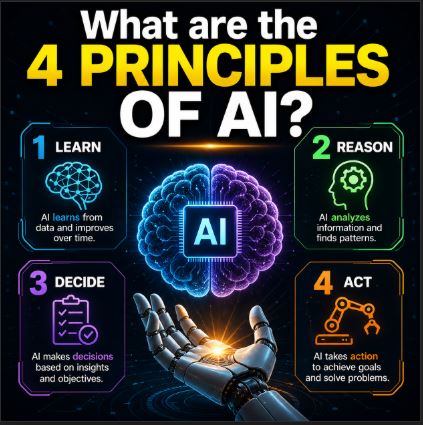
The 4 principles of AI are:
1. Learning
AI learns from data.
It studies patterns and improves over time.Example:
When you watch videos on YouTube, it learns what you like.2. Reasoning
AI analyzes information and finds patterns.
It connects data to make sense of things.Example:
Google predicts what you’re typing before you finish.3. Decision-Making
AI chooses the best option based on data.
It uses logic, not emotions.Example:
Netflix suggests movies based on your watch history.4. Action
AI takes action based on decisions.
It actually does something.Example:
Siri sets an alarm or sends a message when you ask.AI = Learn → Reason → Decide → Act
Why principles help us understand AI
AI can be smart.
But sometimes it can make wrong decisions.That’s why we need rules (principles).
These principles help us ask:
- Is it fair?
- Can we trust it?
- Who is responsible?
- Is it safe?
Without these, AI can confuse people.
Or even cause problems.With these, AI becomes more reliable.
Why this matters?
Let’s take a real example.
You apply for a job.
AI checks your CV.
It rejects you.
Now you think:
- Was it fair?
- Who made this decision?
- Why was I rejected?
- Is the system safe?
This is why these rules matter.
Another example
Netflix suggests a movie you like.
That is good AI.
But if a bank blocks your account by mistake,
that is a problem.
Final Thought
AI is growing fast.
Very fast.
But without rules, it can cause problems.
These 4 principles of AI are for everyone.
Not just experts.
Because we all use technology.
The future is not just smart machines.
It is safe and responsible machines.

What is Artificial Intelligence?
Think of AI like this:
We teach machines to think and learn a little like humans.
Not feelings. Not emotions.
Just solving problems in a smart way.
Ever noticed this?
Your phone understands you even before you finish typing.That is AI.
Basic idea:
Artificial Intelligence means making machines smart.
So they can do work that normally needs human thinking.
In simple words:
AI means machines doing work that usually needs human thinking.
Like understanding language, recognizing faces, and making decisions.
Simple definition:
Artificial Intelligence is when computers learn from data,find patterns,and make decisions with very little human help.
Human vs Machine Intelligence (real difference)
Humans:
We understand things easily.
We feel, imagine, and use common sense.
Sometimes we guess right, even without full information.
Machines (AI):
No feelings. No instincts.
They use data, patterns, and logic only.
Real example:
We recognize a friend in seconds.
AI needs many images to learn the same face.
Everyday AI (you already use it)
- Google
Type a few letters,it completes your sentence.
It is guessing what you want to say. - Siri
You speak normally.
It understands and replies. - YouTube recommendations
You watch one video…
Then your feed becomes very accurate.
AI is learning what you like.
The 4 Core Principles of Artificial Intelligence
1 Principle: Learning (Machine Learning)
AI does not think like humans.
It learns from data.
The more data it gets, the better it becomes.
Think like this:
More practice = better AI.
If AI sees many movies, ratings, and clicks, it starts noticing patterns:
- what you like
- what you skip
- what similar people enjoy
Then it uses this to predict things.
Supervised vs Unsupervised Learning (simple)
Supervised learning is like learning with a teacher.
You give correct answers with examples.
Example:
Dog = Dog
Cat = Cat
So AI learns the right label.
Unsupervised learning is learning without answers.
AI finds patterns on its own.
Example:
It groups similar users together by itself.
Real-life example: Netflix
Netflix is a good example.
It watches your behavior:
- what you watch
- how long you watch
- what you skip
Then it suggests:
👉 “People like you also watched this”
That’s Machine Learning.
It is not guessing.
It is learning from your activity.
Simple truth
AI is not born smart.
It becomes smart by learning from data again and again.
Just like humans learn from experience.
2 Principle : Reasoning(How AI makes decisions)
AI doesn’t just store data.
It also tries to make logical decisions.
This is called reasoning.
It works like this:
AI looks at information → compares patterns → then decides the best possible answer.
Simple thinking, fast calculation.
Rule-based systems vs modern AI
Rule-based systems (old style AI):
They follow fixed rules.
Like:
- IF fever + cough → THEN flu
- IF chest pain → THEN check heart
Very strict. No flexibility.
If something new happens, it gets confused.
Modern AI (today’s AI):
It doesn’t depend only on fixed rules.
It learns from data and past cases.
So it can handle new situations better.
It’s more flexible and smarter.
Real-life example: Medical diagnosis
In hospitals, AI is now used to help doctors.
Example:
A patient has symptoms like:
- fever
- tiredness
- body pain
Old systems would just match fixed rules.
But modern AI:
- checks millions of past patient records
- compares similar cases
- suggests possible diseases
Then it may say:
“This looks like dengue or viral infection. Further test needed.”
Doctors still make the final decision.
AI just helps them think faster and better.
Simple truth
AI reasoning is not “thinking like humans.”
It’s more like:
spotting patterns + applying logic + giving best possible result
Fast, smart, and based on data.
3 Principle : Problem Solving
Problem Solving in AI
AI is really good at solving problems.
Not by guessing, but by trying smart options and picking the best one.
It works step by step:
looks at the problem
checks possible solutions
chooses the fastest or best result
Search algorithms & optimization (simple idea)
Search algorithms are just methods AI uses to “search” for the best answer.
Think of it like this:
If there are many roads, AI doesn’t check every road blindly.
It checks smartly and avoids useless paths.
Optimization means:
finding the best option with the least time, cost, or effort.
So AI always tries:
- shortest path
- fastest result
- best outcome
Real-life example: Google Maps
Google Maps is a perfect example.
When you enter a location:
- it checks all possible routes
- looks at traffic
- avoids accidents or roadblocks
- compares time for each route
Then it says:
“This is the fastest route right now.”
If traffic changes, it updates instantly.
That’s AI problem solving in real time.
Simple truth
AI doesn’t just find a solution.
It finds the best possible solution out of many options.
Fast, smart, and always improving.
4 Principle : Perception
Principle of Perception (AI “seeing” and “hearing”)
AI has something called perception.
It means AI can understand the world through data.
Just like humans use eyes and ears, AI uses:
- images
- sound
- text
It tries to “make sense” of them.
How AI understands images, speech, and text
AI breaks everything into data.
For images: it looks at shapes, colors, and patterns.
For speech: it listens to sound waves and turns them into text.
For text: it understands meaning and context from words.
So it’s not “seeing” like humans.
It’s calculating patterns.
Computer Vision & Speech Recognition
Computer Vision:
This is AI’s ability to understand images and videos.
It can:
- detect faces
- recognize objects
- read signs
Speech Recognition:
This is AI turning voice into text.
It listens to your words and understands what you said.
Real-life example: Face unlock & voice assistants
Your phone’s face unlock is a simple example.
It scans your face, matches patterns, and unlocks.
Even if you change hairstyle or wear glasses, it still works.
Voice assistants like:
- Siri
- Google Assistant
They listen to your voice and respond like a person.
You say:
“What’s the weather today?”
And it replies instantly.
That’s perception in action.
Simple truth
AI doesn’t “see” or “hear” like humans.
It just converts everything into data and finds patterns in it.
Fast, smart, and surprisingly accurate.
How the 4 Principles Work Together in AI Systems
AI doesn’t work on one skill at a time.
It mixes everything together like a system.
These 4 things connect and support each other:
- Learning
- Reasoning
- Problem Solving
- Perception
On their own, they are useful.
But together, they become powerful.
Step-by-step simple flow
First, AI takes in information.
That’s perception.
Then it learns from that data.
It finds patterns.
After that, it thinks logically.
That’s reasoning.
Finally, it solves the problem.
It picks the best action.
Real-life example: Self-driving car
A self-driving car shows this perfectly.
- It “sees” the road, cars, and people (Perception)
- It learns from millions of driving situations (Learning)
- It decides when to stop, turn, or speed up (Reasoning)
- It finds the safest and fastest route (Problem Solving)
All of this happens in seconds.
No pause. No confusion.
Another simple example: AI assistant
When you ask something like:
“Find me the fastest route to office”
It:
- understands your voice/text
- uses past data and maps
- thinks about traffic and distance
- gives the best route
Everything works together in the background.
Real-world AI uses all four principles combined
Real-world AI doesn’t rely on just one ability.
It uses all four principles together at the same time.
That’s what makes it feel “smart” and fast.
How it works in real life?
AI is always doing 4 things together:
- It understands input (images, voice, text)
- It learns from past data
- It makes logical decisions
- It solves problems step by step
Nothing works alone. Everything is connected.
Example 1: Self-driving cars
A self-driving car is a full AI system.
It:
- sees the road, traffic, and people (Perception)
- learns from millions of driving situations (Learning)
- decides when to stop or move (Reasoning)
- chooses the safest route in real time (Problem Solving)
All of this happens in seconds.
No human control needed.
That’s AI working like a complete brain.
Example 2: ChatGPT
A system like ChatGPT also uses all four principles.
It:
- understands your question (Perception)
- learns from huge amounts of text data (Learning)
- builds logical answers (Reasoning)
- breaks down complex questions into simple responses (Problem Solving)
That’s why it can chat like a human.
Simple truth
AI is not doing one job at a time.
It’s running all four principles together in the background.
That combination is what makes modern AI powerful, useful, and real-world ready.
Real-Life Applications of AI Principles
AI is not just theory anymore. It is everywhere in daily life.
From hospitals to social media, it is already working in the background.
Let’s break it down simply.
Healthcare (Diagnosis systems)
In hospitals, AI helps doctors.
It:
- reads patient reports
- checks symptoms
- compares with old medical cases
Then it suggests possible diseases.
Example:
If someone has fever, body pain, and weakness, AI may help doctors suspect things like dengue or viral infection faster.
It doesn’t replace doctors.
It just helps them decide quicker.
Education (AI tutors)
AI is also changing how students learn.
AI tutors:
- explain topics in simple way
- give practice questions
- adjust difficulty based on your level
So if you are weak in math, it gives you easier steps first.
It feels like a personal teacher available 24/7.
Business (Chatbots & analytics)
Companies use AI to handle customers and data.
Chatbots:
- answer customer questions instantly
- work day and night
Analytics:
- study customer behavior
- show what people like or buy
This helps businesses make better decisions faster.
Social Media (Recommendation engines)
Social media apps use AI all the time.
They:
- track what you watch
- see what you like or skip
- suggest similar content
That’s why your feed feels “perfect for you.”
Example:
If you watch cooking videos, you’ll suddenly see more recipes.
That’s AI quietly working in the background.
Simple truth
AI is not far away technology.
It is already inside hospitals, classrooms, businesses, and your phone.
We just don’t always notice it but it’s working every second.
Why These AI Principles Matter for the Future
AI is not slowing down.
It’s growing fast every year.
And these 4 principles are the base of everything.
Without them, AI simply doesn’t work.
AI growth and automation
AI is already taking over repetitive work.
Machines now:
- answer customer calls
- drive cars in testing
- help doctors in hospitals
- write and organize data
This is called automation.
Simple tasks are getting faster and smarter.
And it’s only going to increase in the future.
Job impact and opportunities
Yes, AI will change jobs.
Some old jobs may reduce.
But new jobs are also coming:
- AI developers
- data analysts
- machine learning engineers
- AI trainers
Example:
Just like computers created IT jobs, AI is creating a whole new field.
So it’s not just job loss.
It’s also new career opportunities.
Ethical concerns (simple idea)
With AI, there are also some concerns:
- privacy of data
- misuse of technology
- unfair decisions by machines
Example:
If AI is trained on wrong data, it can give biased results.
That’s why humans still need to control AI carefully.
Simple truth
AI is shaping the future.
It is making life faster, smarter, and more automated.
But at the same time, we need to use it responsibly.
Limitations of AI Principles
AI looks smart from the outside.
But it still has clear limits.
It works well in many areas,
but it’s not perfect like humans.
AI lacks real human understanding
AI can process information.
But it doesn’t truly “understand” it.
It doesn’t feel emotions or context like humans.
Example:
If you say something sarcastic, AI might take it literally.
Because it only reads patterns, not feelings.
So it’s smart, but not truly aware.
Data dependency
AI is fully dependent on data.
No data = no learning.
If the data is wrong or incomplete, AI becomes weak.
Example:
If a medical AI is trained with limited patient records,
it may give less accurate suggestions.
So its performance depends on what it is fed.
Bias issues
AI can also become biased.
Why?
Because it learns from human-made data.
If the data has unfair patterns, AI will copy them.
Example:
If most training data shows one type of behavior or group,
AI may favor that group in results.
That’s why bias is a real concern in AI systems.
Simple truth
AI is powerful, but not perfect.
It doesn’t understand like humans,
it depends heavily on data,
and it can sometimes be biased.
That’s why human control is still very important.
Future of Artificial Intelligence
AI is moving fast.
What we see today is just the starting point.
In the next few years, it will feel even more natural in daily life.
Strong AI vs Weak AI
Weak AI (what we use today):
This is the AI around us right now.
It is good at specific tasks only.
Example:
- Google Maps for routes
- Netflix for recommendations
- Chatbots for answers
It works smart, but only in one area.
Strong AI (future idea):
This is the next level.
It would think more like a human.
It could understand, learn, and adapt in many situations—not just one task.
Right now, Strong AI does NOT fully exist.
It is still research.
What researchers are working on
Scientists are trying to make AI:
- more human-like in understanding
- better at learning from fewer examples
- safer and less biased
- able to handle real-world situations better
They are also working on AI that can explain its decisions clearly, not just give answers.
Predictions for the next 10 years
In the next decade, we will likely see:
- AI doctors helping with faster diagnosis
- AI teachers giving personal learning for students
- smarter self-driving systems in cities
- AI assistants that feel like real conversations
- more automation in offices and industries
Example:
Instead of searching everything yourself, you might just ask AI and it will plan your whole day—travel, work, and reminders.
Simple truth
Today’s AI is like a smart tool.
Tomorrow’s AI may feel more like a smart partner.
But full human-like intelligence is still a goal, not reality yet.
FAQ ( Frequently Asked Questions )
What are the 4 principles of AI?
AI basically works on four simple ideas.
Think of them as the “brain system” behind everything AI does.
1) Learning
AI learns from data.
The more it sees, the better it gets.
Example: Netflix learns what you like by watching your behavior.
2) Reasoning
AI makes logical decisions from what it knows.
It tries to pick the best answer.
Example: A medical AI suggests possible diseases based on symptoms.
3) Problem Solving
AI finds the best solution from many options.
It doesn’t just guess, it checks possibilities.
Example: Google Maps finding the fastest route through traffic.
4) Perception
AI understands the world through images, voice, and text.
It “sees” and “hears” using data.
Example: Face unlock on your phone or voice assistants like Siri.
What are the four pillars of AI?
AI is built on four main “pillars.”
Think of them as the base that holds everything together.
Without these, AI can’t really work properly.
1) Learning
AI learns from data and improves over time.
More data = better results.
Example: Netflix learns your taste from what you watch.
2) Reasoning
AI uses logic to make decisions.
It compares options and picks the best one.
Example: A medical system suggests possible illness from symptoms.
3) Problem Solving
AI breaks problems into steps and finds the best solution.
It checks many possibilities quickly.
Example: Google Maps finding the fastest route in traffic.
4) Perception
AI understands input like images, speech, and text.
It turns real-world info into data.
Example: Face unlock on phones or voice assistants like Siri.
What are the 4 C's of AI?
The 4 C’s of AI are a simple way to understand how AI actually works in real life.
Think of them like the basic skills AI needs to be useful.
1) Collect (Data gathering)
AI first collects data from everywhere.
No data, no AI.
Example: Apps collect your clicks, searches, and watch time.
2) Compute (Processing)
Then AI processes that data.
It runs calculations and finds patterns.
Example: Your phone quickly analyzing your face for Face Unlock.
3) Create (Making output)
After processing, AI creates results.
It can suggest, predict, or generate answers.
Example: YouTube suggesting videos you might like.
4) Communicate (Interaction)
Finally, AI interacts with humans in a simple way.
Through text, voice, or visuals.
Example: Chatbots replying to your questions instantly.
Simple truth
AI is not magic.
It just collects, computes, creates, and communicates really fast.
That’s why it feels so smart in everyday life.
Which type of AI is ChatGPT?
ChatGPT is a Narrow AI (Weak AI).
That just means one simple thing:
it is built to do a specific job — talk, write, and answer questions.
It is very smart in language,
but it does NOT have human-like general thinking or real consciousness.
What does that mean in real life?
ChatGPT:
- understands text
- gives answers
- writes content
- helps explain topics
But it doesn’t “think” like a human.
It doesn’t have feelings or real understanding.
It just works on patterns from data.
Real-life example
When you ask ChatGPT:
“Explain AI in simple words”
It quickly:
- breaks your question
- searches patterns from training data
- builds a clear answer
That’s why it feels like a conversation.
But it’s still just a tool, not a human mind.
Simple truth
ChatGPT is powerful, fast, and useful.
But it is still Narrow AI — focused only on language tasks, not general intelligence.
What are the benefits of AI?
AI is not just a tech buzzword anymore.
It’s already making everyday life faster and easier in many ways.
Let’s break it down simply.
1) Saves time
AI does work in seconds that normally takes hours.
It handles boring, repetitive tasks.
Example: Emails sorted automatically, or quick Google Maps routes.
2) Better accuracy
AI reduces human mistakes.
It follows data, not emotions or guesswork.
Example: In hospitals, AI helps doctors detect diseases earlier.
3) Makes daily life easier
AI is quietly running in your phone and apps.
Example:
- Face unlock
- Voice assistants
- Auto video suggestions on YouTube
You use it every day without even noticing.
4) Helps businesses grow
Companies use AI to understand customers better.
It improves decisions and saves cost.
Example: Online stores suggesting products you might like.
5) Works 24/7
AI doesn’t get tired or need breaks.
It keeps working all the time.
Example: Chatbots answering customer questions at night.
🚀 Simple truth
AI is not here to replace everything.
It’s here to make life faster, smarter, and more efficient.
And honestly, it’s already doing that every single day.
Who is the father of AI?
The father of Artificial Intelligence is John McCarthy.
He was the first person who actually gave the name “Artificial Intelligence” in 1956.
Why is he called the father of AI?
Because he didn’t just study computers.
He helped start the whole idea of machines that can “think” and solve problems.
He also organized the famous Dartmouth Conference, where AI as a field officially began.
That moment is basically where AI research started as a proper science.
Real-life impact (simple way to understand)
Because of his work, today we have things like:
- smart assistants
- Google Maps suggestions
- chatbots like ChatGPT
- face unlock on phones
All of this comes from the idea he helped start.
Conclusion
What are the 4 principles of AI? AI basically works on four simple ideas: learning, reasoning, problem solving, and perception.
Each one has its own role, but when they work together, they make AI smart and powerful.
Quick summary of the 4 principles
Learning: AI looks at data and keeps improving itself over time
Reasoning: AI uses logic to make decisions
Problem Solving: AI checks different options and picks the best solution
Perception: AI understands things like images, speech, and text
That’s really the core system behind how AI works.
Final thoughts on AI in modern life
AI is already part of our daily life—we just don’t always realize it.
For example:
- Your phone unlocks with your face
- You see video suggestions on social media
- Maps help you find the fastest route
All of this is AI working quietly in the background.
Simple truth
AI is no longer just a future technology,it’s our present reality. It makes life faster, easier, and more connected. And in the coming years, it will become even more important in everything we do.