Ever wondered what blockchain really is in simple words?
In this article, we explain it in a very easy way. No heavy terms. Just clear ideas.
Blockchain is like a shared digital record.It keeps data safe and transparent.
Once something is added, it is very hard to change.
We will also look at its key features.Like security, transparency, and no central control.
These make it different from normal systems.
Then we’ll talk about pros and cons.Yes, it has good sides and some limits too.
Most importantly, you’ll see how it is used in real life.From online payments to banking and data sharing.
It’s already around you, even if you don’t notice it.
By the end, you’ll clearly understand blockchain.
Simple. Real. And easy to connect with everyday life.

Table of Contents
ToggleIntroduction to Blockchain Technology
Blockchain is a simple way to store and share data online.
But it works in a smarter way.
It does not keep data in one place.
It spreads it across many computers.
So, no single person or company controls it.
At first, it sounds hard.
But the idea is very simple.
Think of it like a shared digital notebook.
Everyone can see it.
But no one can secretly change or delete old pages.
Real-life example:
Imagine friends lending money to each other.
No one person keeps the record.
Everyone has the same record.
If something changes, it updates for all.
That is blockchain.
Now think about Bitcoin.
When you send it, no bank is needed.
Many computers check the transaction.
Then it is saved forever.
In short:
Blockchain is a shared system to store data.
It has no central control.
And it keeps everything safe and clear.
What is Blockchain Technology in Simple Words ?

Blockchain is a way to store and share information online.
It is safe and open.
Data is not kept in one place.
It is shared across many computers.
So, no single person or company controls it.
Blockchain is like a digital record.
It is also called a ledger.
It stores transactions forever.
Once data is added, it cannot be changed.
What is blockchain? (Simple example)
Think of a small shop.
It keeps a record of everything.
What comes in.
What goes out.
This record book is called a ledger.
In blockchain, this ledger is digital.
Data is stored in small blocks.
These blocks are linked together.
They form a chain.
That is why it is called blockchain.
Real example:
Bitcoin is a big example.
It uses blockchain to record all transactions.
Each block connects to the previous one.
This makes the system very secure.
It is almost impossible to change or break it.
What is Blockchain Technology and How does it Work?
Think of it like sending money to a friend. But everything is written in a shared digital notebook.And everyone trusts it.
1. Transaction starts
You send money or data.Like paying a shop online.
2. Verified by network
Many computers check it.They confirm it is real.And that you have the money.
3. Added to a block
Your transaction joins others.
Like putting many receipts in one folder.
4. Block joins the chain
That folder gets locked.
Then it is added to a chain.
Once added, it cannot be changed.
Real-life example
Imagine you and your friends share a diary.
When someone spends money, it is written there.
Before writing, everyone checks it.
If it is correct, it gets added.
Then it is sealed forever.
No one can erase or edit it.
That is how blockchain stays honest and secure.
Why is it called “blockchain”?,
The name “blockchain” sounds complex but it’s actually very simple.
Let’s break it down.
First, “block”
A block is a small piece of data.Like one page in a notebook.
It stores many transactions.
Then, “chain”
Each block is linked to the one before it.Like pages joined in order.
If you try to change one page,the whole system breaks.
Put it together
Block + chain = blockchain
It is a line of data blocks.
All connected one after another.
Once something is added,
it stays there forever.
No edits.
No hiding.
Just a clear history.
Real-life example
Imagine a train.
Each coach is a block.
All coaches are connected.
That is the chain.
If one coach is disturbed,
the whole train is affected.
Same in blockchain.
Everything depends on the connection.
That’s why the name makes perfect sense.
Blockchain Architecture
Blockchain works in a decentralized way.
No single person controls it.
It uses hash codes to connect blocks.
This makes the system very secure.
Instead of third parties, users verify transactions themselves.
They use digital signatures and network rules.
Once a transaction is verified, it becomes permanent.
It cannot be changed or deleted.
Main parts of blockchain:
- Blockchain platform
- Transactions (that form blocks)
- Security system
- Network nodes
- Block creation process
All these parts work together to keep the system running.
What is mining?
Mining is the process of checking transactions.
Miners or validators confirm if data is real.
Then they add it to the blockchain.
How it works:
Nodes process data and share updates with each other.
Each block includes the hash of the previous block.
This keeps the chain connected and secure.
A block is verified only when everything matches correctly.
After that, a new block is added.
Blockchain and Bitcoin
Bitcoin uses blockchain to record all transactions.
It works like a public digital ledger.
No bank or middleman is needed.
Miner rewards
Miners get rewards for verifying blocks.
Right now, Bitcoin miners get 6.25 BTC per block.
Every 210,000 blocks, the reward is reduced.
This is called Bitcoin Halving.
Blockchain Example

A simple example of blockchain is Bitcoin. It uses blockchain to record every transaction.
When someone sends Bitcoin, the system saves it in a block.
That block is linked to other blocks in a chain.
No one can change or delete the record.
Example:
If you send Bitcoin to a friend, the transaction shows the amount, time, and wallet address.
It gets verified by the network and stored permanently.
Practical Experience About " What is Blockchain Technology in simple words Essay?
I first started learning about blockchain when I saw people using it for payments and data sharing.
At the beginning, it felt a bit confusing. Too many new terms.
But when I looked at real examples, it started making sense.
One small business I saw used blockchain for payments.
Before that, they had problems.
Bank transfers were slow.
Sometimes records were missing or unclear.
Payments could take days.
After switching to blockchain, things changed.
Payments became faster.
Everything was recorded instantly.
Both sides could see the same data.
No confusion. No hidden changes.
I also noticed some organizations using it for secure data sharing.
It helped reduce trust issues between teams.
Everyone worked on the same updated record.
But honestly, it’s not perfect.
Some people still find it hard to learn.
And starting cost can be high.
Still, one thing is clear from my experience.
Blockchain is making systems faster and more trustworthy.
And in the future, it will likely become a normal part of digital work.
Key Features of Blockchain Technology
Blockchain sounds technical, but the core idea is actually pretty simple. It just has a few strong features that make it powerful.
1. Decentralization
No single boss controls it.
No bank, no company, no one owner.
It runs on thousands of computers together.
Real-life feel:
It’s like a group project where everyone keeps a copy of the work. Nobody can secretly change things alone.
2. Transparency
Everything is visible to everyone in the system.
Anyone can check transactions anytime.
Real-life feel:
Like a glass jar. You can see everything inside. Nothing is hidden.
3. Security
Data is locked using strong encryption.
Hack it? Very, very hard. Almost impossible in real use.
Real-life feel:
Like a safe with millions of locks, and the keys are split across the world.
4. Immutability (can’t be changed easily)
Once something is added, it stays there forever.
No editing. No deleting.
Real-life feel:
Like writing with permanent ink in a public record book. Once it’s written, it’s there for good.
Blockchain explained simply
Every time something happens (like sending money), it gets written as a record.
These records are packed into “blocks.”
Then those blocks are linked together in order.
So you get a chain of blocks.
That’s why it’s called blockchain.
Uses of Blockchain Technology
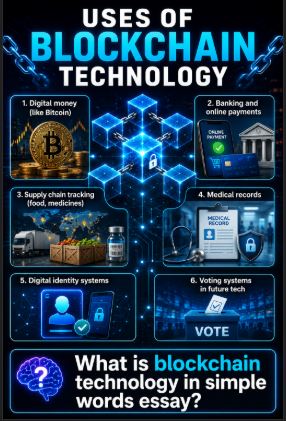
Blockchain is not just for crypto. It’s used in many places:
- Digital money (like Bitcoin)
- Banking and online payments
- Supply chain tracking (food, medicines)
- Medical records
- Digital identity systems
- Voting systems in future tech
It helps make systems more honest and transparent.
Blockchain essay for students (short & simple)
Blockchain is a modern technology used to store data in a secure and transparent way. It works like a digital notebook shared across many computers. Each record is stored in a block, and these blocks are linked together in a chain.
Once data is added, it cannot be easily changed. This makes blockchain very secure and trustworthy.
It is widely used in cryptocurrencies like Bitcoin, online banking, and supply chain tracking. It helps reduce fraud and increases trust between people and systems.
In simple words, blockchain is a system that keeps data safe, open, and permanent.
Real-life example (easy understanding)
Imagine a class register.But instead of one teacher holding it, every student has a copy.
When someone writes something in it, everyone checks it.
Once confirmed, it gets written in all copies.
And once it’s written, nobody can erase or change it.
That’s exactly how blockchain works in real life.
Applications of Blockchain Technology
Where is blockchain actually used?
Not just crypto. It’s showing up in real life, fast.
1. Banking & payments
Send money directly. No long bank chain.
Faster. Cheaper.
Example:
Sending money abroad in minutes instead of days.
2. Supply chain tracking
Track products from start to finish.
No fake data. Everything is visible.
Example:
A food company tracking where your vegetables came from.
You know if it’s fresh and safe.
3. Healthcare records
Patient data stays secure.
Only authorized people can access it.
Example:
Your medical history shared safely between hospitals.
4. Voting systems
Votes are recorded safely.
No tampering. No cheating.
Example:
Online voting where results can’t be changed.
5. Digital identity
You control your own identity.
No need to share full personal data everywhere.
Example:
Logging into apps without giving full documents every time.
6. Smart contracts
Automatic agreements.
No need for a middleman.
Example:
Rent gets paid automatically when the date arrives.
7. Real estate
Buying property becomes simple.
Less paperwork. Less fraud.
Example:
Property ownership stored securely on blockchain.
In simple words:
Blockchain is not just about crypto.
It’s about making systems more honest, fast, and secure.
That’s why industries are slowly moving towards it.
What are the 4 pillars of blockchain?
Think of blockchain like a strong building.It stands on 4 main pillars.If one is weak, the whole system shakes.
1. Decentralization
No single boss. No central control.
Data is shared across many computers.
Everyone has a copy.
Example:
Instead of one bank controlling data,
many computers around the world manage it together.
2. Transparency
Everything is open and visible.
Transactions can be seen by anyone in the network.
Nothing is hidden.
Example:
Like a public record where anyone can check transactions anytime.
3. Immutability
Once data is saved, it can’t be changed.
No editing. No deleting.
Example:
If a payment is recorded,
no one can go back and secretly change the amount.
4. Security
Strong encryption keeps data safe.
Very hard to hack or fake.
Example:
Your transaction is locked with advanced codes.
Only the right person can access it.
In simple words:
Blockchain works because it is:
shared, open, unchangeable, and secure.
That’s what makes people trust it without needing a middleman.
Blockchain Decentralization
Blockchain decentralization means no single person or company controls the system.
Control is shared across many computers in a network.
Each computer helps verify and record transactions. 🔐
So there is no central authority like a bank or government.
This makes the system more open and harder to cheat or hack.
Example:
In Bitcoin, no bank controls your money.
The network itself checks and approves every transaction.
So simply put, decentralization means power is shared, not controlled by one place.
Blockchain Transparency
Blockchain transparency means all transactions are open and visible.
Anyone in the network can see the records.
Nothing is hidden or secret.
This makes the system more trustworthy.
Even though data is public, no one can change it.
So it is open but still secure.
Example:
In Bitcoin, you can view any transaction on the blockchain.
You can see the sender, receiver, and amount.
But you cannot edit or delete it.
So simply put, transparency means everyone can see, but no one can change
What is blockchain used for?
Blockchain is used to store and verify data in a secure way. 🌐
It is mainly used for tracking transactions.
It removes the need for banks or middlemen. 🔐
Everything is recorded and cannot be changed.
Example:
People use Bitcoin to send money anywhere in the world. 💰
Companies use blockchain to track products in supply chains.
Hospitals use it to store patient records safely.
So in simple words, blockchain is used for safe payments, data storage, and tracking information.

Types of Blockchain
There are four main types of blockchain.
Each type works in a different way.
1. Public Blockchain
It is open for everyone.Anyone can join and use it.
Example: Bitcoin and Ethereum.
2. Private Blockchain
It is controlled by one organization.Only selected users can access it.
Example: Company systems for internal data.
3. Consortium Blockchain
It is managed by a group of organizations.Control is shared between them.
Example: Banks using shared payment systems.
4. Hybrid Blockchain
It combines public and private features.Some data is open, some is private.
Example: Government or enterprise projects.
So in simple words, blockchain comes in different types depending on who controls it and how it is used.
Is Blockchain Secure?
Yes, blockchain is very secure. But no system is 100% perfect.Blockchain uses strong encryption.It stores data in many computers, not just one. 🌐
Once data is added, it cannot be changed.
This makes it very hard to hack.
Example:
In Bitcoin, every transaction is verified by the network. 💰
If someone tries to change it, the system will reject it.
But users still need to be careful.
If you lose your private key, your funds cannot be recovered.
So simply put, blockchain is secure, but user mistakes can still cause risks.
Advantages of Blockchain Technology
Blockchain sounds technical, but its benefits are actually very practical.
It’s all about trust, speed, and control.
1. No middleman
No banks or third parties needed for many tasks.
People deal directly with each other.
Real-life feel:
Like sending money straight to a friend, no bank delay, no extra fee.
2. High security
Data is locked using strong encryption.
Once added, it’s very hard to hack or change.
Real-life feel:
Like a diary written in permanent ink and stored in a locked room everyone can see but no one can edit.
3. Transparency
Everyone in the system can verify transactions.
Nothing is hidden or secret.
Real-life feel:
Like a shared Google Sheet where everyone can see updates in real time.
4. No data tampering (trust built-in)
Once something is recorded, it stays there forever.
No editing. No deleting.
Real-life feel:
Like a public record book where every entry is permanent.
5. Faster transactions
No long approval chains or waiting days.
Things move quickly, even across countries.
Real-life feel:
Like sending a message instead of mailing a letter.
6. Lower costs
No middleman means fewer fees.
Businesses save money. Users too.
Real-life feel:
Like buying directly from the farmer instead of paying extra to multiple shops.
Simple wrap-up
Blockchain is useful because it makes systems:
- More secure
- More transparent
- Faster
- Cheaper
- Less dependent on middlemen
That’s why so many industries are moving toward it.
Disadvantages of Blockchain Technology
Blockchain is powerful, but it’s not perfect.
There are a few real problems people don’t talk about enough.
1. High energy consumption
Some blockchain systems use a lot of electricity.
Because thousands of computers are working at the same time to verify data.
Real-life feel:
It’s like having 10,000 calculators solving the same problem just to double-check one answer.
Accurate, yes… but expensive in energy.
2. Complex for beginners
It’s not super easy to understand at first.
Words like “hashing,” “nodes,” and “consensus” can feel confusing.
Real-life feel:
Like learning to drive a car with too many buttons and no clear manual.
You can do it, but it takes time.
3. Slow adoption in some industries
Many businesses are still not fully using blockchain.
Some don’t trust it yet. Others find it too new or expensive to switch.
Real-life feel:
Like switching from cash to digital payments.
Some people adapt fast, others stick to old habits.
Simple wrap-up
Blockchain is strong, but not perfect.
Main issues are:
- It uses a lot of energy
- It’s hard for beginners
- Not everyone is ready to adopt it yet
So yeah… powerful technology, but still growing and evolving.
Blockchain vs Traditional Database (simple comparison)
People often mix these two up.
But they work very differently.
Let’s make it super clear.
1. Centralized vs Decentralized
Traditional database
One central place controls everything.
Like a company server or bank system.
Blockchain
No single owner.
Data is spread across many computers.
Real-life feel:
Traditional database = one teacher holding the class register.
Blockchain = every student has a copy of the register.
2. Editable vs Non-editable
Traditional database
Data can be changed, updated, or deleted anytime.
Admins have full control.
Blockchain
Once data is added, it’s almost permanent.
Very hard to change or remove.
Real-life feel:
Traditional = writing with a pencil (you can erase it).
Blockchain = writing with permanent ink in a public notebook.
3. Single authority vs Distributed network
Traditional database
One authority controls everything.
Company, bank, or government system.
Blockchain
Control is shared across a network of computers.
Everyone verifies together.
Real-life feel:
Traditional = one shop owner decides prices and rules.
Blockchain = a group of shop owners agreeing together before changing anything.
Simple wrap-up
- Traditional database = fast, flexible, but controlled by one authority
- Blockchain = shared, secure, and hard to change
So basically:
One is controlled. One is distributed.
And that’s the whole difference in simple words.
Is blockchain safe or not?
Yes, but not 100% invincible.
Let’s make it simple.
Why blockchain is considered safe?
Blockchain is very hard to hack.
Not because it’s “magic,” but because of how it’s built.
- Data is spread across thousands of computers
- Everything is encrypted
- Every block is linked to the previous one
So if someone tries to change one thing…
they would have to change the whole chain everywhere at the same time.
That’s almost impossible.
But here’s the real truth
Blockchain itself is safe.
But humans around it? Not always.
Most problems happen here:
- People lose private keys (and money is gone forever)
- Fake apps or scams trick users
- Weak platforms can get hacked, not the blockchain itself
So the weak point is usually users or services, not the core system.
Real-life example
Think of blockchain like a super strong bank vault.
Steel doors. Multiple locks. Cameras everywhere.
But if someone steals your key…
or tricks you into opening the door yourself…
then the vault doesn’t matter.
That’s how most crypto losses happen.
Simple wrap-up
Blockchain is:
- Very secure
- Hard to hack
- Trust-based system without a middleman
But still:
- Not foolproof if humans make mistakes
So it’s safe…
but only if you use it carefully.
FAQ (Frequently Asked Questions )
What is blockchain in easy words?
Blockchain is a simple digital record system. It stores information in a safe and shared way.It works like a notebook that many people can see.
But no one can secretly change what is written.
Data is stored in blocks.These blocks are linked together like a chain.Once something is added, it stays there forever.
Example:
When someone sends Bitcoin, the transaction is recorded on blockchain.
Everyone can see it, but no one can delete or change it.
What is an example of a blockchain technology?
A good example of blockchain technology is Bitcoin. 💰
It is the first and most popular use of blockchain.
Bitcoin uses blockchain to record all transactions. 🌐
Every time someone sends Bitcoin, it gets stored in the system.
No bank is needed in the process. 🔐
Everything is verified by the network itself.
Example:
If you send Bitcoin to a friend, the transaction is added to the blockchain.
It shows the amount, time, and wallet address.
And no one can change or delete it later.
What are different types of Blockchains?
There are four main types of blockchains. Each one works in a slightly different way.
1. Public Blockchain
It is open for everyone.Anyone can join and use it.
Example: Bitcoin and Ethereum.
2. Private Blockchain
It is controlled by one organization.Only selected users can access it.
Example: Used inside companies for data sharing.
3. Consortium Blockchain
It is managed by a group of organizations.Control is shared between them.
Example: Banks using shared payment systems.
4. Hybrid Blockchain
It mixes public and private features.Some data is open, some is private.
Example: Government or enterprise systems.
How can I make money with blockchain technology?
You can make money with blockchain in a few simple ways.
But it takes learning and patience.
One way is buying and selling crypto.
You buy coins when prices are low and sell when they go up.
Another way is staking.
You lock your coins and earn rewards over time.
You can also work in blockchain jobs.
Like developer, designer, or content writer.
Example:
If you buy Bitcoin at a low price and sell it later at a higher price, you make profit.
Or if you stake Ethereum, you earn small rewards regularly.
So yes, you can earn money.
But there is always some risk involved
What do I need to study if I want to work with blockchain technology?
If you want to work with blockchain, you need to learn a few key things.
It depends on the role you want.
First, learn basic computer science.
Understand how data and systems work.
Then learn programming languages.
Python, JavaScript, and Solidity are popular.
You should also learn how blockchain works.
Like blocks, transactions, and smart contracts.
Example:
If you want to build apps on Ethereum, you learn Solidity.
Then you can write smart contracts.
Also learn cryptography basics.
It helps you understand security in blockchain.
So in simple words:
Learn coding, blockchain basics, and security.
What is the most important feature of blockchain technology?
The most important feature of blockchain is decentralization.
It means no single person or company controls it.
Instead, many computers work together to run the system.
This makes it more open and secure.
Example:
In Bitcoin, no bank controls your money.
The network itself verifies every transaction.
So the main idea is simple:
Power is shared, not controlled by one authority
What are the various layers of blockchain?
Blockchain is usually built in different layers.
Each layer has its own job.
1. Infrastructure Layer
This is the base layer.
It includes computers (nodes) and the network.
2. Data Layer
This layer stores all the data.
It keeps transactions in blocks.
3. Network Layer
It connects all the nodes together.
It helps them share information.
4. Consensus Layer
This layer checks and confirms transactions.
It makes sure everything is valid.
5. Application Layer
This is where users interact.
Apps, wallets, and smart contracts run here.
Example:
When you send Bitcoin, the app layer starts the process.
Then other layers verify, store, and secure the transaction.
What's the biggest risk of the blockchain technology?
The biggest risk of blockchain technology is security loss from user mistakes.
Not the system itself, but how people use it.
If you lose your private key, you lose your money forever.
There is no bank or support to recover it.
Another risk is scams and fake projects.
Some people create fraud tokens and trick users.
Example:
If someone shares their private key by mistake, their crypto can be stolen.
Or if a user invests in a fake coin, they can lose everything.
So the main risk is simple:
One small mistake can cause a big loss.
What is a blockchain in one word?
One word for blockchain is “Ledger.”It means a digital record book that stores data safely.
Example:
Bitcoin uses a blockchain ledger to record all transactions.
How do you explain blockchain to a child?
Blockchain is like a special notebook.
Many people can write in it, but no one can erase anything.
Every page is a “block.”
When a page is full, it gets linked to the next one.
This makes a long chain of pages.
That is why it is called blockchain.
Example:
Imagine writing down every time you trade stickers with friends.
Everyone can see it.
And no one can change the record later.
What is a blockchain for beginners?
Blockchain for beginners is a simple digital record system.
It stores information in a safe and organized way.
It works like a notebook shared by many people.
Once something is written, it cannot be changed or erased.
Data is stored in blocks.
These blocks are linked together like a chain.
Example:
When someone sends Bitcoin, the transaction is recorded on blockchain.
Everyone can see it, but no one can delete or edit it.
What is a simple example of blockchain technology?
A simple example of blockchain technology is Bitcoin. 💰
It uses blockchain to record all transactions. 🌐
Every time someone sends Bitcoin, it gets saved on the network.
No bank is needed. 🔐
The system itself verifies and stores everything.
Example:
If you send Bitcoin to a friend, the transaction is added to blockchain.
It shows the amount, time, and wallet address.
And no one can change it later.
What are the top 5 blockchains?
Here are 5 of the most popular blockchains.
1. Bitcoin
It is the first blockchain.It is used for sending and storing Bitcoin.
2. Ethereum
It is used for smart contracts and apps.Many DeFi and NFT projects run on it.
3. Binance Smart Chain (BSC)
It is fast and has low fees.
Many crypto apps use it.
4. Solana
It is known for very fast transactions.
It is used for DeFi and NFT platforms.
5. Polygon
It helps Ethereum work faster and cheaper.
It reduces fees for apps built on Ethereum.
Who owns the blockchain?
No one owns blockchain. It is not controlled by a single company or person.
Blockchain is a decentralized system. It is run by many computers around the world.
Everyone in the network helps maintain it.
So control is shared, not owned.
Example:
Bitcoin is used by millions of people. 💰
No bank or government owns it or controls it.
How to start blockchain as a beginner?
Starting with blockchain is easier than most people think.
You just need to learn step by step.
First, understand the basics.
Learn what blockchain is and how it works.
Then learn a little programming.
Languages like JavaScript, Python, or Solidity are useful.
After that, explore popular blockchain platforms like Ethereum or Bitcoin.
See how transactions and smart contracts work.
You can also take online courses.
Many beginners start with simple tutorials and videos.
Example:
A beginner might install a crypto wallet and try sending a small amount of Ethereum to a friend.
By doing this, they see how blockchain transactions actually work.
The best way to learn blockchain is simple.
Start small, practice often, and keep exploring
What are the top 10 blockchains?
Here are 10 popular blockchains people talk about today. 🌐
Each one is used for different things like payments, apps, or digital assets.
- Bitcoin
The first and most famous blockchain.
Example: People use it to send digital money across the world. 💰 - Ethereum
Known for smart contracts and decentralized apps.
Example: Many NFT projects run on Ethereum. - Binance Smart Chain
Fast and cheaper than many networks.
Example: Many DeFi apps use it for trading tokens. - Solana
Very fast and designed for high-speed transactions.
Example: Used for gaming and NFT marketplaces. - Cardano
Focuses on research and security.
Example: Used for smart contracts and digital identity projects. - Polkadot
Connects different blockchains together.
Example: Projects can share data between networks. - Avalanche
Known for very fast transaction speed.
Example: Used for DeFi platforms and financial apps. - Polygon
Helps Ethereum process transactions faster and cheaper.
Example: Many apps use Polygon to reduce fees. - Ripple
Focuses on fast bank payments.
Example: Some banks use it for international money transfers. - Tron
Popular for digital content and stablecoin transfers.
Example: Many people send USDT using the Tron network
Where is blockchain used in real life?
Blockchain is used in many real-life situations today. It helps store records safely and makes systems more transparent. 🌐
1. Digital Payments
People use blockchain to send money online.
Example: You can send money using Bitcoin without a bank.
2. Banking and Finance
Banks use blockchain to move money faster.
Example: Some banks use Ripple to send international payments in seconds.
3. Supply Chain Tracking
Companies track products from factory to store.
Example: A food company can track where vegetables were grown and shipped.
4. Healthcare Records
Hospitals can store patient data securely.
Example: Doctors can quickly see medical history without changing records.
5. Digital Ownership (NFTs)
Blockchain proves who owns digital items.
Example: Artists sell digital art using Ethereum.
Is blockchain 100% safe?
Blockchain is very secure, but it is not 100% safe.
The technology itself is hard to hack.
Data is stored in many computers, not just one.
So changing the records is almost impossible.
But problems can still happen because of people or apps.
Example:
Someone may lose the password to their crypto wallet.
If that happens, they cannot access their money anymore.
Another example is scams.
A person may send money to the wrong address in Bitcoin.
That transaction cannot be reversed.
Who invented blockchain?
Blockchain was introduced by Satoshi Nakamoto in 2008.
No one knows the real identity of this person or group.
The name is just a nickname used on the internet.
The idea first appeared in the whitepaper for Bitcoin.
Blockchain was created to record Bitcoin transactions safely.
Example:
When someone sends Bitcoin to another person, the transaction is saved on the blockchain.
Everyone on the network can see the record.
But no one can change it later.
So in simple words,
Satoshi Nakamoto created blockchain to make digital money work without banks
What is the main use of blockchain technology?
That’s where blockchain comes in. Blockchain is used to store and verify records safely.
No middleman is needed.
It keeps a permanent record.Once data is added, it stays there.No one can secretly change it.
Everyone in the network sees the same record.
So everything is clear and transparent.
Example
When someone sends Bitcoin to a friend,
the transaction is recorded on the blockchain.
The network checks it first.
Then it is saved forever.
No bank is needed to confirm it.
In simple words
Blockchain is used to record transactions.
It is safe.
And fully transparent.
Who is using blockchain?
Many people and organizations use blockchain.
1. Companies
Tech and finance companies use it.They keep payments and data safe.
Example: IBM uses blockchain.
It helps track products in supply chains.
2. Banks
Banks use blockchain to move money faster.It also helps reduce fraud.
Example: JPMorgan Chase uses it for digital payments.
3. Cryptocurrency users
Millions of people use blockchain daily.
They send and receive digital money.
Example: People use Bitcoin
and Ethereum.
4. Governments
Some governments are testing blockchain.
They use it for secure records.
And digital identity systems.
Simple idea
Blockchain is used by companies, banks, governments,
and everyday people.
It helps store data.
And move money safely.
Which coin has its own blockchain?
Some coins run on their own blockchain network.
These are called native coins. 🌐
Here are a few simple examples:
1. Bitcoin
Bitcoin has its own blockchain called the Bitcoin network.
Example: When you send Bitcoin to a friend, the transaction is recorded on the Bitcoin blockchain. 💰
2. Ethereum
Ethereum also runs on its own blockchain.
Example: Developers build apps and smart contracts on the Ethereum network.
3. Solana
Solana has its own blockchain designed for very fast transactions.
Example: Many crypto apps and NFTs run on the Solana network.
4. Cardano
Cardano is another coin with its own blockchain.
Example: It is used for smart contracts and digital payments.
What is L1, L2, and L3 in blockchain?
L1, L2, and L3 are different layers of blockchain.
Think of them like levels that help the system work faster and better. 🌐
1. Layer 1 (L1)
Layer 1 is the main blockchain network.
It is the base system where transactions are recorded.
Examples are Bitcoin and Ethereum.
Example:
When someone sends Bitcoin to a friend, the transaction is recorded directly on the Bitcoin blockchain. 💰
2. Layer 2 (L2)
Layer 2 is built on top of Layer 1.
Its job is to make transactions faster and cheaper.
Examples include Lightning Network and Polygon.
Example:
If you use Lightning Network, you can send small Bitcoin payments instantly with very low fees. ⚡
3. Layer 3 (L3)
Layer 3 is the application layer.
This is where users interact with blockchain apps.
Examples include Uniswap or blockchain games and wallets.
Example:
If you swap tokens on Uniswap, you are using a Layer 3 application built on top of other blockchain layers.
Who is CEO of blockchain?
The CEO of Blockchain.com is Peter Smith.
He is one of the co-founders of the company.
His job is to manage the business and guide its growth.
Example:
When people use the Blockchain.com wallet to send or receive crypto like Bitcoin, they are using a platform run by the company led by Peter Smith.
One important thing to understand:
Blockchain technology itself has no CEO.
It is a decentralized system.
No single person owns or controls it.
What are the three pillars of blockchain?
The three main pillars of blockchain are decentralization, transparency, and security.
1. Decentralization
No single person or company controls it.
The system is run by many computers together.
Example:
No bank controls Bitcoin transactions.
2. Transparency
All transactions can be seen on the network.
Nothing is hidden.
Example:
Anyone can check a Bitcoin transaction on the blockchain.
3. Security
Data is very hard to change or hack.
Once recorded, it stays permanent.
Example:
If you send crypto, no one can delete or alter it later.
Which type of blockchain is best?
There is no single “best” type of blockchain.
It depends on what you need it for.
But in most cases, public blockchain is considered the best for general use.
Because it is open, transparent, and secure.
Example:
Bitcoin and Ethereum use public blockchains.
Anyone can join, send transactions, and verify data.
If a company needs privacy, it may choose a private blockchain.
It is faster, but not open to everyone.
So the simple answer is this:
Public blockchain is best for openness and trust.
But the “best” type always depends on the use case.
Where is the headquarters of blockchain?
Blockchain itself does not have a headquarters. It is not a company. It is a technology.
So there is no single office or location for it.
It runs on computers all around the world.
But some companies that use blockchain do have headquarters.
Example:
Blockchain.com has its headquarters in Luxembourg.
Bitcoin and Ethereum have no headquarters at all.
So simply put:
Blockchain is global. It exists everywhere and nowhere at the same time.
Who is the largest blockchain company?
There is no single “largest blockchain company” in the world.
Blockchain is a technology, not one business.
But some companies are very big in the blockchain space.
One of the largest is Binance.
It is one of the biggest crypto trading platforms in the world.
Another major one is Coinbase.
It is widely used for buying and selling crypto.
Example:
People use Binance to trade coins like Bitcoin and Ethereum.
So the simple answer is this:
There is no single largest blockchain company.
But Binance and Coinbase are among the biggest players.
What are the three main Blockchains?
Here are three of the most important:
1. Bitcoin 💰
This is the first blockchain.
It is mainly used for digital money and payments.
2. Ethereum ⚙️
This one is used for smart contracts and apps.
Many DeFi and NFT projects run on it.
3. Solana ⚡
This blockchain is known for very fast transactions.
It is popular for gaming and NFT platforms.
Example:
Bitcoin is used to send money.
Ethereum is used to build apps.
Solana is used for fast and cheap transactions.
.
Can I transfer money from blockchain to bank account?
Yes, you can transfer money from blockchain to your bank account.
But not directly from blockchain itself.
You need a crypto exchange or wallet service first.
It helps you convert crypto into real money.
Then you send that money to your bank account.
Example:
If you have Bitcoin, you sell it on an exchange like Binance or Coinbase.
After selling, you get cash in USD or your local currency.
Then you withdraw it to your bank account.
So the simple process is:
Crypto → Exchange → Bank account
Which blockchains are not public?
Not all blockchains are open to everyone. Some are private or permissioned blockchains used by companies.
Examples include networks built with platforms like Hyperledger Fabric or R3 Corda.
Example:
A bank may use a private blockchain to track transactions between branches. Only authorized employees can access it.
What are the risks of investing in blockchain?
Blockchain investments can be profitable but risky.
Main risks include:
- Price volatility
- Scams and fake projects
- Regulatory changes
Example:
A token price can rise 50% in one week and drop just as quickly.
What skills are needed for blockchain jobs?
Blockchain jobs require a mix of technical and problem-solving skills.
Important skills include:
- Programming (Solidity, Python, JavaScript)
- Smart contract development
- Cryptography basics
- Understanding decentralized systems
Example:
Developers build smart contracts on Ethereum using Solidity.
What is the limit of blockchain?
Blockchains have limits such as:
- Transaction speed
- Storage capacity
- Scalability
Example:
Bitcoin processes only a few transactions per second compared to traditional payment systems.
Which blockchain type is the fastest?
High-performance networks like Solana are known for very fast transaction speeds.
Example:
Solana can process thousands of transactions per second.
What are the different types of cryptography in blockchain?
Blockchain mainly uses three cryptographic techniques:
- Hash functions
- Public-key cryptography
- Digital signatures
Example:
Hashing keeps blocks connected and secure.
Which chain has the lowest gas fee?
Some blockchains offer very low fees.
Examples include:
- Solana
- Polygon
Example:
Sending crypto on Solana may cost only a fraction of a cent.
How fast is blockchain growing?
Blockchain is growing rapidly across finance, healthcare, logistics, and gaming.
Companies are investing billions in blockchain infrastructure every year.
Example:
Major financial institutions now explore blockchain for international payments.
How do you prove ownership on the blockchain?
Ownership is proven using private keys and digital signatures.
Example:
If you own a wallet holding Bitcoin, your private key proves that the funds belong to you.
What is the structure of blockchain?
A blockchain is made of blocks linked together.
Each block contains:
- Transaction data
- Timestamp
- Hash of the previous block
This creates a secure chain of records.
How can I open a blockchain account?
You don’t open an account like a bank. Instead, you create a crypto wallet.
Steps:
- Install a wallet app
- Create a wallet address
- Secure your recovery phrase
How profitable is blockchain?
Blockchain can be profitable through:
- Crypto investments
- Blockchain jobs
- Building decentralized apps
But profits depend on knowledge and market timing.
What are some popular blockchains?
Some widely used blockchains include:
- Bitcoin
- Ethereum
- Solana
- Cardano
- Polkadot
What challenges does blockchain face?
Major challenges include:
- Scalability
- Regulation uncertainty
- High energy consumption
- User adoption
What happens if blockchain goes down?
Public blockchains rarely go completely offline.
Because thousands of computers maintain the network, it keeps running even if some nodes fail.
How much data can a blockchain hold?
The storage capacity depends on block size and network design.
Large blockchains store hundreds of gigabytes of data over time.
What kind of transactions are recorded in blockchain?
Transactions include:
- Cryptocurrency transfers
- Smart contract interactions
- Token transfers
Example:
Sending ETH on the Ethereum network.
What are the privacy issues with blockchain?
Public blockchains are transparent.
Anyone can view transactions linked to wallet addresses.
While identities are hidden, activity can still be tracked.
What language is used for blockchain development?
Common programming languages include:
- Solidity
- Rust
- Python
- JavaScript
- Go
Which industry uses blockchain the most?
The financial industry uses blockchain the most.
Other growing sectors include:
- Supply chain
- Healthcare
- Gaming
- Digital identity
What problems do blockchains solve?
Blockchain solves several problems:
- Trust between strangers
- Secure data sharing
- Faster cross-border payments
Example:
A freelancer can receive international payments without banks.
What happens to lost coins on the blockchain?
Lost coins remain permanently on the blockchain but cannot be accessed.
If someone loses their private key, the funds are effectively gone forever.
Does blockchain run on the internet?
Yes. Blockchain networks operate through the internet.
Thousands of nodes communicate and maintain the network globally.
Can you cancel a transaction on blockchain?
No. Once a transaction is confirmed, it cannot be reversed.
This makes the system secure but also unforgiving.
Is blockchain used outside of crypto?
Yes. Blockchain is used for:
- Supply chain tracking
- Digital identity
- Voting systems
- Healthcare records
How to improve scalability in blockchain?
Scalability can be improved using:
- Layer-2 networks
- Sharding
- Faster consensus mechanisms
What is zero-knowledge proof in cryptography?
Zero-knowledge proof allows someone to prove something is true without revealing the actual information.
Example:
A user can prove they have enough funds without showing their balance.
Where can I learn Blockchain technology?
You can learn blockchain technology in many simple and practical ways today.
No need to feel confused. It’s easier than it sounds.
First, start online.
Websites like Coursera, Udemy, and edX offer beginner courses.
They explain blockchain step by step.
You can also learn from official documentation.
For example, Ethereum has free guides for developers.
They show how real systems work.
YouTube is another easy option.
Many creators explain blockchain in simple language with real examples.
If you like books, start with beginner-friendly ones.
They help you understand basics without technical stress.
Real-life example:
A student starts learning blockchain from a free online course.
At first, it feels confusing.
But after watching videos and doing small practice projects, things become clear.
Later, they even build a simple blockchain demo app.
In simple words:
You can learn blockchain online, through documentation, videos, or courses.
Just start small.
Practice a little every day.
And slowly it starts making sense.
Where is Blockchain used?
It is used in banking, finance, healthcare, supply chains, and cryptocurrencies.
How is blockchain technology going to change the world?
It will make systems more secure, faster, and reduce fraud and middlemen.
What is the major limitation of blockchain technology?
It is slow, expensive, and uses a lot of energy.
What is blockchain technology, could you explain it in an easy way?
Blockchain is a digital system that stores data in blocks linked together. It is secure and hard to change.
What is the potential of blockchain technology?
It has huge potential to change finance, data security, and digital systems.
When was blockchain technology first introduced?
It was first introduced in 2008 with Bitcoin.
What are non-Bitcoin/cryptocurrency applications of blockchain technology?
It is used in voting, healthcare records, supply chains, and digital identity systems.
Who invented blockchain?
Blockchain was invented by a person or group called Satoshi Nakamoto.
What makes blockchain technology unique?
It is secure, transparent, and very hard to change.
Is the blockchain overhyped?
Some people think so, but others believe it has real future value.
How do I get certified in blockchain technology?
You can get certified through online courses like Coursera, Udemy, and IBM.
What is the future of blockchain technology for a developer?
It has a strong future with many job opportunities in tech.
What is the most important feature of blockchain technology?
Its main feature is security and transparency.
Where do I learn about Blockchain?
You can learn it online from YouTube, courses, and websites.
Is Blockchain technology the future of online transactions?
Yes, it can make online transactions faster and more secure.
How will the blockchain transform banking?
It will reduce middlemen and make banking faster and cheaper.
What is a blockchain?
It is a system that stores data in linked digital blocks.
How can blockchain technologies be applied to patent information?
It can protect patents and record ownership safely.
How will blockchain technology affect the real estate industry?
It can make property buying and selling faster and more transparent.
How will the future of Blockchain technology look like?
It will grow and be used in many industries.
Which university offers a master in blockchain technology?
Many universities offer it, like MIT and University of Nicosia.
What is the future of blockchain technology for businesses?
It will improve security, speed, and trust in business systems.
Which industries have adopted blockchain technology?
Finance, healthcare, supply chain, and tech industries.
What is the best way to invest in block chain technology?
Invest in blockchain companies and related technologies.
What are some jobs the blockchain technology will destroy?
It may reduce jobs that depend on middlemen.
What is the best way to make a long-term investment in blockchain technology?
Focus on blockchain companies and long-term technology growth.
How do I market Blockchain technology?
By showing its benefits like security, speed, and transparency.
Future of Blockchain Technology
Blockchain isn’t just “crypto tech” anymore.
It’s slowly turning into basic internet infrastructure.
Like WiFi or Google today.
Let’s break it own simply.
1. Finance (biggest growth area)
Banks are already testing blockchain heavily.
Why?
Because it makes money transfer faster and cheaper.
No middleman.
No long waiting times.
Real-life feel:
Sending money abroad today can take days.
With blockchain, it can feel like sending a WhatsApp message.
Fast. Direct. Simple.
2. AI integration (smarter systems)
AI needs data. Blockchain gives trusted data.
So both together = powerful combo.
AI can use blockchain records to make better decisions.
And blockchain can track how AI is using data.
Real-life feel:
Think of AI as a smart brain.
Blockchain is its honest diary.
No fake entries. No manipulation.
3. Web3 (next version of the internet)
Web3 is the idea of a user-owned internet.
Right now, big companies control most data.
In Web3, users control their own data.
Blockchain is the backbone of it.
Real-life feel:
Instead of Facebook owning your profile,
you own it.
You decide who sees it. Not a company.
4. Digital identity (future ID system)
Your identity will move online completely.
Blockchain can store it safely.
No forgery. No fake IDs.
You can prove who you are without sharing everything.
Real-life feel:
Like a digital passport in your phone.
One tap to verify yourself anywhere in the world.
Simple wrap-up
Blockchain is moving into everything:
- Money systems (finance)
- Smart machines (AI)
- Internet ownership (Web3)
- Identity and security (digital ID)
It’s slowly becoming the backbone of the future internet.
Not loud. But very powerful.
Conclusion
In simple words, blockchain is a safe way to store and share data.No middleman needed. Everything stays open and clear.
In real life, it is already useful.Payments are faster now.Records are more secure.
People trust the system more.
But it’s not perfect.
It can be confusing for beginners.And setting it up can cost a lot.
Still, the future looks strong.
Blockchain is not just an idea anymore.It is becoming part of daily digital life.
Soon, we will see it more in banking, business, and online systems everywhere.