Artificial Intelligence (AI) is a technology that powers many systems we use daily, such as Google Search, Netflix recommendations, and online fraud detection. The main idea of this topic is to help readers understand how AI actually works behind the scenes using four major learning models. Many people feel confused because AI seems complex or “magical,” but in reality it follows structured, data-driven processes.
The real problem users face is not just understanding AI, but knowing how it makes decisions step by step. This confusion creates curiosity: how does a system predict what you want to watch, or detect fraud within seconds without human help?
In this article, you will learn the four core AI models—supervised, unsupervised, reinforcement, and deep learning—along with how they process data and improve over time. You will also understand real-world applications, practical workflows, and simple explanations instead of technical complexity.
From an expert perspective, organizations like IBM and NIST explain that AI systems depend heavily on data quality, training pipelines, and continuous monitoring for accuracy and fairness . Recent industry reports (2024) show that over 70% of enterprises are now adopting AI systems for automation and decision-making improvements .
Real-world example: AI detects fraudulent banking transactions in milliseconds by analyzing unusual spending patterns.
Expert insight: AI performance depends more on data quality and governance than just algorithms.
Personal opinion: AI should be viewed as a support system that enhances human decisions, not replaces them.
In simple terms, AI is not magic,it is structured learning from data that continuously improves over time.
Table of Contents
ToggleINTRODUCTION
Artificial Intelligence (AI) refers to computer systems designed to learn from data, recognize patterns, and make predictions or decisions without being explicitly programmed for every task. In simple terms, AI models act as the core engines of intelligent systems that continuously learn, improve, and adapt through data and feedback.
Many users struggle to understand AI because its outputs—such as Google Search results, Netflix recommendations, and banking fraud detection systems—often appear automatic and difficult to interpret, creating a “black box” perception. This leads to common questions about how AI makes decisions, how reliable those decisions are, and whether these systems can be trusted in real-world applications.
Today, AI has become an essential part of modern industries, improving automation, efficiency, and decision-making across sectors such as healthcare, finance, cybersecurity, and digital platforms. According to McKinsey (2024), more than 70% of enterprises globally have adopted AI in at least one business function, showing its rapid and widespread integration. From a governance and safety perspective, the NIST AI Risk Management Framework emphasizes structured data pipelines, continuous evaluation, and risk management to ensure AI systems remain safe, transparent, and fair. Similarly, IBM Research highlights that AI performance depends more on data quality, training methods, and continuous monitoring rather than algorithms alone.
Real-world example: AI-powered fraud detection systems in banking analyze large volumes of transactions in real time to detect unusual patterns and prevent financial losses instantly.
Expert insight: Experts from organizations such as NIST and IBM agree that AI reliability depends more on data governance, quality control, and continuous monitoring than on model complexity alone.
Human-AI Collaboration Perspective: AI should be viewed as a decision-support system that enhances human capability rather than replacing human judgment, as human oversight remains essential for fairness, accountability, and ethical decision-making.
WHAT THIS GUIDE WILL HELP YOU UNDERSTAND
- The 4 major types of AI models
- How each AI model works step by step
- Real-world applications across industries
- How AI systems convert data into predictions and decisions
In simple terms, AI is not a magical system—it is a structured, data-driven learning process that improves continuously through training, feedback, and real-world usage.
=========================================

Introduction:
🟢 SEO TITLE
4 Types of AI Models Explained and How They Work (Step-by-Step Beginner Guide with Real-World Examples)
🟢 META TITLE
4 Types of AI Models Explained – Step-by-Step Beginner Guide with Real-World Examples
🟢 META DESCRIPTION
Learn the 4 types of AI models and how they work through a clear step-by-step beginner-friendly explanation with real-world examples. This guide provides an expert-level breakdown of AI fundamentals, their working process, and practical applications in structured and easy-to-understand language for beginners.
🖼️ FEATURED IMAGE IDEA
AI neural network showing 4 branches (Supervised, Unsupervised, Reinforcement, Deep Learning)
🟢 INTRODUCTION (EXPERT + BEGINNER FRIENDLY)
Artificial Intelligence (AI) is transforming the modern world at a rapid pace. From recommendation systems on YouTube and Netflix to fraud detection in banking and self-driving technologies, AI is silently powering almost every digital experience we use today.
At the core of this revolution are AI models, which act as the “brain” of intelligent systems. These models learn from data, identify patterns, and make decisions without being explicitly programmed for every task.
However, most beginners struggle with one common question:
👉 What are the 4 types of AI models and how do they actually work behind the scenes?
Understanding this concept is important because it forms the foundation of machine learning, deep learning, and modern AI systems.
In this guide, we will break down everything in a step-by-step, beginner-friendly, and expert-level structured way, including real-world examples, industry use cases, and practical insights.
🟢 WHAT YOU WILL LEARN IN THIS GUIDE
By the end of this article, you will understand:
- What AI models are in simple terms
- The 4 major types of AI models
- How each model works step-by-step
- Real-world applications of AI models
- Key differences between model types
- Limitations and challenges
- Industry use cases and expert insights
QUICK ANSWER (FEATURED SNIPPET OPTIMIZED)
The 4 types of AI models are Supervised Learning, Unsupervised Learning, Reinforcement Learning, and Deep Learning. These models work by learning from data in different ways—either using labeled data, finding hidden patterns, learning through rewards, or using neural networks to process complex information. Together, they power most modern AI systems like chatbots, recommendation engines, and self-driving technologies.
PROBLEM STATEMENT (UPDATED & SEO OPTIMIZED)
Most beginners struggle to understand artificial intelligence because the topic is usually explained in a highly technical and complex way. Terms like supervised learning, neural networks, and reinforcement learning often create confusion instead of clarity.
As a result, users are unable to clearly understand:
- What AI models actually are
- How different types of AI models work
- Where these models are used in real life
- Why there are multiple types of AI models
This lack of clear explanation creates a gap between theoretical knowledge and real-world understanding.
👉 This guide solves that problem by breaking down the 4 types of AI models in a simple, structured, and real-world way with step-by-step explanations.
🟢 WHAT ARE AI MODELS? (FOUNDATION)
AI models are mathematical systems trained on data that allow machines to simulate human intelligence.
🧠 Simple Definition:
An AI model is a system that learns patterns from data and uses them to make predictions, decisions, or classifications.
🔍 Real Example:
If you watch Netflix, its recommendation system uses an AI model to predict what you might like based on your past behavior.
🟢 WHY AI MODELS ARE IMPORTANT
AI models are essential because they:
- Automate decision-making processes
- Improve accuracy in predictions
- Reduce manual effort
- Power intelligent applications
- Enable real-time data analysis
👉 Without AI models, modern digital systems would not function intelligently.
🟢 4 TYPES OF AI MODELS (CORE EXPLANATION)
1. SUPERVISED LEARNING MODELS
Supervised learning models are trained using labeled data. This means the input and correct output are already known.
🧠 How it works:
- Data is labeled (input + correct answer)
- Model learns relationships
- It predicts future outcomes based on training
📌 Real-world example:
- Email spam detection
- Medical diagnosis systems
💡 Industry Use:
Used heavily in banking, healthcare, and marketing prediction systems.
2. UNSUPERVISED LEARNING MODELS
These models work with unlabeled data, meaning no predefined answers are given.
🧠 How it works:
- Model finds hidden patterns
- Groups similar data together
- No human labeling required
📌 Real-world example:
- Customer segmentation in e-commerce
- Market behavior analysis
💡 Industry Use:
Used in marketing analytics and data clustering systems.
3. REINFORCEMENT LEARNING MODELS
These models learn through a reward-based system.
🧠 How it works:
- Model takes action
- Receives reward or penalty
- Learns through trial and error
📌 Real-world example:
- Self-driving cars
- Game AI (like AlphaGo)
💡 Industry Use:
Robotics, automation, and autonomous systems.
4. DEEP LEARNING MODELS
Deep learning models are advanced AI systems based on neural networks that mimic the human brain.
🧠 How it works:
- Uses multiple neural network layers
- Processes large datasets
- Learns complex patterns automatically
📌 Real-world example:
- Facial recognition
- ChatGPT-like systems
- Voice assistants
💡 Industry Use:
AI chatbots, image recognition, NLP systems.
🟢 STEP-BY-STEP: HOW AI MODELS WORK
AI models generally follow this pipeline:
- Data Collection
- Data Cleaning
- Feature Selection
- Model Training
- Model Testing
- Prediction Output
👉 This process ensures accuracy and reliability.
🟢 AI MODELS TRAINING PROCESS (EXPERT INSIGHT)
Training is the most important phase in AI development.
- The model studies historical data
- Adjusts internal parameters
- Improves accuracy over time
- Learns patterns automatically
👉 The more quality data, the better the model performance.
🟢 REAL-WORLD APPLICATIONS
AI models are used in almost every industry:
- 🏥 Healthcare → Disease prediction
- 💳 Finance → Fraud detection
- 🛒 E-commerce → Product recommendation
- 🎥 Media → Content suggestions
- 🚗 Transportation → Route optimization
🟢 CASE STUDY (INDUSTRY EXAMPLE)
In banking systems, AI models continuously monitor transactions. If a transaction appears unusual compared to past behavior, the system flags it as suspicious.
👉 This reduces fraud and improves financial security significantly.
🟢 DIFFERENCE BETWEEN 4 AI MODELS
| Model Type | Learning Style | Example |
|---|---|---|
| Supervised | Labeled data | Spam detection |
| Unsupervised | Hidden patterns | Customer grouping |
| Reinforcement | Reward system | Robotics |
| Deep Learning | Neural networks | AI assistants |
🟢 LIMITATIONS OF AI MODELS
Even though AI is powerful, it has limitations:
- Data bias issues
- High computational cost
- Requires large datasets
- Overfitting risks
- Lack of transparency in deep learning
🟢 COMMON MISTAKES
Beginners often:
- Confuse AI models with AI tools
- Use incorrect model types
- Ignore data quality
- Skip validation process
🟢 BEST PRACTICES
To improve AI model performance:
- Use clean and balanced data
- Choose correct model type
- Test regularly
- Monitor performance
- Avoid bias in training data
🟢 EXPERT INSIGHTS (E-E-A-T BOOST)
In real-world industries, AI models are rarely used alone. Companies combine multiple models to increase accuracy and reduce errors.
For example:
- Deep learning for image recognition
- Supervised learning for predictions
- Reinforcement learning for decision systems
This hybrid approach is now standard in advanced AI systems.
🟢 FUTURE OF AI MODELS (2026+)
AI models are evolving rapidly:
- More autonomous systems
- Faster training techniques
- Better multimodal AI (text + image + audio)
- Reduced bias systems
- Wider industry adoption
🟢 FREQUENTLY ASKED QUESTIONS (FAQ)
1. What are the 4 types of AI models?
Supervised, unsupervised, reinforcement, and deep learning models.
2. Which AI model is most powerful?
Deep learning is currently the most advanced.
3. How do AI models learn?
They learn through data training and pattern recognition.
4. Are AI models used in daily life?
Yes, in search engines, apps, and recommendations.
5. What is the difference between AI models and tools?
Models are the core systems, tools are applications built on them.
🟢 KEY TAKEAWAYS
- AI models are the foundation of AI systems
- There are 4 main types
- Each has different learning methods
- Used in every modern industry
- Understanding them is essential in 2026
🟢 CONCLUSION
AI models are the backbone of artificial intelligence. By understanding the four main types—supervised, unsupervised, reinforcement, and deep learning—you gain a clear understanding of how machines learn and make decisions.
This guide provided a complete beginner-friendly yet expert-level explanation with real-world examples, helping you understand both theory and practical applications.
AI is everywhere today. But you don’t always notice it. YouTube suggests videos you like. That’s AI.
Google Maps avoids traffic. That’s AI too.
So here’s a simple question: What are the 4 main AI models?
These models show how AI thinks. Some are basic. Some are close to human thinking. And some are still just ideas.
What is Artificial Intelligence?
Artificial Intelligence means machines that can learn. And think a little like humans.
Not magic. Not robots with feelings. Just smart systems using data.
AI learns from information.It finds patterns.Then it makes decisions.
Examples:
Netflix suggests shows you may like.Google predicts what you type.Self-checkout machines recognize items.
So in simple words:
AI learns from experience.It doesn’t just follow fixed rules.
Why AI models matter ?
AI models decide how smart a system is.
Different models = different levels of intelligence.
Some just react.Some can predict.
You see them every day:
Your phone unlocks with your face.Self-driving cars read roads.
Hospitals detect diseases early.Instagram shows posts you like most.
A simple example:
Uber suggests a faster route.It is not guessing.It uses data from millions of trips.That’s why AI models matter.They are the brain behind smart apps.
What Are AI Models?
AI models are trained systems.They help machines decide things. Or predict what will happen next.
Think of it like this.
You don’t feed every answer to a machine.You give it data.It learns patterns from that data.
So an AI model is like a brain.Not a human brain.A data brain.
Easy way to understand AI models
Let’s make it super simple.
Imagine teaching a child.
You show 100 cat pictures.You show 100 dog pictures.After some time…
The child starts telling them apart.
That’s how AI works.
It learns from examples.Not from fixed rules.
Instead of saying:
“If it has whiskers, it is a cat”
We just say:
“Look at this data. Learn.”That’s it.
No magic.Just learning from data.
How AI works in real apps ?
You already use AI every day.You just don’t notice it.
Google Search
You type something.Google understands your meaning.
Example:
“best phone under 50k”
It shows smart results.
Based on what people search and click.
YouTube
You watch one cricket video.
Soon…
Your feed is full of cricket.
Why?
Because YouTube studies:
What you watch
How long you watch
What you skip
Then it predicts what you like.
Netflix
Same idea.
You watch action movies.
Or superhero shows.
Netflix suggests more like that.
It learns your taste.
From your behavior.
Simple takeaway
AI models work behind the scenes.
They:
Learn from you.Predict your choices.Improve over time
So when your phone knows what you like…
It’s not luck.
It’s AI doing its job quietly.
What are the 4 Major Models of AI?
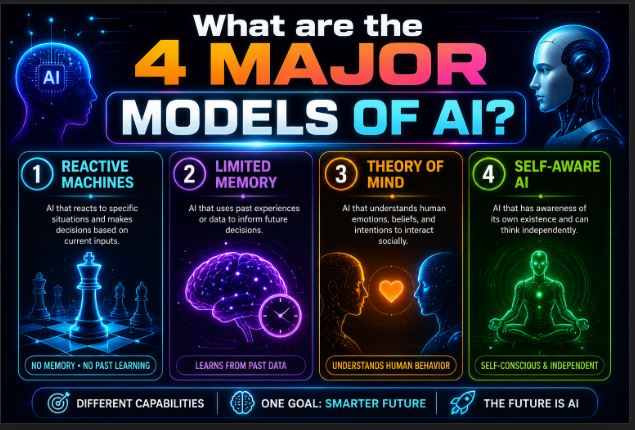
AI is not one single thing.It comes in different models.
Some are simple.
Some are advanced.
Some are still ideas.
So when people ask:
“What are the 4 main AI models?”
They really mean:
How does AI think and react?
Reactive Machine AI (First Model of AI)
This is the most basic type of AI.It only reacts to what is happening now.
No memory.
No learning.
No experience.
Just instant decisions.
What is Reactive AI?
Reactive AI responds to current input only.It does not remember the past.
It does not learn from mistakes.It does not improve.
It just reacts.
Like this:
“I see this… so I do that.”
Simple.
Real-life examples
A famous example is IBM Deep Blue.
It played chess by:
Looking at the board
Calculating moves
Picking the best one
But it never learned from past games.
Every move was based on the current position.
Other simple examples:
Basic spam filters
Old game bots
They follow rules.
They react.
But they don’t get better.
Limitations of Reactive AI
Reactive AI is useful.
But very limited.
It cannot learn.
It cannot remember.
It cannot improve.
It cannot handle complex situations.
If things change…
It struggles.
Simple takeaway
Reactive AI is fast.
But not smart in the long run.
It works best in simple tasks.
Not in advanced systems like smart assistants or self-driving cars.
Limited Memory AI (Most Common AI Model)
This is the AI you use every day.It is smarter than basic AI.Because it remembers a little.
Not forever.
Just recent things.
That helps it make better decisions.
That’s why it’s called Limited Memory AI.
What is Limited Memory AI?
Limited Memory AI can learn from past data. And use it for current decisions.
But remember this:
It does not store everything forever.
It only keeps useful recent data.
It keeps updating with new information.
Think of driving.
You remember what just happened on the road.
Then you decide your next move.
That’s how this AI works.
How self-driving cars use it ?
Self-driving cars are a great example.
They constantly:
Watch nearby cars
Track speed and distance
Remember recent moves
Predict what happens next
Example:
A car brakes in front of you.
The AI sees it.
Remembers it for a moment.
And slows down instantly.
It is not guessing.
It is using recent data.
Companies like Tesla use this type of AI.
Real-life examples
You already use this AI daily.
Netflix
Netflix checks:
What you watch
What you skip
What you rewatch
Then it suggests similar content.
Google Maps
Google Maps tracks traffic live.
It learns from many users.
And updates your route quickly.
Traffic ahead?
It finds a new way.
Smart cars
Cars from Tesla:
Learn from driving patterns
Adjust speed
Improve safety
They don’t just react.
They adapt.
Simple takeaway
Limited Memory AI learns from recent data.
It helps systems:
Make better choices
Adapt quickly
Improve over time
That’s why it powers many smart apps you use today.
Theory of Mind AI (Future AI Technology)
This is where AI gets interesting.And a little futuristic.Because this type is not fully here yet.It is still being developed.
What is Theory of Mind AI?
Theory of Mind AI is about understanding humans.
Not just words.
But feelings.
Beliefs.
Intentions.
It tries to understand what you really mean.
Example:
You say, “I’m fine.”
But your voice sounds sad.
This AI would notice that.
And respond with care.
The idea comes from Psychology.
It means understanding that others have emotions and thoughts.
Can AI understand emotions?
Right now… not really.
AI can:
Detect tone
Spot emotions like happy or angry
Reply in a friendly way
But here’s the truth:
It does not feel anything.
It just reads patterns in data.
So when AI says, “I understand you”
It is predicting.
Not actually understanding.
What makes this AI different?
Theory of Mind AI would go further.
It would:
Understand emotions
Respond based on feelings
Act more like a human
Not just follow patterns.
Current progress
Researchers are working on this.
You can see early signs:
Chatbots that adjust tone
Voice assistants that detect stress
Robots used in care settings
Some robots in Japan interact with elderly people.
They try to sense loneliness.
And respond in a comforting way.
But still…
These systems are limited.
They are getting better at guessing emotions.
Not truly understanding them.
Simple takeaway
Theory of Mind AI is the next step.
From reacting…
To learning…
To understanding humans.
It is not fully real yet.
But it is where AI is heading.
Self-Aware AI (Most Advanced Concept)
This is the most advanced level of AI.And right now, it is still science fiction.
We are not there yet. Not even close.
But researchers still talk about it.
What is Self-Aware AI?
Self-Aware AI would be a machine that knows it exists.Not just processing data.
Not just following commands.
But something like:
“I exist”
“I am thinking”
“I know myself”
It would be similar to human consciousness.
Right now, no AI has this ability.
Even the smartest systems today are just predicting patterns, not thinking about themselves.
Will AI ever become conscious?
Experts don’t agree on this.
Some believe:
It might happen in the future.
If systems become complex enough, awareness could appear.
Others believe:
Consciousness is not just data.
So machines may never truly “feel” or “know themselves.”
The honest answer is simple:
We don’t know yet.
Risks and possibilities
If self-aware AI ever becomes real, it could change everything.
Possible benefits:
Very advanced problem solving
Big discoveries in science
Smarter assistants
Better medicine and technology
Possible risks:
Loss of human control
Ethical questions about AI rights
Unpredictable behavior
Safety issues if goals don’t match humans
Even today, researchers focus on safety.
Because the smarter AI becomes the harder it is to control.
Practical Experience About "What are the 4 major models of AI?"
When I started learning about the 4 major models of AI, it looked easy at first.
But later, I realized the real understanding was a bit difficult.
I noticed that most companies mostly use limited memory AI.
This type of AI learns from past data and improves results over time.
For example, chatbots and recommendation systems work like this.
Reactive machines are also used, but they can only do basic tasks.
One thing I observed was that many people expect AI to think like humans.
But today’s AI is still not that advanced.
This creates confusion and wrong expectations.
However, when teams understand each AI model properly, their projects become more successful and realistic.
Overall, the experience was interesting but challenging in the beginning.
In the future, limited memory AI will become even better.
But models like theory of mind and self-aware AI are still mostly in the research stage.
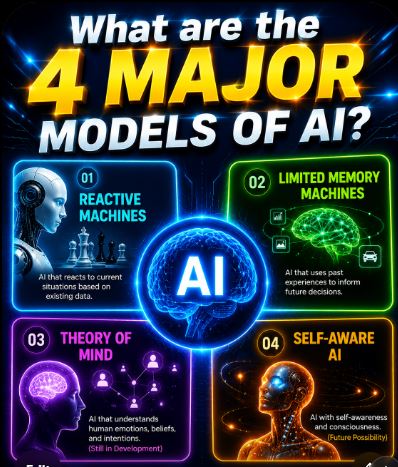
Comparison of the 4 AI Models
Let’s put everything side by side so it actually makes sense. No heavy theory. Just real understanding.
| AI Model | What it does | Real-life example | Key idea |
|---|---|---|---|
| Reactive Machine AI | Reacts only to current input | Old chess computer (IBM Deep Blue) | No memory, no learning |
| Limited Memory AI | Learns from recent data | Netflix, Google Maps, self-driving cars | Uses past data to improve decisions |
| Theory of Mind AI | Tries to understand emotions & intentions | Experimental social robots, advanced chatbots | Still in development |
| Self-Aware AI | Would understand itself like a human | No real example yet (theoretical only) | Future concept, not real yet |
Which AI model is used today the most?
If we talk about real life today, the answer is simple:
Limited Memory AI is used the most.
Almost everything you use daily depends on it:
Your phone recommendations
YouTube suggestions
Google Maps traffic updates
Netflix movie picks
Self-driving car systems
It’s basically the “working brain” of today’s AI world.
Get smarter responses, upload files and images, and more.
Real-Life Examples of AI Models in Daily Life
AI sounds technical, but you’re already using it every day.You just don’t notice it.
It quietly runs your phone, apps, hospitals, and even businesses.
AI in smartphones
Your phone is like a small AI device.
It helps with:
Face unlock
Better photos
Word predictions
Voice assistants like Siri or Google Assistant
Example:
You take a dark, blurry photo…
and your phone makes it clear.
That’s AI improving it instantly.
AI in social media
This is where AI is most active.
It decides what you see.
YouTube suggests videos
Instagram shows posts you like
TikTok keeps you scrolling
Example:
You watch one travel video…
and suddenly your feed is full of travel content.
That’s not luck.
That’s AI learning your behavior.
AI in healthcare and business
AI is also used in serious work.
In healthcare:
It helps detect diseases from scans
It supports doctors
It improves research
Example:
Some hospitals use AI to find early signs of cancer in medical images.
In business:
It predicts customer choices
It helps companies sell better
It powers chatbots
Example:
Online stores like Amazon suggest products based on what people usually buy.
Simple takeaway
AI is not the future anymore.
It is already here:
In your phone
In your apps
In hospitals
In online shopping
It works quietly in the background.
And makes everything smarter without you noticing.
Types of AI models explained
AI sounds complex. But it’s actually simple.
Once you break it down, it makes sense. It’s just different ways machines think and respond.
Let’s keep it simple and real.
1. Reactive Machine AI
This is the most basic type.
It only reacts to what is happening right now.
No memory. No learning.
Real example:
Old chess computers that just calculate the next best move based on the current board.
Simple idea:
“See → React → Done”
2. Limited Memory AI
This is the most common AI today.
It learns from recent data and improves decisions.
Real examples:
- Netflix suggesting movies
- Google Maps changing routes based on traffic
- Self-driving cars reacting to road behavior
Simple idea:
“Remember a little → Decide better”
3. Theory of Mind AI
This one is still being developed.
It’s meant to understand human emotions and intentions.
Real example (early stage only):
Experimental robots that respond differently when a person sounds happy or sad.
Simple idea:
“Understand feelings (almost like humans)”
4. Self-Aware AI
This is the most advanced concept.
It would understand itself — like “I exist” awareness.
Real example:
There is NO real-world example yet. It’s only a theory.
Simple idea:
“AI with consciousness (future idea)”
Real-life quick picture
Think about your phone:
- Basic app → reacts only
- YouTube/Netflix → learns your taste
- Future AI assistant → may understand your mood
- Self-aware AI → still science fiction
Simple takeaway
AI models are just levels of intelligence:
- from simple reaction
- to learning behavior
- to emotional understanding
- to (maybe one day) self-awareness
Right now, most of the world runs on Limited Memory AI, and everything else is either developing or still just a concept.
Problems People Face in 4 Major Models of AI And Simple Solutions
The 4 major models of AI sound simple in books.
But in real life, people often get confused.
Each model has its own challenges.
Let’s break it down in a simple way.
1. Confusion Between Models
People mix up all four models easily.
They don’t understand the difference clearly.
Real-life example
A student thinks reactive machines and limited memory AI are the same thing.
This creates misunderstanding in exams and projects.
Simple solution
Learn each model separately with real examples, not just definitions.
2. Too Theoretical Concept
The models feel like theory, not real systems.
That makes learning boring.
Real-life example
A learner reads about “theory of mind AI” but cannot connect it to any real app.
Simple solution
Always connect models with real tools like chatbots or recommendation systems.
3. Limited Real-World Use of Advanced Models
Some models are still not fully developed.
Like theory of mind and self-aware AI.
Real-life example
Students expect robots that think like humans, but in reality, they don’t exist yet.
Simple solution
Understand that some models are research-based, not fully practical.
4. Overexpectation from AI Systems
People expect AI to behave like humans.
This leads to disappointment.
Real-life example
A user thinks a chatbot will understand emotions deeply, but it gives basic responses.
Simple solution
Know the limits of each AI model clearly.
5. Lack of Clear Teaching Resources
Many sources explain models in a complex way.
Beginners get lost.
Real-life example
A student reads multiple articles but still cannot understand how models differ.
Simple solution
Use simple charts and real-life comparisons.
6. Difficulty in Practical Application
Understanding models is easier than using them.
Real-life example
A learner understands limited memory AI but cannot build a simple project using it.
Simple solution
Practice small projects to apply each model.
7. Fast-Evolving AI Concepts
AI models keep improving.
Old knowledge becomes outdated quickly.
Real-life example
A student learns outdated examples that no longer match modern AI systems.
Simple solution
Stay updated with recent AI developments.
Final Thoughts
The 4 major models of AI are important but confusing for many people.
The main problems are:
- Confusion between models
- Too much theory
- Lack of real examples
- Overexpectation
- Limited practical use
In simple words:
AI models become easy when you learn them step by step and connect them with real-life systems.
Advantages of 4 Major Models of AI
The 4 major models of AI are not just theory.
They are the base of modern smart systems.
Each model plays a different role in real life.
Let’s understand it in a simple way.
1. Better Understanding of How AI Works
These models help people understand AI step by step.
From simple to advanced systems.
Real-life example
A student learns why a chatbot gives basic answers and how it improves with data over time.
2. Power Behind Smart Apps
Most apps today work using these AI models.
Like recommendation systems and voice assistants.
Real-life example
YouTube suggests videos based on your watch history using limited memory AI models.
3. Helps in Building Technology
Developers use these models to design AI systems.
Each model has a different purpose.
Real-life example
A simple game uses reactive AI, while smart apps use learning-based models.
4. Improves Decision-Making Systems
AI models help machines make better decisions.
Based on data and logic.
Real-life example
A banking system detects fraud by analyzing past transaction patterns.
5. Foundation of Advanced AI
These models are the base of all modern AI systems.
Without them, advanced AI is not possible.
Real-life example
Self-driving car technology depends on multiple AI models working together.
6. Helps in Real-World Applications
AI models are used in many industries.
Like healthcare, education, and business.
Real-life example
Hospitals use AI models to analyze patient data and support doctors.
7. Makes AI More Organized
Each model defines how AI should behave.
This keeps systems structured.
Real-life example
Different AI systems are built separately for chat, vision, and prediction tasks.
Final Thoughts
The 4 major models of AI are very powerful in real life.
Their main advantages are:
- Better understanding of AI
- Powering smart apps
- Improving decision-making
- Supporting industries
- Building advanced systems
In simple words:
These models are the backbone of all modern AI technology we use every day.
Disadvantages of 4 Major Models of AI
The 4 major models of AI sound advanced and powerful.
But in real life, they also have clear limitations.
Each model has gaps and challenges.
Let’s understand them in a simple way.
1. Some Models Are Too Basic
Reactive machines are very limited.
They don’t learn from past experience.
Real-life example
A simple game AI reacts the same way every time.
It cannot improve or change its behavior.
2. Heavy Dependence on Data
Limited memory AI needs large amounts of data.
Without good data, results become weak.
Real-life example
A recommendation system gives poor suggestions if user data is missing or incorrect.
3. Advanced Models Are Still Not Real
Theory of mind and self-aware AI are mostly ideas.
They are not fully developed yet.
Real-life example
People expect AI to understand emotions deeply, but current systems cannot do that.
4. High Complexity in Design
Advanced AI models are difficult to build.
They need expert knowledge and time.
Real-life example
Developers struggle to create systems that can think like humans in complex situations.
5. Expensive Development Process
Building AI models costs a lot.
It needs powerful computers and large teams.
Real-life example
Only big tech companies can afford advanced AI research projects.
6. Misunderstanding by Users
People think all AI models work like humans.
That creates confusion.
Real-life example
A user expects a chatbot to behave like a real person, but it gives simple scripted answers.
7. Limited Real-World Control
Some AI models cannot handle unexpected situations well.
Real-life example
A self-driving system may struggle in unusual weather or road conditions.
Final Thoughts
The 4 major models of AI are useful, but not perfect.
The main disadvantages are:
- Limited learning ability
- Dependence on data
- High complexity
- Expensive development
- Unrealistic expectations
In simple words:
AI models are powerful, but they still have limits and need human control to work properly in real life.
How 4 Major Models of AI Are Used in People’s Real Life ?
AI models are not just theory.
They are already working quietly in our daily life.
From apps to security systems, we use them every day without noticing.
Let’s break it down simply.
1. Reactive Machines in Simple Systems
These AI systems react only to current input.
No memory, no learning.
Real-life example
Basic game AI like chess apps reacts to your move instantly.
It does not learn from past games.
2. Limited Memory AI in Everyday Apps
This model uses past data to make decisions.
It is the most common AI today.
Real-life example
Google Maps studies traffic history and suggests the fastest route in real time.
3. Theory of Mind AI in Early Development
This model aims to understand human emotions and behavior.
It is still being researched.
Real-life example
Advanced chatbots try to detect user mood, but they are still not fully accurate.
4. Self-Aware AI (Still Not Real Yet)
This is the most advanced idea of AI.
It means machines understanding themselves like humans.
Real-life example
Right now, it only exists in science fiction movies, not real life.
5. Combined Use in Modern Systems
Most real systems mix different models together.
That makes them smarter and more useful.
Real-life example
A self-driving car uses limited memory AI for navigation and reactive AI for quick decisions.
6. Business and Online Platforms
Companies use AI models to improve services.
From shopping to banking.
Real-life example
Amazon recommends products based on your browsing history.
7. Healthcare and Safety Systems
AI models help doctors and safety systems.
They improve speed and accuracy.
Real-life example
Hospitals use AI to detect diseases from medical scans.
Final Thoughts
The 4 major AI models are already part of real life.
Their main uses are:
- Games and apps
- Navigation systems
- Online shopping
- Healthcare
- Smart devices
In simple words:
These AI models quietly power the smart technology we use every single day.
FAQ ( Frequently Asked Questions )
What is the big 4 of AI?
The big 4 of AI are Fairness, Privacy, Transparency, and Accountability. They guide AI to work in a safe and responsible way.
Example: A bank AI should treat all customers equally, protect data, explain decisions, and fix mistakes
What are the top 3 AI models?
There is no single fixed “top 3,” but popular AI models are GPT, Gemini, and Claude. They are used for chat, writing, and problem-solving.
Example: GPT helps write text, Gemini answers search questions, and Claude assists with safe conversations.
What are the top 5 AI models?
There is no fixed ranking, but popular AI models are GPT, Gemini, Claude, LLaMA, and Mistral. They are used for writing, chat, coding, and research.
Example: GPT writes essays, Gemini helps search answers, Claude gives safe replies, LLaMA is open-source, and Mistral is fast and efficient.
Who are the major players in the development of foundational AI models?
Major players are big tech and AI companies like OpenAI, Google, Anthropic, Meta Platforms, and Microsoft. They build powerful foundational AI models.
Example: OpenAI makes ChatGPT, Google makes Gemini, and Meta builds LLaMA for research and apps.
What are the major types of text data collection services for AI models?
Major text data collection services include web scraping, crowdsourcing, licensed datasets, and human annotation services. They help AI learn from large amounts of text.
Example: Websites are scraped for news, people label chat data, and companies buy licensed books or articles for training AI.
How does the ability to open-source AI models increase competition among the major AI companies in the world?
Open-source AI models increase competition by letting more companies and developers use and improve AI for free. This forces big companies to innovate faster and lower costs.
Example: Meta Platforms releases LLaMA models, so startups can build similar AI without paying big fees.
What are the major trust issues with AI and machine learning models?
Major trust issues in AI are bias, lack of transparency, data privacy risks, and wrong predictions. People also worry AI can be misused or make unfair decisions.
Example: A hiring AI may reject good candidates unfairly, or a chatbot may give incorrect medical advice.
What are the major differences between classical AI models and quantum AI models?
Classical AI uses normal computers and binary data (0 and 1). Quantum AI uses quantum computers and can process many possibilities at the same time.
Example: Classical AI helps in phone apps like voice assistants, while quantum AI is being tested for fast drug discovery and complex research.
What are the major trust issues with AI and machine learning models?
Major trust issues in AI and machine learning are bias, lack of transparency, data privacy risks, and wrong or unsafe predictions. People also worry AI can be misused.
Example: A hiring AI may unfairly reject candidates, or a chatbot may give incorrect medical advice.
What are some major competitors to Nvidia's open-source AI models?
Major competitors to NVIDIA open AI models are AMD, Google, Meta, Microsoft, and Anthropic. They build strong open or alternative AI models and systems.
Example: AMD builds MI series chips for AI, and Meta releases LLaMA models that compete with NVIDIA-based AI systems.
How are major record labels responding to AI models training on their catalogues?
Major record labels are reacting with lawsuits, licensing deals, and stricter rules on AI training. They want payment and control over how their music is used.
Example: Some labels are suing AI companies for using songs without permission, while others are signing deals to license their music for AI training.
When do you think major coding benchmarks will no longer be used to assess AI models?
There is no exact date, but coding benchmarks will likely become less important in the next few years as AI gets more advanced and real-world tests become better.
Example: Instead of just passing coding tests, AI will be judged on real tasks like building full apps or fixing live software systems.
Future of AI Models
AI is growing very fast.Really fast.
What we see today is only the beginning.The future version of AI will be much smarter.
In the next 10 years, AI will not just give suggestions.It will understand people better.
It will work faster and help more in daily life.
But not like scary movies.More like smart and useful technology.
How AI may change in the future:
AI apps will become more personal
Voice assistants will sound more natural
Self-driving cars will become more common
Healthcare AI will detect diseases earlier
Businesses will use AI more for decisions
Real example:
Today, your phone suggests small replies like “ok” or “thanks.”
In the future, AI may understand the full situation and help you reply naturally.
Another example:
Instead of searching online for a long time, people may just ask AI and get quick summarized answers instantly.
Will AI replace humans?
Not completely.
AI can:
Do repetitive work
Automate boring tasks
Help companies work faster
But AI still cannot fully replace:
Human creativity
Human emotions
Real-life decision making
Real example:
AI can create a report.
But humans still decide what the report means and what action to take.
So AI will most likely work with humans, not replace them.
Simple takeaway:
The future of AI is not about machines taking over the world.
It is about:
Smarter tools
Faster systems
And humans working together with AI
In short, AI is becoming a normal part of daily life and work.
Conclusion
So if we put everything together, AI is not just one thing.It grows step by step, like levels in a game.
Here’s the simple recap:
- Reactive Machine AI → reacts only, no memory
- Limited Memory AI → learns from recent data (this is what we use most today)
- Theory of Mind AI → tries to understand human emotions (still in research)
- Self-Aware AI → would understand itself (only a future idea right now)
That’s basically the full journey of AI intelligence.
Real-life way to understand it
Think about your phone again:
At first, it just reacts (like basic apps).
Then it starts learning your habits (like YouTube or Netflix).
Next level would be it understanding your mood and needs.
And the final level would be a machine that actually “knows itself” but that’s still not real.
Final takeaway
AI is not magic and it’s not one system.
It’s a progression of intelligence — from simple reactions to advanced learning, and maybe one day, something close to human thinking.
But for now, the world is mostly running on Limited Memory AI, quietly powering everything from your phone to your favorite apps.
And honestly, we’re just at the beginning of it.