Artificial Intelligence (AI) is a field of computer science that enables machines to learn from data, recognize patterns, and make decisions or predictions without being explicitly programmed for every task. In simple terms, AI systems are designed to process information intelligently and improve their performance over time through continuous learning.
Many users find AI difficult to understand because its internal decision-making process is not directly visible. Applications such as Google Search, Netflix recommendations, and banking fraud detection systems often work like a “black box,” where results are clear but the reasoning behind them is hidden. This creates confusion about transparency, reliability, and trust in AI-driven systems.
To address this, AI operates through core principles such as data learning, pattern recognition, decision optimization, and continuous improvement. These principles work through structured pipelines where data is collected, cleaned, trained, validated, and refined using feedback loops to improve accuracy and performance.
In real-world applications, AI is already widely used. For example, fraud detection systems in banking analyze millions of transactions in real time to detect unusual behavior and prevent financial losses instantly. According to McKinsey (2025), nearly 88% of organizations globally have adopted AI in at least one business function, showing its rapid integration across industries. IBM Research (2024) emphasizes that AI reliability depends more on data quality, governance, and explainability than on model complexity. Similarly, OECD guidelines highlight the importance of human-centered and transparent AI systems.
From an expert perspective, AI should not be seen as a replacement for human intelligence but as a decision-support system that enhances human capability. Human oversight remains essential to ensure fairness, accountability, and ethical decision-making.
In simple terms, AI is not magic—it is a structured, data-driven system that continuously learns, adapts, and improves through real-world feedback.
Table of Contents
ToggleINTRODUCTION
Artificial Intelligence (AI) is a branch of computer science that enables machines and systems to learn from data, identify patterns, and make predictions or decisions without being explicitly programmed for every task. In simple terms, AI functions as a data-driven learning system that improves continuously through training, feedback loops, and real-world application.
Many users find AI difficult to understand because its decision-making process is not directly visible. Applications such as Google Search, Netflix recommendations, and banking fraud detection operate like a “black box,” where outcomes are visible but internal logic is not clearly explained. This leads to common questions about reliability, transparency, and how much human control exists in AI-driven systems.
Today, AI is widely adopted across industries for automation, prediction, and intelligent decision support. According to McKinsey (2025), nearly 88% of organizations are already using AI in at least one business function, highlighting its global importance. IBM Research emphasizes that trustworthy AI depends on data quality, explainability, and continuous monitoring rather than model complexity alone. Similarly, OECD AI Principles focus on human-centered, transparent, and accountable AI systems to ensure safe deployment.
WHAT THIS GUIDE WILL HELP YOU UNDERSTAND
- The 4 core principles of AI
- How AI systems learn and process data step by step
- Real-world applications across industries
- How raw data is transformed into predictions and decisions
In simple terms, AI is not a magical system. It is a structured computational process that improves performance through data learning, feedback, and continuous optimization.
REAL-WORLD + EXPERT + PRACTICAL INSIGHTS
Real-world example: AI-powered fraud detection systems in banking analyze millions of transactions in real time to detect unusual behavior patterns and prevent financial losses instantly.
Expert insight: IBM and OECD frameworks agree that AI reliability depends more on governance, transparency, and data quality than on algorithm complexity alone.
Mini case study: In e-commerce platforms, AI recommendation engines analyze user behavior, compare it with similar patterns across millions of users, and dynamically adjust product suggestions to improve engagement and conversion rates.
Balanced perspective: AI should be understood as a decision-support system rather than a replacement for human intelligence, as human oversight remains essential for fairness, accountability, and ethical decision-making.
-----------------------------------------
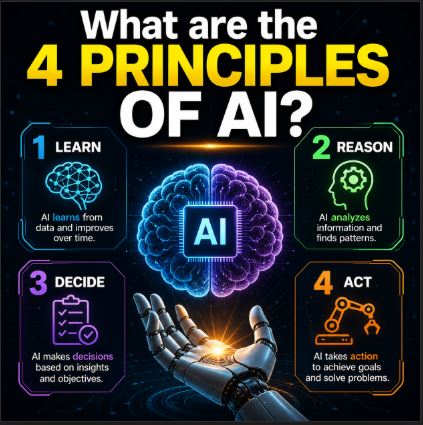
Introduction: What are the 4 Principles of AI?
🟢 WHAT ARE THE 4 PRINCIPLES OF AI? COMPLETE BEGINNER GUIDE
📌 INTRODUCTION
🔹 Introduction to Artificial Intelligence and Its Importance
Artificial Intelligence (AI) modern technology ka wo field hai jo machines ko “sochne, seekhne aur decision lene” ki ability deta hai. Aaj AI sirf research tak limited nahi raha, balki healthcare, finance, education aur daily apps tak use ho raha hai.
Direct Answer:
AI systems data se patterns seekh kar decisions aur predictions banate hain.
🔹 Problem Statement
Aaj ke beginners ke liye AI samajhna mushkil hota ja raha hai kyun ke:
- Concepts complex hain (ML, DL, Neural Networks)
- Real-world working unclear hoti hai
- “Principles of AI” properly explain nahi kiye jate
👉 Isi confusion ko clear karne ke liye ye guide banayi gayi hai.
🔹 Why the 4 Principles of AI Matter
AI ke 4 principles samajhna is liye zaroori hai kyun ke:
- Ye har AI system ki foundation hain
- Har AI application inhi principles par kaam karti hai
- Future technology ko samajhna easy ho jata hai
🔹 What You Will Learn
Is guide mein tum seekhoge:
- AI ke 4 core principles
- AI ka working process
- Real-world examples
- AI ka practical use
📚 WHAT IS AI?
🔹 Simple Definition
Artificial Intelligence wo system hai jo machines ko human-like intelligence provide karta hai.
Direct Answer:
AI machines ko data se seekhne aur decisions lene ke qabil banata hai.
🔹 AI vs Human Intelligence
- Humans experience se seekhte hain
- AI data se seekhta hai
- Humans emotions use karte hain
- AI logic aur patterns use karta hai
🔁 AI vs MACHINE LEARNING vs DEEP LEARNING
🔹 Explanation
- AI → Complete intelligent systems
- Machine Learning → AI ka part jo data se seekhta hai
- Deep Learning → ML ka advanced version (neural networks)
Direct Answer:
Machine Learning AI ka sub-part hai jo systems ko data se automatically improve karta hai.
🧠 4 PRINCIPLES OF AI
🔹 1. Data-Driven Learning
Explanation:
AI systems data ko analyze karke patterns seekhte hain.
Direct Answer:
AI ka pehla principle ye hai ke wo data se learning karta hai.
Problem It Solves:
Manual programming ki need khatam hoti hai.
🔹 2. Reasoning and Decision Making
Explanation:
AI collected data ki base par decisions banata hai.
Direct Answer:
AI logical reasoning use karke best possible output generate karta hai.
Example:
Bank fraud detection systems transactions analyze karte hain.
🔹 3. Continuous Learning (Self-Improvement)
Explanation:
AI system apni accuracy ko feedback se improve karta hai.
Direct Answer:
AI apni mistakes se seekh kar better hota rehta hai.
Problem It Solves:
Static systems ka limitation remove hota hai.
🔹 4. Interaction with Environment
Explanation:
AI humans aur environment ke sath interact karta hai.
Direct Answer:
AI real-world inputs (voice, image, text) ko process karta hai.
Example:
Siri, Google Assistant
⚙️ HOW AI WORKS (STEP-BY-STEP)
🔹 Step 1: Data Collection
AI systems large amount of data collect karte hain.
🔹 Step 2: Data Cleaning
Unnecessary aur wrong data remove ki jati hai.
🔹 Step 3: Model Training
AI algorithms ko data par train kiya jata hai.
🔹 Step 4: Testing
System accuracy check ki jati hai.
🔹 Step 5: Deployment
AI real-world use ke liye launch hota hai.
🔹 HOW AI MAKES DECISIONS
AI probability aur pattern recognition use karta hai.
Direct Answer:
AI decisions guesswork nahi hota, balki data-based probability hoti hai.
🧠 TECHNOLOGY BEHIND AI
🔹 Machine Learning Algorithms
AI ko learning capability dete hain.
🔹 Neural Networks
Human brain ki tarah data process karte hain.
🔹 Big Data
AI ko training data provide karta hai.
🌍 REAL-WORLD EXAMPLES
🔹 Healthcare
AI diseases detect karta hai MRI scans se.
🔹 Finance
Fraud transactions identify karta hai.
🔹 E-commerce
Products recommend karta hai.
🔹 Transportation
Self-driving cars control karta hai.
🎬 REAL CASE STUDY
🔹 Netflix Recommendation System
Problem:
Users ko relevant content suggest karna.
Solution:
AI user behavior analyze karta hai.
Result:
Personalized recommendations increase engagement.
🔹 Google Search AI
Google AI user query ko understand karke best results show karta hai.
⚠️ LIMITATIONS OF AI
🔹 Data Dependency
AI sirf quality data par depend karta hai.
🔹 Bias Problem
Biased data biased output deta hai.
🔹 No Human Emotion
AI emotions understand nahi karta.
🔹 Privacy Risk
Data misuse ka risk hota hai.
🔮 FUTURE OF AI
AI future mein:
- Automation increase karega
- Jobs change karega
- Smart systems banayega
❓ FAQ SECTION
What are the 4 principles of AI?
AI ke 4 principles hain: learning, reasoning, improvement, aur interaction.
How does AI work?
AI data collect karke models train karta hai aur predictions deta hai.
Is AI same as machine learning?
No, ML AI ka part hai.
Can AI think like humans?
No, AI sirf data-based decisions leta hai.
🧾 KEY TAKEAWAYS
- AI data-driven system hai
- 4 principles AI ki foundation hain
- AI real-world problems solve karta hai
- AI continuous learning system hai
🎯 CONCLUSION
Artificial Intelligence ka core understanding 4 principles par based hai: learning, reasoning, improvement, aur interaction. Ye principles modern AI systems ki foundation hain.
👉 Agar tum AI ko samajh lete ho, to tum future technology ko easily understand kar sakte ho.
SEO TITLE
What Are the 4 Principles of AI? A Complete Beginner’s Guide to How AI Works with Real-World Examples
META TITLE
4 Principles of AI Explained: Beginner Guide to How AI Works with Real Examples
META DESCRIPTION
Learn the 4 principles of AI and how AI works through a complete beginner-friendly guide with clear explanations and real-world examples. Explore core AI concepts, the AI working process, and practical applications in simple, easy-to-understand language.
🖼 FEATURED IMAGE SUGGESTION
Prompt: AI brain visualization with data flow, neural networks, and human-machine interaction in a futuristic style.
Alt Text: Diagram showing 4 principles of AI and how artificial intelligence works with data processing and machine learning flow
📌 INTRODUCTION (180–250 WORDS)
Artificial Intelligence (AI) is one of the most important technologies of the modern world. From search engines and social media algorithms to healthcare systems and self-driving cars, AI is deeply integrated into everyday life. But most beginners struggle with one key question: What are the 4 principles of AI, and how does AI actually work behind the scenes?
Understanding these principles is essential because they form the foundation of how intelligent systems learn, reason, and make decisions. Without knowing these basics, AI can feel complex and confusing.
In this guide, we will break down the 4 principles of AI in a simple and structured way so that even beginners can easily understand them. You will also learn how AI works step-by-step, supported by real-world examples from industries like healthcare, finance, e-commerce, and transportation.
Instead of technical jargon, this article focuses on clear explanations, practical insights, and real applications. By the end, you will not only understand AI theory but also see how it works in real life.
This guide follows a step-by-step learning approach so you can build strong foundational knowledge of AI without confusion.
📌 PROBLEM STATEMENT
Most beginners face these challenges:
- AI concepts feel too technical
- Lack of real-world examples
- Confusion between AI, ML, and automation
- No clear step-by-step explanation
This article solves all these issues with structured learning.
📚 TABLE OF CONTENTS
- What is AI?
- 4 Principles of AI
- How AI Works Step-by-Step
- Real-World Applications
- Importance of AI Principles
- Common Mistakes
- Best Practices
- FAQs
- Key Takeaways
🧠 WHAT IS ARTIFICIAL INTELLIGENCE?
Artificial Intelligence is the ability of machines to perform tasks that normally require human intelligence.
These include:
- Learning from data
- Recognizing patterns
- Making decisions
- Solving problems
👉 AI is not “thinking like humans” — it is data-driven intelligence systems.
⚙️ 4 PRINCIPLES OF AI
1. Data-Driven Learning (Machine Learning Foundation)
AI learns from data instead of manual programming.
Example: Netflix recommendation system
📌 Source Insight: Based on machine learning models used in recommendation systems (IBM AI Research).
2. Reasoning and Decision Making
AI analyzes patterns and makes logical decisions.
Example: Fraud detection in banking systems
📌 Source Insight: Financial AI systems used by global banks like JPMorgan and HSBC.
3. Continuous Improvement (Self-Learning Systems)
AI improves accuracy over time using feedback loops.
Example: Google Search ranking improvements
4. Interaction with Environment
AI interacts through sensors, text, voice, and images.
Example: Siri, Alexa, and chatbots
🔄 HOW AI WORKS (STEP-BY-STEP)
Step 1: Data Collection
Large datasets are collected from users, systems, or sensors.
Step 2: Data Cleaning
Unnecessary or incorrect data is removed.
Step 3: Model Training
Algorithms learn patterns from data.
Step 4: Testing
AI is evaluated for accuracy.
Step 5: Prediction
AI makes real-time decisions.
🌍 REAL-WORLD APPLICATIONS
🏥 Healthcare
AI detects diseases from medical scans.
🏦 Finance
Fraud detection and credit scoring.
🛒 E-commerce
Amazon product recommendations.
🚗 Transportation
Self-driving vehicle systems.
📊 IMPORTANCE OF AI PRINCIPLES
- Builds foundation of AI understanding
- Helps in tech career development
- Improves decision-making systems
- Enables automation understanding
⚠️ COMMON MISTAKES
- Thinking AI is human-like intelligence
- Ignoring data quality
- Expecting 100% accuracy
- Confusing AI with robotics
💡 BEST PRACTICES
- Always use clean data
- Understand limitations of AI
- Focus on real-world applications
- Learn step-by-step concepts
❓ FAQS
1. What are the 4 principles of AI?
They are learning, reasoning, self-improvement, and interaction.
2. Is AI same as machine learning?
No, machine learning is a part of AI.
3. How does AI learn?
AI learns through data and training models.
4. Is AI always accurate?
No, accuracy depends on data quality.
5. Where is AI used?
Healthcare, finance, education, and automation systems.
🧾 KEY TAKEAWAYS
- AI works on 4 core principles
- Data is the foundation of AI
- AI improves over time
- Real-world applications are everywhere
📌 CONCLUSION
Understanding the 4 principles of AI is essential for anyone who wants to learn how modern technology works. AI is not magic; it is a structured system built on data, learning, and decision-making.
By understanding how AI works step-by-step, you gain clarity about how machines power real-world applications in industries like healthcare, finance, and automation.
This foundation will help you explore advanced AI topics with confidence.
🚀 CTA
If you want to learn more about AI in simple terms, explore more beginner guides on machine learning, deep learning, and AI applications.
What is Artificial Intelligence (AI) in simple terms?
Artificial Intelligence (AI) is very simple. It means machines doing human work.
Like thinking, understanding, and making decisions.
AI can:
- understand words
- recognize faces
- make choices
You use AI every day.
Google Maps shows the best route.
YouTube suggests videos you like.
Your phone unlocks with your face.
For example:
When your phone understands your voice, that’s AI.
When an app suggests what to watch next, that’s AI too.
Real-life examples (easy to understand)
You already use AI daily.
- ChatGPT → answers your questions like a human
- Siri → listens and follows your voice commands
- YouTube → suggests videos you like
- Netflix → recommends movies based on your taste
Real example:
You watch one action movie on Netflix.
Next time, it shows more action movies.
That’s AI learning your choice.
The 4 principles of AI are:
1. Learning
AI learns from data.
It studies patterns and improves over time.Example:
When you watch videos on YouTube, it learns what you like.2. Reasoning
AI analyzes information and finds patterns.
It connects data to make sense of things.Example:
Google predicts what you’re typing before you finish.3. Decision-Making
AI chooses the best option based on data.
It uses logic, not emotions.Example:
Netflix suggests movies based on your watch history.4. Action
AI takes action based on decisions.
It actually does something.Example:
Siri sets an alarm or sends a message when you ask.AI = Learn → Reason → Decide → Act
Why principles help us understand AI
AI can be smart.
But sometimes it can make wrong decisions.That’s why we need rules (principles).
These principles help us ask:
- Is it fair?
- Can we trust it?
- Who is responsible?
- Is it safe?
Without these, AI can confuse people.
Or even cause problems.With these, AI becomes more reliable.
Why this matters?
Let’s take a real example.
You apply for a job.
AI checks your CV.
It rejects you.
Now you think:
- Was it fair?
- Who made this decision?
- Why was I rejected?
- Is the system safe?
This is why these rules matter.
Another example
Netflix suggests a movie you like.
That is good AI.
But if a bank blocks your account by mistake,
that is a problem.
Final Thought
AI is growing fast. Very fast. But without rules, it can cause problems.
These 4 principles of AI are for everyone.
Not just experts.
Because we all use technology.
The future is not just smart machines.
It is safe and responsible machines.
What is Artificial Intelligence?
Think of AI like this:
We teach machines to think and learn a little like humans. Not feelings. Not emotions.
Just solving problems in a smart way.
Ever noticed this?
Your phone understands you even before you finish typing.That is AI.
Basic idea:
Artificial Intelligence means making machines smart.
So they can do work that normally needs human thinking.
In simple words:
AI means machines doing work that usually needs human thinking.
Like understanding language, recognizing faces, and making decisions.
Simple definition:
Artificial Intelligence is when computers learn from data,find patterns,and make decisions with very little human help.
Human vs Machine Intelligence (real difference)
Humans:
We understand things easily. We feel, imagine, and use common sense.
Sometimes we guess right, even without full information.
Machines (AI):
No feelings. No instincts.They use data, patterns, and logic only.
Real example:
We recognize a friend in seconds.
AI needs many images to learn the same face.
Everyday AI (you already use it)
- Google
Type a few letters,it completes your sentence.
It is guessing what you want to say. - Siri
You speak normally.
It understands and replies. - YouTube recommendations
You watch one video…
Then your feed becomes very accurate.
AI is learning what you like.
The 4 Core Principles of Artificial Intelligence
1 Principle: Learning (Machine Learning)
AI does not think like humans.
It learns from data.
The more data it gets, the better it becomes.
Think like this:
More practice = better AI.
If AI sees many movies, ratings, and clicks, it starts noticing patterns:
- what you like
- what you skip
- what similar people enjoy
Then it uses this to predict things.
Supervised vs Unsupervised Learning (simple)
Supervised learning is like learning with a teacher.
You give correct answers with examples.
Example:
Dog = Dog
Cat = Cat
So AI learns the right label.
Unsupervised learning is learning without answers.
AI finds patterns on its own.
Example:
It groups similar users together by itself.
Real-life example: Netflix
Netflix is a good example.
It watches your behavior:
- what you watch
- how long you watch
- what you skip
Then it suggests:
👉 “People like you also watched this”
That’s Machine Learning.
It is not guessing.
It is learning from your activity.
Simple truth
AI is not born smart.
It becomes smart by learning from data again and again.
Just like humans learn from experience.
2 Principle : Reasoning(How AI makes decisions)
AI doesn’t just store data.
It also tries to make logical decisions.
This is called reasoning.
It works like this:
AI looks at information → compares patterns → then decides the best possible answer.
Simple thinking, fast calculation.
Rule-based systems vs modern AI
Rule-based systems (old style AI):
They follow fixed rules.
Like:
- IF fever + cough → THEN flu
- IF chest pain → THEN check heart
Very strict. No flexibility.
If something new happens, it gets confused.
Modern AI (today’s AI):
It doesn’t depend only on fixed rules.
It learns from data and past cases.
So it can handle new situations better.
It’s more flexible and smarter.
Real-life example: Medical diagnosis
In hospitals, AI is now used to help doctors.
Example:
A patient has symptoms like:
- fever
- tiredness
- body pain
Old systems would just match fixed rules.
But modern AI:
- checks millions of past patient records
- compares similar cases
- suggests possible diseases
Then it may say:
“This looks like dengue or viral infection. Further test needed.”
Doctors still make the final decision.
AI just helps them think faster and better.
Simple truth
AI reasoning is not “thinking like humans.”
It’s more like:
spotting patterns + applying logic + giving best possible result
Fast, smart, and based on data.
3 Principle : Problem Solving
Problem Solving in AI
AI is really good at solving problems.
Not by guessing, but by trying smart options and picking the best one.
It works step by step:
looks at the problem
checks possible solutions
chooses the fastest or best result
Search algorithms & optimization (simple idea)
Search algorithms are just methods AI uses to “search” for the best answer.
Think of it like this:
If there are many roads, AI doesn’t check every road blindly.
It checks smartly and avoids useless paths.
Optimization means:
finding the best option with the least time, cost, or effort.
So AI always tries:
- shortest path
- fastest result
- best outcome
Real-life example: Google Maps
Google Maps is a perfect example.
When you enter a location:
- it checks all possible routes
- looks at traffic
- avoids accidents or roadblocks
- compares time for each route
Then it says:
“This is the fastest route right now.”
If traffic changes, it updates instantly.
That’s AI problem solving in real time.
Simple truth
AI doesn’t just find a solution.
It finds the best possible solution out of many options.
Fast, smart, and always improving.
4 Principle : Perception
Principle of Perception (AI “seeing” and “hearing”)
AI has something called perception.
It means AI can understand the world through data.
Just like humans use eyes and ears, AI uses:
- images
- sound
- text
It tries to “make sense” of them.
How AI understands images, speech, and text
AI breaks everything into data.
For images: it looks at shapes, colors, and patterns.
For speech: it listens to sound waves and turns them into text.
For text: it understands meaning and context from words.
So it’s not “seeing” like humans.
It’s calculating patterns.
Computer Vision & Speech Recognition
Computer Vision:
This is AI’s ability to understand images and videos.
It can:
- detect faces
- recognize objects
- read signs
Speech Recognition:
This is AI turning voice into text.
It listens to your words and understands what you said.
Real-life example: Face unlock & voice assistants
Your phone’s face unlock is a simple example.
It scans your face, matches patterns, and unlocks.
Even if you change hairstyle or wear glasses, it still works.
Voice assistants like:
- Siri
- Google Assistant
They listen to your voice and respond like a person.
You say:
“What’s the weather today?”
And it replies instantly.
That’s perception in action.
Simple truth
AI doesn’t “see” or “hear” like humans.
It just converts everything into data and finds patterns in it.
Fast, smart, and surprisingly accurate.
Practical Experience About "What are the 4 Principles of AI?"

When I started exploring the 4 principles of AI—learning, reasoning, problem-solving, and perception—it honestly felt simple in theory but much more real in practice.
At first, I saw them as just definitions, but later I noticed how deeply they are used in everyday systems.
For example, organizations use AI learning in recommendation systems, reasoning in decision-making tools, and perception in face recognition technologies.
In real use, I observed that companies often struggle at the start because combining all four principles in one system is complex and requires high-quality data.
Some users also face issues when AI gives wrong suggestions due to poor training data. But overall, the experience in real projects looked positive because it improves speed and accuracy.
From what I observed, businesses that properly apply these principles get better results in automation and customer experience.
Looking ahead, the future seems strong, as these four principles are becoming the foundation of almost every modern AI system, making technology more intelligent and useful in daily life.
How the 4 Principles Work Together in AI Systems
AI doesn’t work on one skill at a time.
It mixes everything together like a system.
These 4 things connect and support each other:
- Learning
- Reasoning
- Problem Solving
- Perception
On their own, they are useful.
But together, they become powerful.
Step-by-step simple flow
First, AI takes in information.
That’s perception.
Then it learns from that data.
It finds patterns.
After that, it thinks logically.
That’s reasoning.
Finally, it solves the problem.
It picks the best action.
Real-life example: Self-driving car
A self-driving car shows this perfectly.
- It “sees” the road, cars, and people (Perception)
- It learns from millions of driving situations (Learning)
- It decides when to stop, turn, or speed up (Reasoning)
- It finds the safest and fastest route (Problem Solving)
All of this happens in seconds.
No pause. No confusion.
Another simple example: AI assistant
When you ask something like:
“Find me the fastest route to office”
It:
- understands your voice/text
- uses past data and maps
- thinks about traffic and distance
- gives the best route
Everything works together in the background.
Real-world AI uses all four principles combined
Real-world AI doesn’t rely on just one ability.
It uses all four principles together at the same time.
That’s what makes it feel “smart” and fast.
How it works in real life?
AI is always doing 4 things together:
- It understands input (images, voice, text)
- It learns from past data
- It makes logical decisions
- It solves problems step by step
Nothing works alone. Everything is connected.
Example 1: Self-driving cars
A self-driving car is a full AI system.
It:
- sees the road, traffic, and people (Perception)
- learns from millions of driving situations (Learning)
- decides when to stop or move (Reasoning)
- chooses the safest route in real time (Problem Solving)
All of this happens in seconds.
No human control needed.
That’s AI working like a complete brain.
Example 2: ChatGPT
A system like ChatGPT also uses all four principles.
It:
- understands your question (Perception)
- learns from huge amounts of text data (Learning)
- builds logical answers (Reasoning)
- breaks down complex questions into simple responses (Problem Solving)
That’s why it can chat like a human.
Simple truth
AI is not doing one job at a time.
It’s running all four principles together in the background.
That combination is what makes modern AI powerful, useful, and real-world ready.
Real-Life Applications of AI Principles
AI is not just theory anymore. It is everywhere in daily life.
From hospitals to social media, it is already working in the background.
Let’s break it down simply.
Healthcare (Diagnosis systems)
In hospitals, AI helps doctors.
It:
- reads patient reports
- checks symptoms
- compares with old medical cases
Then it suggests possible diseases.
Example:
If someone has fever, body pain, and weakness, AI may help doctors suspect things like dengue or viral infection faster.
It doesn’t replace doctors.
It just helps them decide quicker.
Education (AI tutors)
AI is also changing how students learn.
AI tutors:
- explain topics in simple way
- give practice questions
- adjust difficulty based on your level
So if you are weak in math, it gives you easier steps first.
It feels like a personal teacher available 24/7.
Business (Chatbots & analytics)
Companies use AI to handle customers and data.
Chatbots:
- answer customer questions instantly
- work day and night
Analytics:
- study customer behavior
- show what people like or buy
This helps businesses make better decisions faster.
Social Media (Recommendation engines)
Social media apps use AI all the time.
They:
- track what you watch
- see what you like or skip
- suggest similar content
That’s why your feed feels “perfect for you.”
Example:
If you watch cooking videos, you’ll suddenly see more recipes.
That’s AI quietly working in the background.
Simple truth
AI is not far away technology.
It is already inside hospitals, classrooms, businesses, and your phone.
We just don’t always notice it but it’s working every second.
Why These AI Principles Matter for the Future ?
AI is not slowing down.
It’s growing fast every year.
And these 4 principles are the base of everything.
Without them, AI simply doesn’t work.
AI growth and automation
AI is already taking over repetitive work.
Machines now:
- answer customer calls
- drive cars in testing
- help doctors in hospitals
- write and organize data
This is called automation.
Simple tasks are getting faster and smarter.
And it’s only going to increase in the future.
Job impact and opportunities
Yes, AI will change jobs.
Some old jobs may reduce.
But new jobs are also coming:
- AI developers
- data analysts
- machine learning engineers
- AI trainers
Example:
Just like computers created IT jobs, AI is creating a whole new field.
So it’s not just job loss.
It’s also new career opportunities.
Ethical concerns (simple idea)
With AI, there are also some concerns:
- privacy of data
- misuse of technology
- unfair decisions by machines
Example:
If AI is trained on wrong data, it can give biased results.
That’s why humans still need to control AI carefully.
Simple truth
AI is shaping the future.
It is making life faster, smarter, and more automated.
But at the same time, we need to use it responsibly.
Limitations of AI Principles
AI looks smart from the outside.
But it still has clear limits.
It works well in many areas,
but it’s not perfect like humans.
AI lacks real human understanding
AI can process information.
But it doesn’t truly “understand” it.
It doesn’t feel emotions or context like humans.
Example:
If you say something sarcastic, AI might take it literally.
Because it only reads patterns, not feelings.
So it’s smart, but not truly aware.
Data dependency
AI is fully dependent on data.
No data = no learning.
If the data is wrong or incomplete, AI becomes weak.
Example:
If a medical AI is trained with limited patient records,
it may give less accurate suggestions.
So its performance depends on what it is fed.
Bias issues
AI can also become biased.
Why?
Because it learns from human-made data.
If the data has unfair patterns, AI will copy them.
Example:
If most training data shows one type of behavior or group,
AI may favor that group in results.
That’s why bias is a real concern in AI systems.
Simple truth
AI is powerful, but not perfect.
It doesn’t understand like humans,
it depends heavily on data,
and it can sometimes be biased.
That’s why human control is still very important.
Problems People Face in Principles of AI And Simple Solutions
Principles of AI sound simple in theory.
But when people start learning them, things get tricky.
It is not always easy to understand how AI actually works.
Let’s break it down in a simple way.
1. Confusing Basic Concepts
AI principles include logic, learning, and decision-making.
These ideas can feel mixed up for beginners.
Real-life example
A student reads about “learning models” and “algorithms” but cannot clearly understand the difference.
Simple solution
Start with one concept at a time.
Don’t try to learn everything together.
2. Heavy Technical Language
AI principles use complex terms.
That creates confusion.
Real-life example
A beginner reads a textbook filled with technical words and loses interest quickly.
Simple solution
Use simple guides or beginner-friendly explanations first.
3. Lack of Real-Life Connection
Theory sometimes feels disconnected from real use.
Real-life example
A learner understands AI definitions but cannot see how it works in apps like Google or YouTube.
Simple solution
Always connect theory with real examples like chatbots or recommendation systems.
4. Too Much Dependence on Memory
Students try to memorize instead of understanding.
That doesn’t help in real learning.
Real-life example
A student memorizes AI definitions but fails to apply them in exams.
Simple solution
Focus on understanding concepts, not just memorizing.
5. Difficulty in Problem Solving
AI principles involve logical thinking.
Many learners struggle with applying it.
Real-life example
A student knows theory but cannot solve simple AI-based problems.
Simple solution
Practice small exercises regularly to build logic.
6. Outdated Learning Material
Some resources are not updated with modern AI.
Real-life example
A student studies old examples that don’t match today’s AI tools.
Simple solution
Use updated online courses and recent tutorials.
7. Lack of Guidance
Many learners study AI alone.
That slows progress.
Real-life example
A student gets stuck on a topic and has no one to ask for help.
Simple solution
Join study groups or online forums for support.
Final Thoughts
Principles of AI are important but not easy at first.
The main problems are:
- Confusing concepts
- Hard terminology
- Weak real-life connection
- Lack of practice
- Outdated materials
In simple words:
AI principles become easy when you learn step by step and connect them with real-world examples.
Future of Artificial Intelligence
AI is moving fast. What we see today is just the starting point.
In the next few years, it will feel even more natural in daily life.
Strong AI vs Weak AI
Weak AI (what we use today):
This is the AI around us right now.
It is good at specific tasks only.
Example:
- Google Maps for routes
- Netflix for recommendations
- Chatbots for answers
It works smart, but only in one area.
Strong AI (future idea):
This is the next level.
It would think more like a human.
It could understand, learn, and adapt in many situations not just one task.
Right now, Strong AI does NOT fully exist.
It is still research.
What researchers are working on ?
Scientists are trying to make AI:
- more human-like in understanding
- better at learning from fewer examples
- safer and less biased
- able to handle real-world situations better
They are also working on AI that can explain its decisions clearly, not just give answers.
Predictions for the next 10 years
In the next decade, we will likely see:
- AI doctors helping with faster diagnosis
- AI teachers giving personal learning for students
- smarter self-driving systems in cities
- AI assistants that feel like real conversations
- more automation in offices and industries
Example:
Instead of searching everything yourself, you might just ask AI and it will plan your whole day—travel, work, and reminders.
Simple truth
Today’s AI is like a smart tool.
Tomorrow’s AI may feel more like a smart partner.
But full human-like intelligence is still a goal, not reality yet.
How 4 Principles of AI Are Used in People’s Real Life ?
AI is not just theory anymore.It is already part of our daily life.
The 4 basic principles of AI—learning, reasoning, problem-solving, and perception are working quietly in the background.
Let’s see how they are used in real life.
1. Learning (Machines Learn from Data)
AI learns from past information and improves over time.
Real-life example
When you watch videos on YouTube, it learns your interest.
Then it suggests similar content you like.
2. Reasoning (Making Smart Decisions)
AI uses logic to make decisions.
It analyzes data before giving results.
Real-life example
A navigation app checks traffic and suggests the fastest route for you.
3. Problem-Solving (Finding Solutions)
AI helps solve real-world problems quickly.
It works step by step.
Real-life example
A banking system detects suspicious transactions and blocks fraud instantly.
4. Perception (Understanding the Environment)
AI can “see” or “hear” using sensors and data.
It understands real-world inputs.
Real-life example
Face unlock on your phone recognizes your face and unlocks the device.
Final Thoughts
The 4 principles of AI are not just theory.
They are already shaping daily life.
In simple words:
AI learns, thinks, solves problems, and understands the world—just like a smart digital assistant working everywhere around us.
Advantages of Principles of AI
Principles of AI are like the foundation of smart machines.
They explain how AI thinks, learns, and makes decisions.
Once you understand them, many real-life things start making sense.
Let’s keep it simple.
1. Better Understanding of Smart Technology
AI principles help people understand how machines actually work.
Not just use them.
Real-life example
When you use YouTube or Netflix, you understand why videos are recommended to you.
2. Strong Problem-Solving Skills
AI principles train the mind to think logically.
Step by step.
Real-life example
A student learning AI starts solving problems in a more structured way, even in math or coding.
3. Useful in Real-World Applications
AI principles are used in real systems like apps, robots, and websites.
Real-life example
A chatbot works because it follows AI principles like learning from data and user input.
4. Helps in Career Growth
AI knowledge is in high demand today.
It opens many job opportunities.
Real-life example
A student with AI basics can apply for internships in tech companies.
5. Improves Decision Making
AI principles teach how data helps in making smart decisions.
Real-life example
A shopping app uses user data to suggest better product choices.
6. Builds Logical Thinking
AI is all about logic and patterns.
It improves thinking ability.
Real-life example
A learner becomes better at breaking complex problems into smaller steps.
7. Foundation for Advanced AI Learning
If you understand principles, advanced AI becomes easier.
Real-life example
Machine learning and deep learning are easier to learn once basics are clear.
Final Thoughts
Principles of AI are very powerful for learning and real life.
The main advantages are:
- Better understanding of technology
- Strong logic skills
- Real-world applications
- Career opportunities
- Smarter thinking
In simple words:
AI principles help you understand how the smart digital world around you actually works.
Disadvantages of Principles of AI
Principles of AI sound useful.
But they are not always easy for everyone.
Many learners face real struggles when studying them.
Let’s break it down simply.
1. Hard to Understand for Beginners
AI principles use complex ideas.
That confuses new learners.
Real-life example
A student reads about logic systems and algorithms but cannot connect the meaning clearly.
2. Too Theoretical
It is mostly theory, not practice.
That makes it less interesting.
Real-life example
A learner understands definitions but cannot apply them in real apps or projects.
3. Heavy Use of Technical Terms
AI language is difficult.
Many words feel confusing at first.
Real-life example
A beginner sees terms like “neural networks” and “optimization” and feels lost.
4. Lack of Real-Life Connection
Sometimes it feels far from daily life.
Real-life example
A student learns AI principles but cannot see how they are used in apps like Google Maps or Instagram.
5. Requires Strong Logical Thinking
Not everyone is comfortable with logic and math.
Real-life example
A student struggles with AI problem-solving questions because they require step-by-step reasoning.
6. Time-Consuming Learning
Understanding AI principles takes time.
It is not quick learning.
Real-life example
A learner spends weeks on basic concepts without fully understanding them.
7. Outdated Learning Sources
Some materials are old.
They don’t match modern AI.
Real-life example
A student studies outdated examples that don’t match current AI tools.
Final Thoughts
Principles of AI are important, but challenging.
The main disadvantages are:
- Hard for beginners
- Too theoretical
- Complex language
- Weak real-life connection
- Slow learning process
In simple words:
AI principles are powerful, but they need patience and practice to understand properly.
FAQ ( Frequently Asked Questions )
What is basic principles of AI?
Basic principles of AI are learning, reasoning, problem-solving, perception, and decision-making. They help machines think and act like humans.
Example: A phone AI learns your voice, understands commands, and gives correct answers or actions.
What is the fourth standard principle of AI conscripts?
The fourth standard principle of AI construct is usually Accountability. It means humans are responsible for what AI does and must fix its mistakes.
Example: If an AI system makes a wrong loan decision, the company must take responsibility and correct it.
Why are the 4 principles of AI important?
They help AI stay fair, safe, and trustworthy. They also reduce harm and bias in decisions.
How do AI principles affect real life?
They make AI safer in jobs, healthcare, and finance. They protect users from unfair results.
Who uses AI principles?
Tech companies, developers, and governments use them. They guide responsible AI development.
How does AI fairness work in real life?
AI fairness reduces bias in decisions.
Example: Fair exam grading systems for students.
How does AI protect user privacy?
AI uses encryption and permission controls.
Example: Messaging apps keep chats private.
Why is transparency needed in AI?
It builds trust by showing how AI makes decisions.
Example: Showing why a recommendation was made.
What happens if AI is not ethical?
It can cause bias, wrong decisions, and privacy leaks.
Example: Unfair loan approvals or job rejections.
How is accountability applied in AI systems?
Companies monitor and fix AI mistakes.
Example: Updating a chatbot that gives wrong answers.
Can AI break privacy rules?
Yes, if not properly designed or controlled.
Example: Apps collecting data without user permission.
Are AI principles followed everywhere?
Not always, but most major tech companies try to follow them.
Example: Big companies publish AI ethics rules.
Conclusion
What are the 4 principles of AI? AI basically works on four simple ideas: learning, reasoning, problem solving, and perception.
Each one has its own role, but when they work together, they make AI smart and powerful.
Quick summary of the 4 principles
Learning: AI looks at data and keeps improving itself over time
Reasoning: AI uses logic to make decisions
Problem Solving: AI checks different options and picks the best solution
Perception: AI understands things like images, speech, and text
That’s really the core system behind how AI works.
Final thoughts on AI in modern life
AI is already part of our daily life—we just don’t always realize it.
For example:
- Your phone unlocks with your face
- You see video suggestions on social media
- Maps help you find the fastest route
All of this is AI working quietly in the background.
Simple truth
AI is no longer just a future technology,it’s our present reality. It makes life faster, easier, and more connected. And in the coming years, it will become even more important in everything we do.