In this article, we will explore Artificial General Intelligence (AGI) stocks and what they really mean for investors and everyday people.
We will explain how AGI stocks link to smart machines and why they matter in finance.
You will learn their advantages like high growth and future tech exposure, and disadvantages like risk and volatility.
We will discuss costs and investment challenges in this fast market.
We will highlight problems in AI and blockchain, with simple solutions.
The article will explain how AGI is changing finance, healthcare, and automation.
Finally, we will show how AGI may impact jobs, businesses, and the global economy.

Table of Contents
ToggleIntroduction to Artificial General Intelligence (AGI) Stocks
AGI stocks are becoming one of the hottest topics in tech investing right now.
Let’s keep it simple.
Artificial General Intelligence means AI that can think and learn like a human. Not just one task… but many tasks, just like a real brain.
Now when companies build this kind of advanced AI, their stock value can change a lot. That’s why people call them AGI stocks.
Why investors care
Because AGI could change everything.
From healthcare to banking to jobs.
Companies working on it today might become the biggest winners tomorrow.
Real-life example
Think about companies like Google or Microsoft.
They are heavily investing in advanced AI systems.
If their AGI projects succeed, their value could grow massively in the future. That’s why investors are watching them closely.
Simple idea
AGI stocks are basically bets on the future of “human-like AI.”
High potential… but also high risk.
In short:
AGI stocks are about investing in companies building the next level of artificial intelligence that could think, learn, and act like humans.
What is Artificail Intellegence (AI)?
AI stands for Artificial Intelligence.
In simple words, it’s machines that can “think” a bit like humans.Not real thinking like us.But they can learn patterns, solve problems, and make decisions.
How it works in real life
AI learns from data.The more data it gets, the smarter it becomes.
Real-life example
When Netflix suggests a movie you might like.That’s AI.
Or when Google Maps shows the fastest route.
That’s AI too.
Even voice assistants like Siri or Alexa use AI to answer questions.
Why it matters
AI saves time.It makes apps and services smarter.And it helps businesses work faster and better.
In short:
AI is technology that helps machines act a little like humans… by learning from data and making smart decisions.
What is Artificial General Intelligence (AGI)?
AGI is the next level of AI.
It stands for Artificial General Intelligence.
In simple words, it’s AI that can think and learn like a human — not just one task, but many tasks.
Normal AI vs AGI
Normal AI is limited.
It does one job really well.
But AGI would be flexible.
It could learn anything, adapt, and solve new problems on its own.
Real-life example (easy to imagine)
Today’s AI is like Google Maps.
It only helps you find routes.
But AGI would be like a human assistant.
It could plan your trip, book tickets, suggest hotels, and even adjust plans if something changes — all by itself.
Why people talk about it
Because AGI could change everything.
Jobs, education, healthcare, even daily life.
It’s still in development, but big tech companies are trying to build it.
In short:
AGI is AI that doesn’t just follow instructions…
it can think, learn, and act more like a human brain.
.
What are Artificial General Intelligence (AGI) stocks?

Artificial general intelligence stocks are shares of companies.These companies build very smart AI systems.These systems can think and learn like humans.
These stocks can grow fast.But they also have high risk.This is because the technology is new and uncertain.
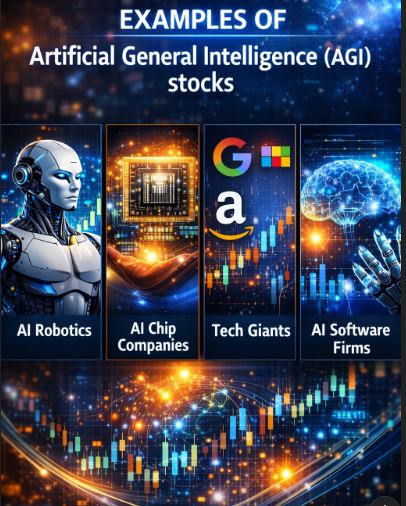
Examples of Artificial General Intelligence (AGI) stocks
Here are some simple examples:
- NVIDIA – makes AI chips
- Microsoft – works on AI tools and cloud
- Alphabet Inc. – does advanced AI research
- Amazon – uses AI in automation
- Tesla – works on self-driving AI
These companies are connected to the future of AI technology.
PRACTICAL EXPERIENCE ABOUT Artificial GENERAL INTELLIGENCE (AGI) STOCKS
From my own experience exploring Artificial General Intelligence (AGI) stocks, I noticed something interesting.
Both individual investors and organizations are very curious. But they are also a bit cautious.
When I first started tracking companies connected with AGI research, the excitement was huge. Everyone believes AGI could transform industries. For example, healthcare, finance, and automation.
However, I also saw a common problem. Many companies claim to be “AGI-focused.” But in reality, they are still working on basic AI tools.
This made research and investment decisions confusing. Some organizations reported great results.
They invested early in AI infrastructure companies. But others struggled. The technology is still evolving. Profits are not always immediate.
Personally, the experience felt like entering a fast-moving future market. It was exciting but uncertain. The good part is that innovation is growing quickly.
Major tech firms are investing billions into AGI research. Looking ahead, AGI-related stocks could become very powerful. But only for people who study the technology carefully. And stay patient for long-term growth.
Artificial General Intelligence (AGI) Stocks: Problems and Solutions
Artificial general intelligence stocks sound exciting, but they are also full of uncertainty. Let’s break it down in a simple, real-world way
Problems in AGI Stocks
1. Overvaluation risk
AGI stocks often rise too fast because of hype.
Real-life example:
A company announces “future AGI plans,” and its stock price jumps even before real profits come.
Problem:
Prices can become too high compared to actual performance.
2. AGI is not here yet
True AGI does not exist today.
Example:
Companies are still building early AI systems, not human-level intelligence.
Problem:
Investors are betting on something that is still uncertain.
3. High volatility
AI and AGI-related stocks move up and down quickly.
Real-life example:
One AI breakthrough news → stock jumps
One delay or bad report → stock falls sharply
4. Regulation risk
Governments may control how powerful AI can become.
Problem:
Stricter rules can slow down profits and growth.
5. Technology uncertainty
Nobody knows when AGI will fully arrive.
Problem:
Investors may misjudge timing.
Solutions for AGI Stock Risks
1. Diversification
Don’t invest in one company only.
Real-life example:
Instead of betting on one AI firm, investors spread money across chip makers, cloud companies, and software firms.
2. Focus on strong fundamentals
Choose companies with real earnings and real products.
Simple idea:
Not all “AI companies” are equally strong.
3. Invest in infrastructure players
Companies building the AI backbone are more stable.
Example:
Chip makers and cloud providers benefit even if AGI takes time.
4. Long-term mindset
AGI is a long journey, not a quick trade.
Simple idea:
Think in 5–10 year cycles, not days or weeks.
5. Ignore hype, follow real usage
Look at real AI adoption, not just headlines.
Real-life example:
A company actually using AI in products is stronger than one just talking about it.
Final takeaway
AGI stocks are powerful, but risky.
Problems:
- hype-driven prices
- uncertainty about AGI timeline
- high volatility
Solutions:
- diversify investments
- focus on real companies
- think long-term
- avoid hype traps
Simple truth:
AGI investing is not about guessing the future perfectly…
it’s about staying balanced while the technology evolves.
Advantages of AGI Stocks
1. Huge growth potential
If AGI becomes real, the companies building it could grow massively.
Real-life example:
Just like early internet companies became giants (like Amazon and Google), AGI leaders could become the next mega companies.
2. Early exposure to future technology
Investors get a chance to be early in a big tech revolution.
Simple idea:
You’re investing before AGI becomes mainstream.
3. Strong innovation in many industries
AGI-related companies also improve:
- healthcare
- finance
- robotics
- software
Example:
AI already helps doctors detect diseases faster. AGI could take that even further.
4. Long-term wealth creation
If the technology succeeds, returns could be very large over time.
Disadvantages of AGI Stocks
1. High risk and uncertainty
AGI does not exist yet, so it’s mostly future expectation.
Real-life example:
Stocks can rise just because of “AI hype,” not real profits.
2. Extreme volatility
Prices can move up and down very fast.
Simple idea:
Good news → big jump
Bad news → sharp drop
3. Long waiting time
AGI may take many years to fully develop.
Problem:
Investors may need to wait a long time for results.
4. Technology may not fully arrive soon
Some experts believe AGI is still decades away.
5. Regulatory risks
Governments may limit how powerful AI systems can become.
Example:
Stricter rules on AI safety could slow company growth.
Final takeaway
AGI stocks are like betting on the future of intelligence itself.
Advantages:
- massive growth potential
- early access to future tech
- strong innovation impact
Disadvantages:
- high risk
- uncertainty
- volatility
- long timeline
Simple truth:
AGI investing is not a safe bet…
it’s a high-risk, high-reward future play.
This article explores the key players behind Artificial General Intelligence (AGI). It also explains the specialized investment options connected to this technology. You will learn which companies are leading AGI development. The article also looks at the financial tools investors use to gain exposure to this fast-growing field. Finally, it discusses how blockchain and decentralized systems could shape the future of intelligent machines.
Publicly Traded AGI Leaders (US Stocks)
There is no pure “AGI stock” yet. But some big tech companies are leading the race.
Examples include companies investing heavily in advanced AI research and infrastructure.
Real-life example:
A cloud company building powerful AI systems and selling them to businesses.
Simple idea:
These companies are not selling AGI yet, but they are building the foundation for it.
(1) The Infrastructure Layer (Hardware)
AGI needs massive computing power. That means powerful chips, GPUs, and data centers.
Real-life example:
Companies making AI chips supply the “engines” that run advanced AI models.
Without this hardware, AGI systems cannot function.
Think of it like electricity for AI.
(2) The Model & Software Layer
This layer is where the “intelligence” lives.
Companies build large AI models that can understand language, analyze data, and solve problems.
Real-life example:
AI tools that can write reports, analyze financial data, or generate code.
These systems are early steps toward AGI.
Specialized AGI Investment Vehicles
Some investors want direct exposure to the AI revolution.
So financial firms create special funds focused on AI and future AGI technologies.
Example:
Investment funds that only hold AI-related companies.
This makes it easier for investors to join the AI trend.
(1) Exchange-Traded Funds (ETFs)
ETFs are like baskets of stocks.
Instead of picking one company, investors buy a group of AI companies together.
Real-life example:
Buying one ETF that includes chip makers, cloud providers, and AI software firms.
Simple idea:
One investment gives exposure to the whole AI industry.
(2) Private Equity and Pre-IPO Trends
Many AI startups are still private.
Big investors and venture capital firms invest in them before they go public.
Real-life example:
A startup building advanced AI models receives billions in funding before listing on the stock market.
These early investments can become huge if the company later goes public.
Decentralized Artificial General Intelligence (Crypto)
Some projects are trying to build AGI using blockchain.
Instead of one company controlling AI, the system runs on a decentralized network.
Real-life example:
Developers around the world contribute computing power and data.
The AI system runs on a distributed network.
(1) The AGI Token (Ethereum Ecosystem)
Certain crypto projects have tokens connected to AI development.
These tokens can power decentralized AI platforms.
Example:
Users pay tokens to access AI services on blockchain networks.
But these markets are still very experimental.
(2) AI Agentic Protocols
Agentic AI means AI systems that can act on their own.
Instead of just answering questions, they perform tasks.
Real-life example:
An AI agent that:
- researches a topic
- writes a report
- sends the results automatically
All without human help.
Market Dynamics and Risks
The AI and AGI market is exciting but also risky.
Common risks include:
- hype cycles
- overvalued stocks
- fast technology changes
Real-life example:
A company’s stock may jump quickly because of AI hype, then drop later.
(1) The “AGI Race” Volatility
Big tech companies are competing heavily in AI development.
This competition creates strong market movements.
Example:
When a company announces a new AI breakthrough, its stock price may jump immediately.
Investors react quickly to AI news.
(2) Disambiguation: The AGI Ticker
The ticker “AGI” in the stock market is actually unrelated to Artificial General Intelligence.
It represents a mining company.
Important point:
Some investors confuse this ticker with AI-related investments.
Always check what the ticker actually represents before investing.
Simple takeaway
The AGI investment world includes:
- tech companies building AI
- hardware makers powering AI
- software companies creating models
- ETFs and investment funds
- crypto and decentralized AI projects
The truth is simple:
AGI is still developing, but the investment ecosystem around it is already huge.
7 Best Stocks to Buy If Artificial General Intelligence (AGI) Becomes Reality

If Artificial General Intelligence (AGI) really becomes a reality, it won’t just change technology — it will reshape entire industries. Think about it like the internet boom in the early 2000s. The companies building the infrastructure and platforms ended up winning big.
So if AGI starts becoming real, these are some companies that could benefit the most.
1. NVIDIA – The Engine Behind AI
If AI is the brain, NVIDIA builds the muscles that power it.
Most advanced AI systems today run on NVIDIA GPUs. These chips train huge models like chatbots, self-driving systems, and medical AI tools.
Real example:
When companies train large AI models, they often use thousands of NVIDIA GPUs in massive data centers.
That’s why NVIDIA has become one of the biggest winners of the AI boom.
2. Microsoft – AI in Everything
Microsoft is quietly putting AI into almost every product it owns.
From AI copilots in Word and Excel to massive cloud infrastructure on Azure, the company is positioning itself as a central AI platform.
Real example:
Businesses now use Microsoft AI tools to automatically write emails, summarize meetings, and analyze data.
If AGI arrives, Microsoft already has the ecosystem ready.
3. Alphabet – The AI Research Giant
Alphabet (Google’s parent company) has been working on AI for years.
They own DeepMind, one of the most advanced AI research labs in the world.
Real example:
DeepMind created AlphaFold, an AI that predicted protein structures and helped scientists accelerate drug discovery.
If AGI happens, Alphabet could be one of the companies leading the research.
4. Amazon – AI + Cloud Power
Amazon isn’t just an online store. It also runs AWS, one of the largest cloud computing platforms.
Most AI startups run their models on cloud infrastructure.
Real example:
A small AI startup can launch a global AI service using Amazon’s cloud without building its own servers.
If AGI needs massive computing power, AWS will likely play a big role.
5. Taiwan Semiconductor Manufacturing Company – The Chip Factory
Even the best AI companies can’t build AI without chips.
That’s where TSMC comes in. They manufacture chips for companies like Apple, NVIDIA, and AMD.
Real example:
Many of the world’s most powerful AI processors are actually manufactured in TSMC factories.
So if AI demand explodes, chip manufacturing demand will too.
6. Advanced Micro Devices – The Rising AI Chip Competitor
AMD is becoming a strong competitor in the AI chip market.
Its new AI accelerators are starting to challenge NVIDIA’s dominance.
Real example:
Big tech companies are testing AMD AI chips in their data centers to reduce reliance on one supplier.
If AGI systems need more hardware options, AMD could grow quickly.
7. Meta Platforms – Building the AI Future
Meta is investing billions in AI research and computing infrastructure.
They are developing powerful open-source AI models and building massive GPU clusters.
Real example:
Meta uses AI to recommend content on Instagram and Facebook, analyze billions of posts, and power virtual reality environments.
AGI could turn Meta into a leader in digital worlds and intelligent platforms.
Final Thoughts
If AGI truly arrives, the biggest winners will likely be the companies that:
- Build AI chips
- Provide cloud computing
- Develop AI models
- Own massive data ecosystems
That’s why companies like NVIDIA, Microsoft, Alphabet, Amazon, TSMC, AMD, and Meta are often seen as key players in the AGI future.
Think of it like investing in the railroads during the industrial revolution. The companies building the infrastructure often become the biggest winners.
Artificial General Intelligence: What Are We Investing In?
When people talk about investing in Artificial General Intelligence (AGI), they are not buying AGI itself.
AGI does not exist yet as a finished product. Instead, investors are putting money into the technologies and companies building the path toward it.
Think of it like investing in the internet in the 1990s. People were not buying the internet directly. They were investing in companies building browsers, servers, and infrastructure.
What investors are really buying
Most AGI-related investments fall into a few main areas.
AI chips and computing power
AGI will require enormous computing power. Companies that build advanced processors and GPUs are essential for training large AI systems.
Real-life example:
Training a modern AI model can require thousands of powerful chips running in huge data centers.
Cloud computing platforms
AGI systems will run on massive cloud infrastructure. Businesses need powerful servers and storage to operate advanced AI models.
Example:
A startup building an AI product usually rents computing power from a cloud provider instead of buying expensive servers.
AI software and models
Some companies are building the actual intelligence layer. They develop advanced AI models that can analyze data, understand language, and solve problems.
Example:
Businesses already use AI tools to summarize reports, analyze customer data, and generate marketing content.
Data and infrastructure companies
AI systems learn from massive amounts of data. Companies that store, manage, and process data also play a big role in the AI ecosystem.
Example:
A healthcare company may use AI to analyze millions of patient records to detect diseases earlier.
Why investors are interested
The reason investors are excited about AGI is simple: productivity.
If machines can perform complex intellectual tasks, businesses could operate much faster and more efficiently.
Imagine a company where AI helps design products, analyze markets, write reports, and manage logistics. That kind of efficiency could create huge economic value.
The reality today
Right now, we are still in the advanced AI stage, not true AGI.
Current AI systems are powerful, but they specialize in specific tasks. AGI would be able to learn and perform many different tasks like a human mind.
Simple takeaway
When people invest in AGI today, they are really investing in the ecosystem building it:
- AI chip makers
- cloud computing companies
- AI software developers
- data infrastructure providers
In other words, investors are betting on the future of intelligent technology, not AGI itself.
How to prepare for General Artificial Intelligence
Preparing for AGI starts with understanding how AI works today. Businesses should begin by using current AI tools, building strong data systems, and training employees to work with intelligent software.
💡 Real-life example:
A company first uses AI for customer support chatbots. Later it expands to AI that analyzes sales data and predicts demand.
Simple idea:
Start small with AI today so your business is ready for AGI tomorrow.
What differentiates Artificial General Intelligence from traditional AI?
Traditional AI focuses on specific tasks. AGI aims to think and learn like a human across many tasks.
Example:
Traditional AI can translate languages.
AGI could translate, write, analyze data, and solve complex problems all at once.
Simple idea:
Traditional AI = one skill
AGI = many skills like a human mind.
Traditional AI: effective but with a defined scope
Traditional AI works very well when the task is clearly defined.
Examples include:
- recommendation systems
- fraud detection
- voice assistants
Real-life example:
Streaming platforms recommending movies based on your watching history.
But it cannot think beyond its assigned task.
Artificial General Intelligence: the next big leap
AGI aims to perform many types of thinking like humans.
It could:
- learn new tasks quickly
- reason and plan
- solve unfamiliar problems
Real-life example:
Instead of separate AI tools for marketing, finance, and logistics, one AGI system could manage all three.
Why does this matter for your business?
AGI could dramatically increase productivity and decision-making speed.
Companies that adopt advanced AI early may gain a strong competitive advantage.
Real-life example:
A retail company using AI to predict demand can reduce waste and increase profits.
What criteria to consider before investing in AGI-based solutions?
Before investing, businesses should evaluate a few key factors:
- technology maturity
- transparency
- real business value
Not every AI solution is truly ready for business use.
Real level of technology maturity
Many companies claim to offer “advanced AI,” but the technology may still be experimental.
Businesses should check:
- real case studies
- proven performance
- stability of the system
Example:
An AI tool that works well in a demo may fail with real company data.
Transparency and explainability
Businesses must understand how AI systems make decisions.
This is important for:
- trust
- compliance
- risk management
Real-life example:
A bank must explain why a loan was rejected if AI makes the decision.
Adherence to your business problem
Technology should solve a real problem.
Buying AI just because it is trendy often wastes money.
Example:
A logistics company benefits more from route optimization AI than from fancy marketing AI.
How to assess the organizational readiness level for adopting Artificial General Intelligence?
Companies must check if they are truly ready for advanced AI systems.
This includes:
- technology infrastructure
- skilled employees
- leadership support
Digital and technological maturity
Organizations need modern systems to use AI effectively.
Important foundations include:
- cloud computing
- structured data
- cybersecurity
Example:
A company using outdated software will struggle to integrate AI tools.
Culture oriented to experimentation
Innovation requires experimentation.
Businesses should encourage testing new technologies without fear of failure.
Real-life example:
Many tech companies run small AI pilot projects before scaling them company-wide.
Which business areas can generate the most value with AGI applications?
AGI could impact many departments, especially:
- customer service
- finance
- supply chain
- healthcare
- marketing
Example:
AGI could automatically analyze customer feedback and suggest product improvements.
What metrics to track to measure impact and scalability of projects with Artificial General Intelligence?
Businesses should measure clear results such as:
- productivity improvement
- cost reduction
- revenue growth
- decision speed
- customer satisfaction
Real-life example:
If AI reduces customer service response time from 10 minutes to 1 minute, the value is obvious.
How to turn AGI into a competitive advantage?
The key is not just using AI—but using it better than competitors.
Companies should:
- integrate AI into core operations
- train employees to work with AI
- continuously improve systems
Example:
A company that uses AI to predict market trends earlier can launch products before competitors.
Simple takeaway:
AGI is still developing, but businesses that prepare today—by building data systems, experimenting with AI, and training teams—will have a huge advantage when AGI becomes reality.
What are Artificial General Intelligence (AGI) Stocks?
AGI stocks are shares of companies working on Artificial General Intelligence.
That means AI that can think and learn like a human, not just do one small task.
Simple idea
When you buy AGI stocks, you are investing in companies trying to build the next level of AI.
It’s like betting on the future of smart machines.
Real-life example
Think about companies like Microsoft or Google.They are investing billions in advanced AI systems.
If their AGI projects succeed, their company value could grow a lot.
That’s why investors watch them closely.
Why people care
Because AGI could change everything.Healthcare, jobs, banking, education — all of it.So people see AGI stocks as high risk, high reward investments.
In short:
AGI stocks are shares of companies building AI that could think and learn like humans — and they could shape the future of technology and money.
AGI Stocks vs AI Stocks (What’s the difference?)
Think of it like this:
AI Stocks (Today’s smart tools)
AI stocks are companies building narrow AI.
That means AI that is good at one specific job.
- Chatbots
- Image generators
- Self-driving features
- Recommendation systems (like YouTube, Netflix)
Example:
NVIDIA makes chips that power AI tools.
Microsoft uses AI in Copilot to help you write emails.
These are powerful, but still limited systems.
AGI Stocks (Future super intelligence)
AGI stocks are tied to companies trying to build Artificial General Intelligence.
That means AI that can:
- Think like humans
- Learn anything
- Solve any problem
Example idea:
Instead of just writing emails, AGI could:
- Manage your business
- Do your coding job
- Make investment decisions
- Learn new skills like a human
AGI is not fully here yet. It’s still in development.
Why investors are interested in AGI companies
Investors are excited because AGI could be HUGE. Like “new industrial revolution” huge.
Here’s why:
1. Massive profit potential
If a company builds AGI first, it could dominate everything.
2. Replacement of many jobs
AGI could automate:
- Offices
- Customer service
- Programming
- Finance tasks
3. Whole industries could change
One AGI system could impact:
- Healthcare
- Education
- Transportation
- Business
Real-life thinking:
It’s like investing in the internet before Google existed.
Is AGI already being developed by big tech?
Yes — but it’s still not complete.
Big companies are racing:
- OpenAI → pushing toward advanced general intelligence models
- Google (DeepMind) → working on human-level AI systems
- Microsoft → investing heavily in AGI research through AI partnerships
- Meta → building advanced “superintelligence” research teams
OpenAI (Microsoft-backed AI leader)
OpenAI is the company behind tools like ChatGPT.
It’s trying to push AI closer to real human-level thinking.
Real-life example:
You ask it to write an email, solve a problem, or even code something — and it does it in seconds.
Big picture: It’s one of the closest companies working toward AGI.
And yes, it’s heavily supported by Microsoft.
Google (DeepMind + AI division)
Google is not just a search engine anymore.
Its DeepMind team is working on very advanced AI research.
Real-life example:
Google Maps predicting traffic before you even leave home — that’s AI already learning patterns.
Their goal: smarter systems that can think and reason more like humans.
NVIDIA (AI power engine)
NVIDIA doesn’t make AI apps.
It builds the “brain chips” that run them.
Real-life example:
Every time ChatGPT answers you fast, NVIDIA’s GPUs are often behind that speed.
Think of it like this:
No NVIDIA = no powerful AI computing.
Meta (AI + future superintelligence)
Meta (Facebook’s parent company) is heavily investing in AI and long-term “superintelligence” research.
Real-life example:
Instagram showing you exactly what videos you like — that’s AI learning your behavior.
Their focus: building AI that understands people deeply and interacts naturally.
Anthropic (Claude AI creator)
Anthropic is a newer AI company building Claude, a chatbot competitor to ChatGPT.
Real-life example:
People use Claude to write, summarize, and analyze documents like a smart assistant.
Their goal: safe and reliable AI that behaves more predictably.
Amazon (AWS + AI backbone)
Amazon is quietly one of the biggest AI players.
Through AWS (cloud computing), it provides the “digital space” where AI systems run.
Real-life example:
When Netflix or apps scale globally, AWS often powers it behind the scenes.
Plus, Amazon is investing heavily in AI tools for business and automation.
Top AGI-Related Stock Categories
AI Chip Manufacturers (the “brain makers”)
NVIDIA, AMD, Intel
These companies build the chips that power AI.
Real-life example:
When you use ChatGPT or image AI, it needs super-fast chips to think and respond.
That speed comes from NVIDIA and AMD.
Simple idea:
No chips = no AI.
Cloud Computing Companies (the “AI homes”)
Microsoft, Amazon, Google
These companies provide cloud servers where AI runs.
Real-life example:
When you upload photos to Google Photos or use Netflix, everything runs on cloud servers.
For AI, cloud is like:
A giant digital brain storage + processing center.
Data Infrastructure Companies (the “AI memory”)
Seagate, Micron
AI needs massive storage to learn from data — these companies provide it.
Real-life example:
Think of AI like a student.
Seagate and Micron are the “notebooks and memory” where all learning is stored.
No storage = AI forgets everything.
AI Software Companies (the “smart tools”)
Palantir, IBM, Adobe
These companies build AI-powered software and tools.
Real-life example:
- Adobe helps you edit photos automatically
- IBM builds business AI systems
- Palantir helps governments and companies analyze data
Simple idea:
This is where AI actually “does work” for humans.
Robotics & Automation Companies (the “real-world AI”)
Tesla, Symbotic
These companies bring AI into the physical world.
Real-life example:
- Tesla cars driving themselves
- Robots in warehouses sorting packages automatically (like Amazon-style systems)
Simple idea:
This is AI with a body — not just software, but real action.
How AGI Could Impact Stock Market
AGI replacing human knowledge work
This means AGI could do jobs that people use their brain for.
Real-life example:
Instead of a lawyer spending hours reading cases, AGI could analyze everything in seconds and give the answer.
Think about:
- Writing reports
- Coding software
- Customer support
- Business analysis
All done faster, cheaper, and 24/7.
Explosion in productivity → stock market growth
When AI makes people 10x faster, companies earn more money.
Real-life example:
One employee with AGI tools could do the work of a full team.
Result:
- More profit
- Faster businesses
- Higher company valuations
That’s why tech stocks often rise during AI booms.
Automation of entire industries
AGI won’t just help — it can fully replace workflows.
Real-life example:
- Factories run by robots
- AI managing warehouses
- Chatbots handling all customer service
Imagine a company running with almost no human workers in some areas.
That’s real automation.
New trillion-dollar AI economy
This is the biggest idea.
AGI could create completely new industries we don’t even have today.
Real-life example:
Just like the internet created:
- Amazon
- Social media
AGI could create:
- AI managers for businesses
- Personal AI assistants for everyone
- Fully automated companies
Entire new markets worth trillions.
Risks in AGI Investing
AI Bubble Risk & Overvaluation
Sometimes AI stocks rise too fast, too soon.
Real-life example:
A company announces “AI future,” and its stock price suddenly doubles… even if profits didn’t change.
The risk:
- Prices get too high
- Reality doesn’t match expectations
- Then the market corrects (drops hard)
Simple idea:
It’s like everyone rushing to buy a phone just because it’s “new,” even if it’s not better.
Regulation of AGI Development
Governments may step in to control how powerful AI becomes.
Real-life example:
If AGI can make decisions like hiring, banking, or healthcare, governments will want rules around it.
Why it matters:
- Slower innovation
- Extra compliance costs for companies
- Limits on what AI can do
Simple idea:
More rules = slower but safer growth.
Ethical & Safety Concerns
People worry about AI doing things it shouldn’t.
Real-life example:
- AI replacing jobs too quickly
- AI making biased decisions
- AI being used for misinformation
Big question:
Can we trust something smarter than us?
Simple idea:
Powerful tech always brings responsibility problems.
Uncertainty About AGI Timeline
Nobody knows when AGI will actually arrive.
Real-life example:
Some experts say “5 years,” others say “20+ years.”
Problem for investors:
- Markets may price in AGI too early
- Or too late
Simple idea:
You’re investing in something that might not fully exist yet.
High Volatility in AI Stocks
AI stocks move up and down very fast.
Real-life example:
One good AI news announcement → stocks jump
One bad earnings report → stocks drop sharply
Why it happens:
- High expectations
- Fast-changing technology
- Heavy speculation
Simple idea:
AI stocks are like a rollercoaster — exciting, but risky.
Investment Strategies for AGI Stocks
Long-term investing vs short-term trading
This is the first big decision.
Short-term trading
You buy AI stocks and try to profit quickly from price moves.
Real – Life Example:
Buy a stock today because AI news is hot… sell it next week when price jumps.
Risk:
- Very stressful
- Easy to lose money
- Needs timing skills
Long-term investing
You buy strong AI companies and hold for years.
Real-life example:
Buying companies like NVIDIA or Microsoft and just letting them grow with the AI trend.
Benefit:
- Less stress
- Compounds over time
- You don’t need perfect timing
Diversification in AI/Tech ETFs
Instead of picking one stock, you invest in a basket of AI companies.
Real-life example:
It’s like buying a mix of fruits instead of just apples. If one fails, others balance it.
Why it matters:
- Reduces risk
- Gives exposure to many AI companies at once
- Safer for beginners
Infrastructure vs Application companies
This is a smart way to think about AI investing.
Infrastructure companies (the foundation)
These build the backbone of AI.
Real-life example:
NVIDIA makes chips
Amazon and Microsoft provide cloud systems
Simple idea:
Without them, AI doesn’t even run.
Application companies (the tools you use)
These build AI products for users.
Real-life example:
Chatbots, design tools, business software, AI apps.
Simple idea:
These are the “apps on your phone,” powered by AI.
“Picks and shovels” strategy (chips + cloud)
This is one of the smartest investing ideas in AI.
Meaning:
Instead of betting on who wins the AI race…
You invest in the tools everyone needs.
Real-life example:
During the gold rush:
- Some people searched for gold
- Smart investors sold “picks and shovels”
In AI today:
- Chips (like NVIDIA)
- Cloud (like Microsoft, Amazon, Google)
No matter who wins AI… they all need these.
AGI ETFs and Index Funds
AI-focused ETFs (AIQ, BOTZ, etc.)
These are “AI baskets.”
Instead of buying one stock, you buy many AI-related companies together.
Real-life example:
It’s like ordering a combo meal instead of picking one item.
You get a mix of everything.
Examples:
- AIQ → focuses on global AI companies
- BOTZ → focuses on robotics + automation + AI
Simple idea:
You’re investing in the whole AI trend, not one winner.
Tech-heavy ETFs with AGI exposure
Some big tech ETFs already include AGI-related companies inside them.
Real-life example:
When you buy one ETF, you indirectly own parts of:
- AI chip companies
- Cloud companies
- Big tech AI labs
Think of it like:
A “tech power basket” where AI is a big slice.
So even if AGI grows, these ETFs benefit automatically.
Pros of ETF investing in AGI theme
1. Less risk
If one company fails, others balance it.
Example:
If one AI stock drops, others in the ETF may still rise.
2. Easy diversification
You don’t need to research 50 companies.
One ETF = many AI stocks.
3. Captures whole AI trend
You don’t miss out on winners.
Example:
If NVIDIA, Microsoft, or other AI leaders grow → ETF grows too.
4. Beginner-friendly
You don’t need deep stock knowledge.
Just invest and hold.
Cons of ETF investing in AGI theme
1. Lower upside than single stocks
If one company explodes in value, ETF only gives partial benefit.
Example:
Owning one winning AI stock = big gain
ETF = smaller shared gain
2. Includes weak performers too
You also hold companies that may not perform well.
So winners get “mixed” with average ones.
3. Less control
You can’t choose which AI companies you really want.
It’s a fixed bundle.
4. Can still be volatile
Even ETFs go up and down with the AI hype cycle.
AGI vs Narrow AI Investment Debate
This is a big one.
Narrow AI (today’s reality)
AI that does specific tasks.
Real-life example:
- Chatbots answering questions
- Netflix recommending movies
- Google Maps predicting traffic
Most current AI stocks are here.
AGI (future idea)
AI that can think like a human and do almost anything.
Real-life example:
One system that can:
- Run a business
- Code software
- Do medical diagnosis
- Make financial decisions
AGI is still not fully here.
Are current AI stocks already pricing in AGI?
Short answer: partly yes.
Real-life example:
Stocks of companies like NVIDIA and Microsoft often rise not just on today’s AI… but on future AGI hopes.
Problem:
If AGI takes longer than expected → stock prices may drop.
Simple idea:
The market is sometimes “betting on the future too early.”
Will only a few companies dominate AGI?
Most likely yes.
Real-life example:
Like Google dominating search, or Apple dominating smartphones.
AGI could be:
- Expensive
- Complex
- Hard to build
So only big players may survive.
Winner-takes-all market structure
In AGI, the winner could take most of the value.
Real-life example:
If one company builds the best AGI assistant:
- Everyone uses it
- Everyone pays for it
- Smaller competitors disappear
Simple idea:
One or two giants could control the market.
Market Signals & Indicators
These are signs investors watch to understand where AGI is heading.
AI spending from Big Tech
Companies spending billions on AI shows strong belief in AGI future.
GPU demand & chip shortages
When chips are in high demand, AI growth is accelerating.
Example:
More AI = more NVIDIA GPUs needed.
Data center expansion
Big tech building huge AI data centers.
Simple idea:
More AI power needs more digital “factories.”
Venture capital flow
Startups getting billions shows investors are chasing AGI dreams.
Real-world use cases driving AGI stocks
These are the real things pushing the AI market forward.
Self-driving cars
Cars that drive without humans.
AI robotics in factories
Robots assembling products automatically.
Medical diagnosis systems
AI detecting diseases faster than doctors.
Financial trading AI
AI making fast investment decisions in markets.
AI assistants replacing SaaS tools
Instead of software tools, people just ask AI to do work.
Example:
“Make me a report” → AI does everything instantly.
Sentiment & speculation topics
This is where emotions and opinions drive the market.
Is AGI already here or far away?
Experts still disagree.
Some say:
- “Almost here”
Others say: - “Still decades away”
AI bubble vs real revolution
People debate:
- Is AI hype overdone?
- Or is it a real transformation like the internet?
Analyst AGI timeline predictions
Some expect AGI in 5–10 years, others much later.
Public vs private competition
Big public companies vs private AI labs racing for AGI.
Example:
OpenAI working alongside big tech vs startups trying to catch up.
Future of AGI and Market Trends
When AGI might realistically arrive
Nobody knows the exact date. But expectations are rising.
Real-life example:
Some experts say AGI could appear in the next 5–15 years, others say it may take longer.
Simple idea:
It’s like predicting when self-driving cars became normal — progress is fast, but timing is uncertain.
Impact of AGI on global GDP
If AGI becomes real, it could massively boost the world economy.
Real-life example:
One AI system helping millions of businesses run faster, cheaper, and smarter.
What happens:
- More productivity
- Lower business costs
- Faster innovation
Simple idea:
AGI could act like adding billions of “super workers” to the economy.
Human-AI hybrid workforce
Humans won’t fully disappear from work. They’ll work with AI.
Real-life example:
- A marketer uses AI to create ads
- A doctor uses AI to analyze scans
- A programmer uses AI to write code
Simple idea:
Humans become “managers of AI workers.”
Rise of autonomous AI agents in finance
AI won’t just assist — it will act on its own.
Real-life example:
AI systems that:
- Trade stocks automatically
- Manage investment portfolios
- Adjust strategies in real time
Simple idea:
It’s like having a robot financial advisor working 24/7.
Shift from AI tools → full AGI systems
Right now, we use AI tools.
In the future, we may use full intelligent systems.
Real-life example:
Today:
- You ask ChatGPT to write something
Future AGI:
- You just say “run my business today” → it handles everything
Simple idea:
We move from “tools we control” → “systems that think and act for us.”
Final takeaway
- AGI timeline is uncertain but getting closer
- It could massively grow the global economy
- Humans will work with AI, not be fully replaced
- Finance will become highly automated
- AI is evolving from tools → full intelligent agents
Simple truth:
We’re moving toward a world where AI doesn’t just help us…
it starts working alongside us like a digital colleague.
FAQ ( Frequently Asked Questions )
Can I invest in AGI?
You cannot directly invest in “AGI” yet.
AGI is not a product or stock. It’s still a future technology.
You can only invest in companies working toward AI/AGI.
Example: Buying shares in AI companies like chip makers or cloud providers.
What is the difference between AGI and current AI?
Current AI is narrow. It does one task well.
AGI would think like a human and do many tasks.
Example:
AI = Google Maps (one job)
AGI = personal assistant that can do everything
Does selling stock affect AGI?
No. Selling stocks does not affect AGI development.
AGI is built by companies, not stock traders.
What are the risks of developing AGI?
- Job loss
- Misuse of AI
- Loss of control
- Ethical problems
Example: AI making wrong decisions in healthcare or finance.
Do dividends affect AGI?
No. Dividends are just company profits paid to investors.
They have nothing to do with AGI itself.
Should I sell my AGI stock?
There is no direct “AGI stock.”
If you mean AI stocks, decision depends on:
- risk tolerance
- market conditions
- long-term belief
Always research or consult a financial advisor.
What programming languages are used for AGI?
- Python
- C++
- Java
- Rust
Example: Python is widely used in AI research and models.
What are the challenges of AGI?
- Huge computing power needed
- Safety control
- Data complexity
- Human-like reasoning difficulty
Do stocks count as AGI?
No. Stocks are ownership in companies.
AGI is a technology concept, not a financial asset.
What are the best AGI stocks?
There are no true AGI stocks yet.
But AI-related companies include:
- chip makers
- cloud companies
- AI software firms
What are the negatives of AGI?
- Job disruption
- Ethical risks
- Security threats
- Dependence on machines
What are the predictions for AGI?
Experts disagree:
- Some say 5–10 years
- Some say decades
- Some say it may never fully happen
Do stock losses lower your AGI?
No. Stock losses have nothing to do with AGI development.
What will AGI do to the stock market?
It could:
- increase productivity
- boost tech stocks
- create new industries
- cause volatility
Where can I find AGI?
You cannot “find AGI” yet.
It is being researched by big tech companies.
Is AGI a software?
Not yet.
It would be a very advanced intelligent system in the future.
What can decrease AGI?
AGI progress can slow due to:
- lack of computing power
- regulations
- safety restrictions
- funding limits
Is AGI achieved yet?
No. AGI is not achieved yet.
We only have narrow AI.
Will AGI replace human jobs?
Yes, many jobs may change or disappear.
But new jobs will also be created.
Example: AI replaces data entry, but creates AI trainer roles.
What are the risks of AGI?
Same as above:
- loss of control
- job disruption
- misuse
- ethical issues
How long will it take for AGI?
Unknown.
Estimates range from 5 years to 30+ years.
How can we ensure AGI is safe?
- strict regulations
- ethical AI rules
- human supervision
- safety testing
How smart will AGI be?
It could match or exceed human intelligence in many areas.
Example: like a super-smart assistant that never sleeps.
What are the disadvantages of AGI?
- high cost
- control risk
- job impact
- dependency
Which jobs will survive AGI?
- creative jobs
- human care jobs
- leadership roles
- physical skilled jobs
Does AGI expire?
No. AGI is a system, not something that expires like food or software license.
What is the future prediction for AGI?
AGI may:
- transform industries
- change work completely
- boost global economy
How is AGI better than AI?
AGI is more powerful because it can:
- learn anything
- reason like humans
- solve different problems
What are the dangers of AGI?
- misuse
- loss of control
- mass unemployment
- security threats
What are the advantages of AGI?
- faster work
- higher productivity
- medical breakthroughs
- automation of complex tasks
How many jobs will AGI replace?
AGI could replace many knowledge-based jobs, but no exact number is known.
Real-life example:
Office work like data entry, basic writing, and simple analysis could be mostly automated.
Simple idea:
Some jobs disappear, but new AI-related jobs also appear.
Is AGI a good place to work?
There is no “AGI company job” yet as AGI is not fully built.
But AI companies working toward AGI can be good workplaces.
How many questions is the AGI written?
This question is unclear.
AGI is not written as “questions.” It is a concept, not a document.
What is the difference between AGI and BGI?
There is no standard term BGI in AI science.
AGI means Artificial General Intelligence.
BGI is not commonly used in this context.
What technologies are needed for AGI?
- Machine learning
- Deep learning
- Neural networks
- Big data
- Advanced computing power
Example:
Like building a “digital brain” using massive data and chips.
Why is AGI not coming?
Because it is very hard to build.
- Human thinking is complex
- Safety issues
- Lack of full understanding of intelligence
What companies are working on AGI?
- OpenAI
- Google (DeepMind)
- Microsoft
- Meta
- Anthropic
What is the difference between AI, AGI, and superintelligence?
- AI: does specific tasks
- AGI: thinks like a human
- Superintelligence: smarter than humans
Example:
AI = calculator
AGI = human-like assistant
Superintelligence = genius beyond humans
What are the benefits of AGI?
- Faster work
- Medical breakthroughs
- Automation
- Better decision-making
Where is AGI used?
AGI is not fully used yet.
But AI (early form) is used in:
- healthcare
- finance
- customer support
- self-driving tech
Will AGI replace accountants?
Yes, partly.
Example:
Tax calculations and bookkeeping can be automated.
But human review will still exist.
Which jobs will survive AGI?
- creative jobs (artists, designers)
- leadership roles
- human care jobs (doctors, nurses)
- jobs requiring physical presence
Is AGI just salary?
No. AGI is not salary.
Salary is income from work. AGI is a technology concept.
How to become an AGI?
You cannot “become AGI.”
But you can learn:
- AI
- machine learning
- programming
Can you invest in AGI?
Not directly.
You invest in AI companies working toward AGI.
Do we need quantum computers for AGI?
Not necessarily.
But quantum computing could help in future AI research.
What separates AGI from AI?
AGI can think and learn anything.
AI can only do specific tasks.
How far off is AGI?
Experts disagree:
- some say 5–15 years
- some say longer
- some say uncertain
How is AGI different from income?
AGI is technology.
Income is money you earn.
How does AGI affect tax returns?
It doesn’t directly affect taxes.
But AI tools may change how accounting is done.
How many jobs would AGI replace?
No exact number.
But many routine office jobs are at risk.
Can your AGI be $0?
AGI is not a financial number.
So it cannot be $0 or anything like that.
Is ChatGPT considered AGI?
No.
OpenAI ChatGPT is narrow AI, not AGI.
Is Agi Inc. profitable?
There is no widely known company called “AGI Inc.” in this context.
As Elon Musk aims for AGI, should you buy Tesla stock now?
Right now, Tesla is more than just a car company. It is also building serious AI technology.
Elon Musk believes the future of Tesla depends heavily on advanced AI and eventually AGI.
Tesla’s self-driving system, robots like Optimus, and huge amounts of driving data give it a strong AI advantage.
But buying Tesla stock just for AGI is still a bet on the future.
AGI doesn’t exist yet.
Real example:
Tesla collects billions of miles of driving data from its cars. That data trains its AI models. No other automaker has that scale.
So the decision is simple:
- If you believe Tesla will become a major AI and robotics company, the stock could grow big.
- If AGI takes longer than expected, Tesla will still mostly be a car and energy company.
AGI is exciting, but it is not the only reason to buy Tesla stock today.
What is Artificial General Intelligence (AGI)?
Artificial General Intelligence means AI that can think and learn like a human.
Today’s AI is narrow. It can do one task really well.
AGI would be different. It could learn any task, switch between problems, and understand the world.
Example:
ChatGPT can write text.
Midjourney can create images.
A chess AI can play chess.
But AGI could do all of these things at once, and also learn new skills on its own.
Think of it like a digital human brain inside a computer.
Will artificial intelligence destroy the stock market and finance?
No. It will change it, not destroy it.
AI is already heavily used in finance.
Examples:
- Hedge funds use AI for algorithmic trading
- Banks use AI for fraud detection
- Investment firms use AI for risk analysis
Real example:
Companies like BlackRock use AI systems to analyze huge market datasets.
Instead of replacing finance, AI will make markets faster, more data-driven, and more automated.
Human investors will still make strategic decisions.
When do experts think AGI will exist?
There is no clear date.
But many researchers believe AGI could appear between 2035 and 2050.
Some are more optimistic.
Example:
- Elon Musk says it could happen within the next decade.
- Some AI scientists say it may take 30–50 years.
Why the uncertainty?
Because intelligence is still not fully understood.
We can build powerful models, but we still don’t know exactly how human intelligence works.
What is the most advanced AI today?
The most advanced systems today are large language models and multimodal AI systems.
Examples include:
- GPT-style language models
- advanced robotics AI
- AI systems that combine text, images, and video
These systems can write essays, code software, analyze data, and even help with research.
But they still lack true understanding and reasoning.
They are powerful tools, not general intelligence.
Is AGI just a daydream?
Not really.
Thirty years ago, people thought self-driving cars were science fiction.
Today they exist.
AGI may sound futuristic, but progress in computing power and machine learning is moving fast.
Real example:
AI models now pass professional exams, write software, and generate movies.
Things that seemed impossible ten years ago are now common.
AGI is difficult, but it is no longer considered impossible.
What breakthroughs are needed for AGI?
Several big breakthroughs are still needed.
Better reasoning
AI needs stronger logical thinking and planning abilities.
Memory and learning
Current AI models forget quickly.
AGI will need long-term memory and continuous learning.
Understanding the real world
Humans learn from experience.
AGI must understand physics, emotions, and context.
Energy-efficient computing
AGI will require huge computing power.
That’s why companies invest in:
- AI chips
- quantum computing
- massive data centers
What approach are researchers using now?
Researchers are moving toward hybrid AI systems.
This means combining multiple techniques:
- deep learning
- reinforcement learning
- reasoning systems
- neural networks
- symbolic logic
Instead of relying on one model, the goal is to build systems that learn like humans.
Example:
Robotics companies train AI using simulation environments, letting machines practice millions of tasks.
How wealthy could the first AGI company become?
Potentially the most valuable company in history.
AGI could automate many high-value tasks:
- research
- engineering
- finance
- healthcare
- software development
If a company owned such technology, it could power almost every industry.
Real example:
The internet created trillion-dollar companies like:
- Apple
- Microsoft
- Amazon
AGI could create companies even bigger than these.
What is the relationship between AI and AGI?
Think of it like this:
AI today = specialized tools
AGI = universal intelligence
AI can perform specific tasks.
AGI would be able to learn any intellectual task a human can do.
So AGI is basically the next stage of AI evolution.
How businesses will use AGI in the future
If AGI becomes real, businesses will change dramatically.
Autonomous companies
AI systems could manage operations, logistics, and strategy.
AI researchers
AGI could help invent new medicines and technologies.
Smart decision engines
Companies could simulate millions of business scenarios before making decisions.
Real example scenario:
A pharmaceutical company could ask AGI:
“Design a new cancer drug.”
The AGI could analyze medical data, run simulations, and design a treatment in hours instead of years.
Conclusion: Artificial General Intelligence (AGI) Stocks
Artificial General Intelligence (AGI) stocks are getting a lot of attention. AI is now part of daily life.
From smart assistants to self-driving cars, everything is changing fast. AGI goes one step further. It means machines that can think and learn like humans.
For investors, AGI stocks are about future technology. Big companies and startups are investing huge money to build smarter systems.
If AGI becomes real, it can change many industries like healthcare, finance, education, and transport. That’s why people see it as a long-term opportunity.
For example, companies making AI chips or advanced AI models may grow a lot as demand increases. Just like early internet investors made big profits, AGI investors hope for the same future.
But there is also risk. The technology is still new. The market can change quickly and is not fully stable yet.
In simple words, AGI stocks are a bet on the future. If AI keeps growing, these companies could lead the next big tech revolution.