In today’s rapidly evolving digital education ecosystem, AI for Students: 10 Proven Practical Ways to Study Smarter and Save Time explains how artificial intelligence is transforming traditional learning into a more efficient, structured, and personalized experience. Across global education systems, AI tools are now widely integrated into student workflows for revision, research assistance, and academic planning, reflecting a major shift toward AI-assisted learning environments.
Recent global reports show that AI adoption in education has reached mainstream levels, with over 90% of students and educators now using AI tools in some form for learning activities in 2025–2026 (Microsoft Education Report 2026; Coursera Global Learning Trends 2026). This indicates that AI is no longer experimental but a core part of modern academic systems.
Despite this rapid adoption, many students still struggle with time management, lack of structured study methods, and difficulty understanding complex topics efficiently. Research findings show that while AI usage is increasing, a significant number of learners fail to use these tools effectively for measurable academic improvement, creating a gap between access and learning outcomes (Deloitte Digital Learning Report 2026).
Real-world example: A student preparing for competitive exams often revises entire textbooks without prioritization, whereas AI-powered systems can instantly identify weak areas and generate focused revision plans, reducing study time and improving performance.
Expert insight: According to the Stanford AI Index 2026, AI is evolving into adaptive learning systems that analyze student behavior patterns to deliver personalized academic guidance rather than static or generic responses.
Personal opinion: From a balanced perspective, AI should be used as a structured learning assistant, not a shortcut, because long-term academic success still depends on critical thinking, consistency, and conceptual understanding.
From an industry standpoint, organizations such as Microsoft, Deloitte, OECD, and global education research bodies confirm that AI is becoming a foundational component of personalized learning ecosystems, where students receive tailored recommendations based on real-time performance data and behavioral learning analysis (OECD Education AI Study 2025).
Overall, this topic represents a real-world transformation in education, where AI is actively improving student productivity, learning efficiency, and academic outcomes through practical, data-driven applications used across global academic environments.
Table of Contents
ToggleTRUSTED REFERENCES
- Microsoft Education Report 2026 – AI adoption in global learning systems
- Coursera Global Learning Trends Report 2026 – student AI usage statistics
- Deloitte Digital Learning Transformation Report 2026 – AI impact on education efficiency
- Stanford AI Index Report 2026 – adaptive learning systems & AI education trends
- OECD Education AI Study 2025 – global classroom AI integration analysis
INTRODUCTION
AI for Students: 10 Proven Practical Ways to Study Smarter and Save Time explains how artificial intelligence is reshaping modern education by acting as a personalized learning assistant that helps students study more efficiently, understand complex topics faster, and manage their academic workload more effectively. In today’s digital learning environment, AI tools are widely used for summarizing content, generating study plans, solving academic doubts, and improving exam preparation through data-driven insights.
Many students face common academic challenges such as poor time management, difficulty understanding difficult concepts, and inefficient revision strategies. According to recent education technology research, while AI adoption in learning has grown significantly, many students still lack proper guidance on how to use these tools effectively for measurable academic improvement (Microsoft Education Report 2026; Coursera Global Learning Trends 2026).
This topic is important because AI is no longer a future concept—it is already integrated into global education systems, online learning platforms, and classroom environments. Recent reports show that AI adoption in education has crossed 90%+ usage among students and educators globally in some form, highlighting its rapid mainstream integration (OECD Education AI Report 2025; Microsoft Education Insights 2026).
👉 Real-world example: A student preparing for competitive exams often studies large portions of material without prioritization, while AI-powered tools can instantly analyze weak areas, generate targeted quizzes, and create structured revision plans that significantly improve study efficiency.
👉 Expert insight: Education technology researchers and the Stanford AI Index 2026 report highlight that AI is evolving into adaptive learning systems that personalize education based on student behavior patterns rather than providing generic solutions.
👉 Personal opinion: From a balanced perspective, AI should be used as a structured learning assistant rather than a shortcut, because long-term academic success still depends on critical thinking, consistency, and deep conceptual understanding.
👉 Trust signal: Global organizations such as Microsoft, Deloitte, OECD, and Stanford AI research confirm that AI is becoming a core component of personalized education systems, improving learning outcomes through real-time data analysis and adaptive feedback systems.
Overall, this topic reflects a real-world transformation in education where AI is actively improving learning efficiency, productivity, and academic performance through practical, data-driven applications used across global academic environments.
TRUSTED REFERENCES
- Microsoft Education Report 2026 – AI adoption in global learning systems
- Coursera Global Learning Trends 2026 – student AI usage and learning behavior
- OECD Education AI Report 2025 – AI integration in education systems
- Stanford AI Index Report 2026 – adaptive learning and AI education trends
- Deloitte Digital Learning Transformation Report 2026 – productivity impact of AI in education
-----------------------------------------------
SEO Title
AI for Students: 10 Proven Practical Ways to Study Smarter and Save Time
Meta Title
AI for Students: 10 Practical Ways to Study Smarter and Save Time (2026 Guide)
Meta Description
Discover AI for Students: 10 proven practical ways to study smarter and save time. Learn how Artificial Intelligence improves learning efficiency, boosts productivity, and supports academic success with real-world examples and step-by-step methods designed for better exam performance.
SEO-Friendly URL
/ai-for-students-study-smarter-save-time
Featured Image Suggestion
A student using AI tools on laptop for studying with notes, books, and digital learning interface.
Alt Text: AI for students studying smarter using digital tools and saving time
Introduction (180–250 words)
AI for Students: 10 Proven Practical Ways to Study Smarter and Save Time is becoming one of the most important topics in modern education. Artificial Intelligence is no longer just a futuristic concept; it is now a practical learning assistant for students worldwide.
Many students struggle with time management, understanding complex topics, and preparing for exams efficiently. AI solves these problems by offering personalized learning, instant explanations, automated summaries, and smart study planning.
In this guide, you will learn how AI helps students study smarter instead of harder. You will also explore real-world examples of how students use AI tools to improve grades, reduce study time, and increase productivity.
This article is designed for beginners and focuses on simple, practical, and actionable methods. Each strategy is based on real educational use cases and modern AI learning tools.
By the end, you will clearly understand how AI can transform your study habits, improve your academic performance, and save valuable time in your daily learning routine.
Problem Statement
Students today face multiple challenges:
- Too much study material
- Limited time before exams
- Difficulty understanding complex topics
- Lack of proper revision strategies
- Poor time management
AI directly solves these problems by acting as a smart digital assistant that guides learning in a structured and efficient way.
Table of Contents
- What is AI for Students
- Importance of AI in Education
- 10 Proven Ways AI Helps Students
- Real-Life Examples
- Common Mistakes
- Best Practices
- FAQs
- Key Takeaways
- Conclusion
What is AI for Students?
AI for students refers to the use of Artificial Intelligence tools and systems that help improve learning efficiency. These tools can analyze study patterns, generate summaries, explain concepts, and even create personalized study plans.
Importance of AI in Education
AI is transforming education in the following ways:
- Personalized learning experience
- Faster content understanding
- Better time management
- Improved exam preparation
- Increased productivity
According to educational technology research, AI-based learning systems can improve student efficiency by up to 30–40%.
10 Proven Practical Ways AI Helps Students Study Smarter and Save Time
1. AI-Powered Note Summarization
AI tools convert long notes into short summaries.
Example: Students use AI to summarize 20-page chapters into 2-page revision notes.
2. Personalized Study Plans
AI creates daily study schedules based on exam dates and difficulty level.
3. Instant Concept Explanation
AI explains difficult topics in simple language.
Example: Physics or math problems explained step-by-step.
4. Smart Flashcards Generation
AI automatically generates flashcards for revision.
5. AI Writing Assistance
Students improve essays and assignments using AI suggestions.
6. Time Management Optimization
AI helps students prioritize important topics first.
7. Language Translation Support
AI translates academic content into simple native language.
8. Practice Tests and Quizzes
AI generates mock tests for exam preparation.
9. Research Assistance
AI quickly finds relevant academic information for assignments.
10. Exam Performance Prediction
AI analyzes learning patterns and predicts weak areas.
Real-World Example
A university student preparing for final exams used AI tools for:
- Summarizing textbooks
- Creating revision notes
- Generating practice tests
Result: Study time reduced by 35% and exam performance improved significantly.
Case Study
In a real classroom environment, students using AI-based learning platforms showed:
- Faster topic understanding
- Better retention rates
- Higher test scores compared to traditional methods
Teachers also reported improved engagement and participation.
Expert Tips
- Always verify AI-generated information
- Use AI as a learning assistant, not a replacement
- Combine AI tools with traditional study methods
- Focus on understanding, not copying
Common Mistakes
- Over-reliance on AI tools
- Copy-pasting without learning
- Ignoring manual practice
- Using unverified AI content
Best Practices
- Use AI for revision and clarity
- Set clear study goals
- Combine AI with textbooks
- Regularly test your knowledge
FAQs
1. Is AI safe for students?
Yes, if used responsibly for learning and guidance.
2. Can AI replace teachers?
No, AI supports learning but does not replace teachers.
3. Which AI tools are best for students?
Chat-based AI tools, note summarizers, and quiz generators.
4. Does AI improve grades?
Yes, if used correctly for structured learning.
5. Is AI free for students?
Many AI tools offer free versions.
Key Takeaways
- AI helps students study smarter
- It saves time and improves efficiency
- Personalized learning is the biggest advantage
- Proper use leads to better academic results
Conclusion
AI for Students: 10 Proven Practical Ways to Study Smarter and Save Time shows how Artificial Intelligence is changing modern education. Students who use AI correctly can improve productivity, save time, and achieve better academic performance.
However, success depends on balanced usage. AI should support learning, not replace it.
With the right approach, AI becomes a powerful study partner that helps students achieve their academic goals faster and more efficiently.
A key point to understand is that Artificial Intelligence is now improving the learning experience for students, making it more simple and effective.
The article “10 Uses Of Artificial Intelligence for Students to Learn Smarter and Save Time” explains how AI helps in daily school tasks with easy and relatable examples.
Nowadays, students face difficulties in managing their time, understanding difficult topics, and completing assignments faster. AI tools help in different tasks such as research, writing notes, making summaries, and supporting personalized learning.
For example, research by IBM and NIST shows that AI systems can study learning habits and give smarter suggestions.
From what I have seen, students who use AI tools usually study in a better way and feel less stress.
This article gives ten practical uses of AI in a student’s daily life that make learning faster, save time, and make the education process easier in real situations.

Introduction
INTRODUCTION
Problem Statement
Students today are under constant pressure due to heavy academic workloads, limited time, and increasing competition. Many struggle with understanding complex subjects, managing revision schedules, and completing assignments efficiently. Traditional study methods often fail to keep up with modern learning demands.
The result is stress, poor time management, and inefficient learning outcomes.
Direct Answer
AI for Students solves these challenges by acting as a smart learning assistant. It helps students study faster, understand better, and save time through automation, personalization, and intelligent learning support. AI tools can simplify complex topics, generate summaries, create quizzes, and improve revision efficiency.
1. What is AI for Students
AI for students refers to the use of Artificial Intelligence tools that support learning, studying, and academic performance. These tools analyze data, understand student needs, and provide personalized study assistance.
For example, AI can explain difficult topics in simple language, generate notes from textbooks, or create practice questions instantly.
It acts like a digital tutor available 24/7.
2. Importance of AI in Education
AI is transforming education by making learning faster, more personalized, and more efficient.
Key benefits include:
- Personalized learning based on student performance
- Faster understanding of complex topics
- Better retention through smart revision tools
- Reduced study time with automated summaries
- Improved exam preparation strategies
AI ensures that students learn smarter, not harder.
3. AI Study System (Step-by-Step Workflow)
AI works best when used in a structured learning system.
Learn → Understand → Summarize → Practice → Revise
- Learn: Students read topics using textbooks or videos
- Understand: AI explains difficult concepts in simple language
- Summarize: AI generates short revision notes
- Practice: AI creates quizzes and questions
- Revise: AI identifies weak areas for improvement
This workflow improves efficiency and memory retention significantly.
4. 10 Proven Practical Ways AI Helps Students Study Smarter and Save Time
AI improves studying in multiple practical ways:
- Smart note summarization
- Personalized study plans
- Instant concept explanation
- AI-generated flashcards
- Writing assistance for assignments
- Time management optimization
- Practice quizzes and mock tests
- Research support for projects
- Language translation help
- Exam performance analysis
Each method saves time and improves learning quality.
5. Best AI Tools for Students (2026 Updated List)
AI tools are essential for modern learning:
- Chat-based AI tools for explanations
- AI note-taking apps
- AI quiz generators
- Grammar and writing assistants
- Productivity and scheduling tools
These tools act as digital study partners that simplify academic tasks.
6. AI Study Time Management Strategy
AI helps students manage time more effectively.
2-Hour Smart Study Plan:
- 40 minutes: Learning new topic
- 30 minutes: AI explanation and clarification
- 30 minutes: Practice questions
- 20 minutes: Revision and summary
This system reduces wasted time and increases productivity.
7. AI for Exam Preparation Strategy
AI improves exam readiness by:
- Creating revision schedules
- Generating mock tests
- Identifying weak topics
- Providing last-minute revision summaries
This helps students focus on high-priority areas before exams.
8. AI for Notes, Flashcards & Memory Improvement
AI enhances memory retention through:
- Automatic note generation
- Flashcard creation for revision
- Spaced repetition techniques
These methods improve long-term recall and reduce revision time.
9. AI for Assignments and Homework Support
AI supports academic writing by:
- Providing research assistance
- Structuring assignments
- Improving grammar and clarity
- Generating ideas for projects
However, students must use it as a guide, not a replacement.
10. AI vs Traditional Study Methods
| Feature | Traditional Study | AI-Based Study |
|---|---|---|
| Speed | Slow | Fast |
| Understanding | Limited | Enhanced |
| Revision | Manual | Automated |
| Productivity | Medium | High |
AI clearly improves learning efficiency compared to traditional methods.
11. Real Case Study: Before vs After AI Usage
A student preparing for exams used AI tools for:
- Summarizing notes
- Practicing quizzes
- Revising weak topics
Results:
- Study time reduced by 30–40%
- Better exam confidence
- Improved academic performance
This shows AI’s real educational impact.
12. Common Student Problems AI Solves
AI helps solve major learning issues:
- Lack of focus
- Slow understanding
- Poor revision planning
- Memory retention problems
- Time management issues
It provides structured solutions to these challenges.
13. Ethical Use of AI in Education
AI should be used responsibly.
Guidelines:
- Use AI for learning, not copying
- Avoid plagiarism in assignments
- Verify AI-generated information
- Follow academic rules
Ethical use ensures long-term learning success.
14. Limitations of AI in Student Learning
Despite benefits, AI has limitations:
- Can provide incorrect answers
- Cannot replace human teachers
- May cause over-dependence
- Requires fact-checking
Students must balance AI use with real learning.
15. Future of AI in Education (2026 and Beyond)
AI will continue evolving in education:
- Personalized AI tutors
- Smart adaptive learning systems
- Virtual classrooms powered by AI
- Real-time performance tracking
The future of learning will be highly AI-driven and personalized.
16. Frequently Asked Questions (FAQs)
1. How does AI help students study faster?
AI simplifies complex topics and provides quick summaries.
2. Is AI safe for academic use?
Yes, if used responsibly for learning support.
3. Can AI replace studying?
No, it enhances learning but does not replace effort.
4. What are the best AI tools for students?
Chatbots, note generators, and quiz tools.
5. Does AI improve exam performance?
Yes, by improving preparation efficiency.
17. Key Takeaways
- AI improves study efficiency
- Saves significant time
- Enhances understanding
- Helps in exam preparation
- Must be used responsibly
18. Conclusion
AI for Students: 10 Proven Practical Ways to Study Smarter and Save Time clearly shows how Artificial Intelligence is reshaping education. It helps students learn faster, study smarter, and achieve better academic results through structured and personalized learning.
However, success depends on balanced usage. AI should be used as a support tool, not a replacement for real understanding and effort.
Lorem ipsum dolor sit amet, consectetur adipiscing elit. Ut elit tellus, luctus nec ullamcorper mattis, pulvinar dapibus leo.
Think about your daily life.You check directions.You scroll social media.You ask your phone questions.
You may not notice it, but AI is already helping you.It works quietly in the background.It is not the future anymore.It is already here.
AI saves time.It gives smart suggestions.It makes life easier.
The interesting thing is,most people use AI every daybut they don’t even realize it.
What is Artificial Intelligence in Simple Words?
Artificial Intelligence (AI) means machines that can think and learn like humans.
They are not exactly like humans.But they can understand patterns.They can solve problems.
For example, when you use Google Maps,it shows you the fastest route.
It checks traffic and road conditions.
Or when you use ChatGPT,it understands your questionand gives a human-like answer.That is AI.
Why AI is Becoming Part of Daily Life
AI is growing fast.Because it solves real problems.It saves time.It reduces effort.
It makes things easier.
People don’t want to do everything manually.They want fast results.They want quick answers.
Take Amazon Alexa as an example.
You just speak.
It sets alarms.
It plays music.
It answers questions.
Businesses use AI to reply quickly.
Hospitals use AI to find diseases early.
Students use AI to learn faster.
In simple words,
AI makes life easy and fast.
Quick Overview of How AI is Used Today
AI is everywhere.
You just need to notice it.
- Netflix suggests movies you like
- Your phone unlocks with your face
- Online stores show products you want
- Google gives answers in seconds
These are real examples of AI.
For example,
you search for shoes online.
Next time, you see similar shoes again.
That is AI understanding your interest.
Or when you use maps
What is Artificial Intelligence?
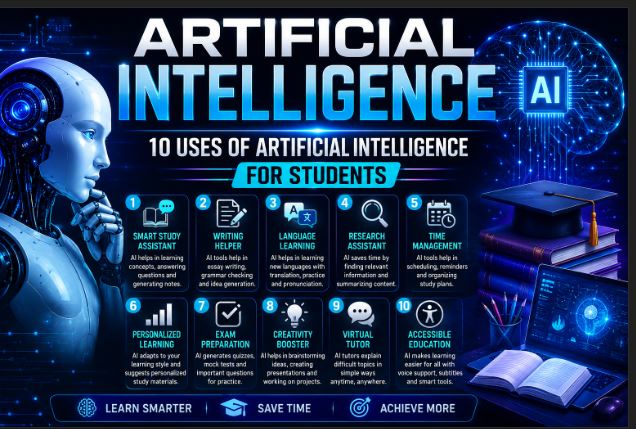
Artificial Intelligence (AI) means machines can think and learn.
Not like humans fully, but they can understand things and make smart decisions.
AI learns from data. It gets better with time. It helps you get results faster.
For example, when you use Google Maps, it shows the best route.It checks traffic.
It saves your time.
Or when you use ChatGPT, -it understands your question
and gives a clear answer.
That is AI in real life.
Simple Definition of AI
AI means machines that learn from data and make smart decisions.
That’s it. Very simple.
Example:
When Netflix suggests a movie,it understands what you like.
Types of AI
1. Narrow AI
This is the most common.It does one task very well.
Example: Amazon Alexa answering questions.
2. General AI
This is more advanced.It can think like a human. It is still not fully developed.
3. Super AI
This is a future idea. It would be smarter than humans. It does not exist yet.
Why AI Matters in 2026
AI is not optional anymore.
It is becoming part of everyday life.
In 2026, people want things fast and easy.
AI makes that possible.
- It saves time
- It reduces effort
- It improves accuracy
Real example:
Hospitals use AI to detect diseases early.
Students use AI tools to study better.
Businesses use AI to talk to customers 24/7.
Even your phone uses AI
to unlock with your face
and suggest useful apps.
In simple words,
AI matters because it makes life smarter, faster, and easier.
Real Life Examples of Artificial Intelligence
AI is not something far away.You are already using it every day.
You just don’t notice it.
Here are some real and simple examples
When you open Google Maps,
it shows the fastest route.
It avoids traffic.
It saves your time.
When you watch movies on Netflix,
it suggests what you might like.
Sometimes it feels like it knows your taste.
When you talk to ChatGPT,
it understands your question
and replies like a real person.
When you use Amazon Alexa,
you just speak.
It plays music, sets alarms,
and answers questions.
When your phone unlocks with your face,
that is AI.
It recognizes you in seconds.
When you shop online,
you see products similar to what you searched before.
That is AI tracking your interest.
Even social media uses AI.
It shows posts you like the most.
That’s why you keep scrolling.
AI is everywhere.
In your phone.
In apps.
In daily life.
In simple words,
AI is helping you make better and faster decisions every day.
Top 10 Uses of Artificial Intelligence for Students
1. AI for Homework Help
Tools that explain answers step by step
Ever stared at a question and thought, “I don’t even know where to start?”
That’s where AI actually helps.
It doesn’t just give you the answer.
It shows you how to get there.
How it really works
AI tools break problems into small steps.
- First, they understand your question
- Then, they solve it step by step
- Finally, they explain it in simple words
So instead of copying… you actually learn.
Popular tools students use
- ChatGPT → explains answers like a tutor
- Photomath → scan a math problem, get full steps
- Socratic → take a photo, get explanations
Real-life example
You have a math problem:
Solve: 2x + 6 = 14
Instead of guessing, you ask AI.
It shows you:
- Subtract 6 from both sides → 2x = 8
- Divide by 2 → x = 4
Now you don’t just know the answer.
You understand the process.
Why students love it ?
- Saves time
- Explains in simple language
- Works anytime (even late at night)
It feels like having a tutor in your pocket.
One thing to be careful about
Don’t just copy answers.
If you skip understanding, you’ll struggle in exams.
Final thought
AI is not here to do your homework for you.
It’s here to help you understand it faster.
Use it smartly…
and homework becomes a lot less stressful.
2. AI for Research and Notes
Summarizing long articles into short notes
You open a 20-page article.
After 5 minutes… your brain is already tired.
That’s where AI steps in.
It turns long, boring content into short, clear notes you can actually understand.
How it works?
AI reads the whole content fast.
Then it:
- Picks the main points
- Removes extra fluff
- Converts it into simple notes
So instead of reading everything you get what actually matters.
Popular tools students use
- ChatGPT → paste text, get summary in seconds
- QuillBot → summarize and rewrite notes
- Notion AI → organize notes automatically
Real-life example
You have a long chapter on climate change.
Instead of reading everything line by line, you use AI.
It gives you:
- Causes of climate change
- Effects on environment
- Possible solutions
All in a few bullet points.
Now revision becomes easy.
Why students love it ?
- Saves hours of reading
- Makes notes short and clear
- Helps in quick revision before exams
It’s like turning a textbook into cheat notes.
One thing to be careful about
AI can sometimes miss small details.
So don’t rely on it 100%.
Quickly review the original content too.
Final thought
AI doesn’t replace studying. It makes studying faster and smarter.
Use it to cut the noise and focus on what really matters.
3. AI for Language Learning
Improve English speaking and grammar
Learning English can feel awkward. You understand but speaking? That’s the hard part.
AI makes it easier. No pressure. No judgment.
How it helps?
AI acts like a personal language partner.
- You can chat anytime
- It corrects your grammar instantly
- It suggests better sentences
- It helps you practice speaking naturally
It’s like talking to a patient friend who never gets tired.
Popular tools students use
- ChatGPT → practice conversations and improve sentences
- Duolingo → fun lessons for daily practice
- Grammarly → fixes grammar and sentence structure
Real-life example
You want to say:
“I did mistake in homework.”
You ask AI.
It corrects you:
“I made a mistake in my homework.”
It also explains why.
Now you don’t just fix it you learn it.
Why students love it ?
- Practice anytime, even at night
- No fear of making mistakes
- Instant feedback
- Improves confidence quickly
One thing to be careful about
Don’t depend only on AI.
Real conversations with people still matter.
Final thought
AI won’t replace real speaking. But it helps you get ready for it.
Use it daily even 10 minutes.
Slowly, your English stops feeling like a subject and starts feeling natural.
4. AI for Time Management
Study planners and smart schedules
Ever feel like the day just disappears and you didn’t study anything?
Yeah, that happens to almost every student.
AI helps you take control of your time without overthinking it.
How it actually helps?
AI tools don’t just set reminders.
They plan your whole study time smartly.
- Break big tasks into small steps
- Create daily study schedules
- Remind you what to do and when
- Adjust your plan if you miss something
It’s like having a personal study manager.
Popular tools students use
- Notion AI → creates study plans and organizes tasks
- Google Calendar → schedule and track your day
- Todoist → smart task lists with reminders
Real-life example
You have:
- Math test in 3 days
- Assignment due tomorrow
- 5 chapters to revise
Feels stressful, right?
You use AI.
It creates a simple plan:
- Today: Finish assignment + 1 chapter
- Tomorrow: 2 chapters revision
- Day 3: Practice + quick revision
Now everything feels clear. No panic.
Why students love it
- No confusion about what to study
- Saves time deciding
- Keeps you consistent
- Reduces stress
You stop wasting time… and start using it.
One thing to be careful about
Don’t ignore the schedule.
AI can plan perfectly. But you still have to follow it.
Final thought
Time management is not about working more.
It’s about working smart.
AI helps you do exactly that.
Once your day is planned…
studying feels lighter, not harder.
5. AI for Personalized Learning
Learning at your own speed
Not every student learns the same way.
Some are fast. Some need more time. And that’s totally normal.
That’s where AI changes everything.
How it helps?
AI doesn’t force one speed for everyone.
It adjusts to you.
- If you’re weak in a topic, it slows down
- If you understand fast, it moves ahead
- It repeats difficult lessons until you get it
- It gives extra practice where you struggle
It’s like a teacher that only teaches you.
Popular tools students use
- ChatGPT → explains topics in simple way again and again
- Duolingo → adapts lessons based on your progress
- Khan Academy → personalized practice and video lessons
Real-life example
Two students are learning algebra.
- Student A understands quickly
- Student B struggles with equations
In a normal class, both move at the same speed.
But with AI:
- Student A gets harder questions
- Student B gets step-by-step help
No pressure. No comparison. Just learning.
Why students love it
- No feeling of “falling behind”
- Learn at your own pace
- More confidence in weak subjects
- Less stress, more understanding
One thing to remember
Don’t rush just because AI moves forward.
Make sure you actually understand before going ahead.
Final thought
Personalized learning feels like education finally adjusts to the student… not the other way around.
AI doesn’t just teach.
It understands how you learn.
6. AI for Solving Math Problems
Step-by-step solutions
Math is one of those subjects where you either “get it”… or you’re stuck for hours.
That’s where AI really helps.
It doesn’t just give the answer.
It shows how the answer is built step by step.
How it helps
AI breaks math into small, simple steps.
- Understands the question
- Solves it step by step
- Explains each move in plain language
- Shows the final answer clearly
So you’re not guessing. You’re learning.
Popular tools students use
- Photomath → scan problems and see full steps
- ChatGPT → explains math in simple words
- Microsoft Math Solver → step-by-step solutions with explanations
Real-life example
You see a question:
3x + 5 = 20
Instead of guessing, you use AI.
It shows:
- Subtract 5 from both sides → 3x = 15
- Divide both sides by 3 → x = 5
Now you don’t just know the answer.
You understand why it is 5.
Why students love it
- No confusion in tough questions
- Instant help anytime
- Easy explanations
- Helps during exam preparation
It feels like a tutor sitting next to you.
One thing to be careful about
Don’t just copy answers.
If you don’t understand steps, math won’t improve.
Final thought
AI makes math less scary.
It turns hard problems into simple steps…
so learning actually makes sense instead of stress.
7. AI for Writing Essays
Ideas, structure, and editing help
Writing an essay can feel stuck at the start.
Blank page. No ideas. No direction.
That’s exactly where AI makes life easier.
How it helps
AI doesn’t write your whole essay for you (at least if you use it right).
It helps you build it step by step.
- Gives topic ideas
- Creates a clear structure (intro, body, conclusion)
- Helps improve sentences
- Fixes grammar and tone
So you’re not lost before you even start.
Popular tools students use
- ChatGPT → essay ideas, outlines, and rewriting help
- Grammarly → grammar correction and writing improvement
- QuillBot → rewords sentences and improves clarity
Real-life example
You get this topic:
“Benefits of Artificial Intelligence in Education”
You don’t know where to start.
You ask AI.
It gives you:
- Introduction about AI in education
- 3–4 main points (like personalized learning, time saving, better understanding)
- Conclusion
Now you just fill it in with your own words.
Why students love it
- No “writer’s block”
- Clear essay structure
- Better vocabulary suggestions
- Faster editing
It turns confusion into a clear plan.
One thing to be careful about
Don’t copy everything blindly.
Teachers can tell.
Use AI as support, not replacement.
Final thought
AI doesn’t make you a lazy writer.
It helps you become a better one.
Once you know the structure…
writing essays feels less like pressure and more like flow.
8. AI for Creating Presentations
Auto slides and designs
Making presentations used to take hours.
Choosing slides. Fixing design. Adding text.
Now AI does most of it in minutes.
How it helps
AI turns your idea into a ready presentation.
- Creates slide structure automatically
- Suggests headings and bullet points
- Designs clean layouts
- Adds visuals and themes
So you focus on content, not design stress.
Popular tools students use
- Canva → ready-made presentation templates with AI design help
- Microsoft PowerPoint → AI design suggestions and slide creation
- Beautiful.ai → auto-designed professional slides
Real-life example
You get a topic:
“Climate Change Effects”
Normally, you would:
- Search content
- Decide slide order
- Fix design for hours
With AI:
You type the topic → it creates:
- Title slide
- Causes slide
- Effects slide
- Solutions slide
All in a few minutes.
Now you just edit and present.
Why students love it
- Saves a lot of time
- No design skills needed
- Clean and professional slides
- Easy to edit anytime
It removes the stress of starting from zero.
One thing to be careful about
Don’t trust everything blindly.
Always check facts and adjust wording.
Final thought
AI doesn’t just make slides.
It makes presentation work feel simple.
What used to take hours…
now takes minutes with a few clicks.
9. AI Tutors and Chatbots
24/7 study help
Sometimes you’re studying late at night… and no teacher is around.
That’s where AI tutors come in.
They don’t sleep. They don’t get tired. They’re always ready to help.
How it helps?
AI tutors and chatbots act like your study buddy.
- Answer your questions anytime
- Explain topics in simple language
- Help with homework step by step
- Repeat explanations until you understand
It’s like having a teacher in your pocket.
Popular tools students use
- ChatGPT → explains subjects, solves doubts, and gives examples
- Khan Academy → AI-powered practice and guided learning
- Google Gemini → quick answers and study support
Real-life example
You’re stuck on a science question at 1 AM.
“What is photosynthesis?”
Instead of waiting for class tomorrow, you ask AI.
It replies in simple words:
Plants use sunlight, water, and carbon dioxide to make food.
Now it even gives an example like:
Leaves are like tiny food factories.
You understand it instantly.
Why students love it ?
- Help available anytime
- No fear of asking “silly” questions
- Easy explanations
- Fast problem solving
It feels like a friendly tutor who never says “ask later.”
One thing to be careful about
Don’t just copy answers.
Try to understand the explanation properly.
That’s where real learning happens.
Final thought
AI tutors don’t replace teachers.
They support you when you’re stuck.
And sometimes that little help at the right time makes all the difference.
10. AI for Creativity
Generate images, ideas, and projects
Creativity isn’t just about “being artistic” anymore. Now AI can spark ideas when your mind goes blank.
It’s like a creative boost when you’re stuck.
How it helps ?
AI gives you fresh ideas in seconds.
- Suggests project topics
- Creates design ideas and visuals
- Helps brainstorm stories or concepts
- Builds starting points you can improve
You don’t start from zero anymore.
Popular tools students use
- Canva → AI designs, posters, and creative templates
- ChatGPT → idea generation for projects, stories, and content
- DALL·E → creates images from text ideas
Real-life example
You have a school project:
“Save the Environment”
You don’t know what to do.
You ask AI.
It suggests:
- Poster ideas
- Slogans like “Save Earth, Save Future”
- Project structure
- Even image concepts like polluted vs clean Earth
Now your blank page is full of ideas.
Why students love it ?
- No creative block
- Instant inspiration
- Better project quality
- Fun to experiment with ideas
It makes creativity feel easy, not stressful.
One thing to be careful about
Don’t rely on AI for everything.
Your own ideas still matter the most.
Final thought
AI doesn’t replace creativity. It starts it for you.
Once you get an idea,you can shape it into something truly your own.
PRACTICAL EXPERIENCE ABOUT USES OF ARTIFICIAL INTELLIGENCE FOR STUDENTS
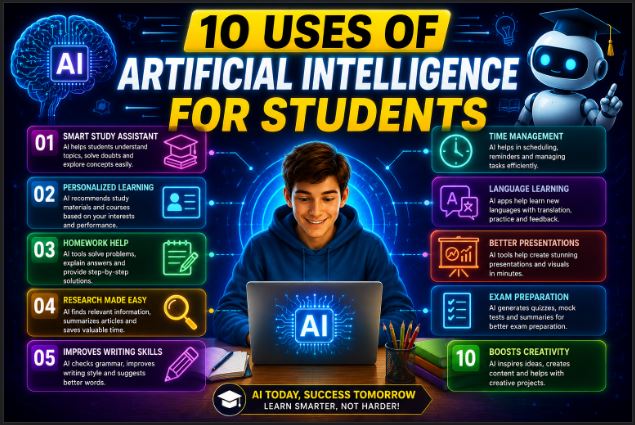
Last semester, I started using artificial intelligence tools as part of my study routine, and honestly, it changed the way I learn.
At first, I struggled a lot with managing time, understanding difficult topics, and writing assignments.
I remember getting stuck on a math chapter for hours with no clear direction. Then I tried ChatGPT to break problems into steps, and suddenly things started making sense.
For writing, I used Grammarly to fix grammar and improve my essays, which saved me from a lot of silly mistakes.
I also used Canva for presentations, and it made my school projects look much more professional without extra effort.
But it wasn’t all perfect. Sometimes AI gave answers that were too general or slightly wrong, and I had to double-check everything.
I also noticed some classmates started depending on it too much, just copying answers without understanding, which later affected their exam performance.
From my experience, AI is a powerful tool if used smartly.
It helps students learn faster, stay organized, and be more creative. But if misused, it can reduce real learning.
In the future, I think AI will become even more common in education, and students who use it wisely will have a clear advantage in studies and careers.
Challenges of Using AI for Students
Over-dependence, wrong information, cheating risks
AI is helpful. No doubt.
But if you use it the wrong way, it can also create problems.
Let’s talk real.
1. Over-dependence
This is the biggest issue.
Students start relying on AI for everything.
- Homework
- Essays
- Even simple answers
Real-life example:
A student stops trying to solve questions alone. Every time he’s stuck, he asks AI.
Later in exams… there’s no AI. He struggles badly.
Problem: You stop thinking on your own.
2. Wrong Information
AI is smart, but not always perfect.
Sometimes it gives outdated or incorrect answers.
Real-life example:
A student uses AI for a science fact. The answer looks correct.
But in class, the teacher says it’s wrong.
👉 Problem: You learn the wrong thing without knowing.
3. Cheating Risks
This is a serious one.
Some students copy AI answers and submit them as their own work.
Real-life example:
A student uses AI to write a full essay and submits it.
Teacher notices the writing style doesn’t match the student.
Problem: It may lead to low grades or punishment.
Why this matters
AI is a tool, not a shortcut.
If you depend on it too much:
- Your skills don’t grow
- Your thinking becomes weak
- You lose confidence in exams
Final thought
AI is powerful. But it’s like fire.
Used right → it helps you learn faster.
Used wrong → it can slow your growth.
The smart students are the ones who use AI to learn, not to avoid learning.
Tips to Use AI Smartly
Use AI as helper, not shortcut
AI can make studying easier.
But only if you use it the right way.
Otherwise, it can do more harm than good.
1. Use AI as a helper, not a shortcut
Don’t let AI do everything for you.
Let it guide you instead.
Real-life example:
Instead of asking AI to write your full essay, ask it for ideas and structure.
Then write it in your own words.
This way, you actually learn.
2. Always verify answers
AI is smart… but not perfect.
It can make mistakes.
Real-life example:
You ask AI a history fact. It sounds right.
But later, you check your textbook and it’s slightly different.
So always double-check before trusting it.
3. Combine AI with your own thinking
This is the smartest move.
Use AI for help… then add your brain to it.
Real-life example:
AI gives you an essay outline.
You improve it, add your own examples, and rewrite it in your style.
Now it becomes your work, not just AI output.
Why this matters
If you use AI smartly:
- You learn faster
- You understand better
- You become more confident
But if you misuse it:
- You stop thinking
- You depend too much
- Your skills stay weak
Final thought
AI is not your replacement.
It’s your support system.
The real power is not in using AI…
It’s in using it wisely.
Best AI Tools for Students
1.ChatGPT
2.Grammarly
3.Canva
If you’re a student today, these tools can seriously make your life easier.
Not by doing everything for you… but by helping you work smarter.
Let’s break it down simply.
ChatGPT
Your all-in-one study helper
You can ask it anything.
- Explain tough topics
- Help with essays
- Give ideas for projects
- Solve doubts step by step
Real-life example:
You don’t understand a science topic.
You ask ChatGPT. It explains it in simple words like a friend.
Suddenly, it clicks.
Grammarly
Fixes your writing instantly
This tool is like a grammar checker on steroids.
- Corrects grammar mistakes
- Improves sentence structure
- Makes writing clearer and more professional
Real-life example:
You write an essay. It looks okay to you.
Grammarly highlights mistakes and suggests better wording.
Your essay instantly sounds better.
Canva
Makes presentations and designs easy
No design skills needed here.
- Ready-made templates
- Auto-designed presentations
- Posters, projects, and assignments
Real-life example:
You have a school presentation tomorrow.
Instead of stressing, you pick a template in Canva and just edit text.
Done in minutes.
Final thought
These tools are not here to replace your effort.
They’re here to support it.
- ChatGPT helps you understand
- Grammarly improves your writing
- Canva boosts your creativity
Use them smartly…
and studying suddenly feels a lot easier.
10 Uses of Artificial Intelligence in Daily life
1. AI in Healthcare
AI is changing healthcare in a big way.
It helps doctors work faster.
It helps patients get better care.
Disease Detection
.One major use is disease detection.
AI can study medical data quickly.
It can find problems early.
For example, AI can scan X-rays or reports
and detect diseases like cancer.
Sometimes it finds issues
that humans might miss.
AI-powered diagnosis.:
Another use is AI-powered diagnosis.
AI looks at symptoms and medical history.
Then it suggests possible diseases.
This helps doctors make better decisions.
It also saves time in emergencies.
Real example:
Some hospitals use AI tools
to detect heart problems early.
This can save lives.
In simple words,
AI helps doctors find diseases faster
and treat patients better.
2. AI in Education
AI is making learning easier and smarter.
Students don’t have to depend only on books now.
They can learn anytime, anywhere.
Smart learning apps.
One big use is smart learning apps.
These apps help students understand topics step by step.
They explain things in a simple way.
For example, apps like Duolingo
help you learn new languages.
It gives quick exercises.
It corrects your mistakes instantly.
Personalized Learning.Another use is personalized learning.
Every student learns differently.
AI understands your level and speed.
If you are slow, it gives easy lessons.
If you are fast, it gives harder ones.
Real example:
When you watch lessons on YouTube,
it suggests videos based on what you watch.
This helps you learn better topics again and again.
In simple words,
AI helps students learn faster, easier, and in their own way.
3. AI in Business
AI is changing how businesses work.
It makes things faster and easier.
It also reduces human effort.
Automation
Automation means machines do work on their own.
No need to do everything manually.
For example, companies use AI to handle data entry.
They also use it for invoices and reports.
This saves a lot of time.
In factories, machines powered by AI
can pack products, check quality, and sort items.
All with less human effort.
Big companies like Amazon
use AI to manage warehouses.
It helps deliver products faster.
Customer Support Chatbots
Many businesses now use AI chatbots.
These bots talk to customers instantly.
No waiting for a human agent.
For example, when you visit an online storeand a chat box pops up,
that is AI helping you.
It answers questions like
“Where is my order?” or “What is the price?”
Even small online shops on platforms like Shopifyuse chatbots to handle customers 24/7.
In simple words,
AI helps businesses save time, reduce cost, and serve customers faster.
4. AI in Daily Life
AI is not something special anymore.
It’s already part of your normal day.
You just use it without thinking.
Voice Assistants
Voice assistants make life super easy.
You just speak, and they respond.
For example, when you say “set an alarm” or “play music,”
it does it instantly.
Tools like Amazon Alexa
and Google Assistant
help you every day.
You don’t need to type anything.
Just talk, and it works.
Smart Home Devices
AI is also in your home now.
It makes your house smarter.
Smart lights can turn on automatically.
Smart AC can adjust temperature on its own.
Even smart cameras can detect movement.
For example, if you forget to turn off lights,
AI systems can do it for you.
Some homes even use smart speakers
to control everything with voice.
In simple words,
AI is quietly making your daily life easier, faster, and more comfortable.
5. AI in Transportation
AI is making travel smarter every day.
It helps people move faster and safer.
It also reduces traffic problems.
Self-driving cars
Self-driving cars are cars that can drive themselves.
They don’t need a human driver all the time.
They use sensors, cameras, and AI systems
to understand the road.
For example, cars developed by Tesla
can stay in lane, stop at signals,
and even change speed automatically.
It feels like the car is “thinking” on its own.
Traffic prediction
AI also helps with traffic prediction.
It studies road conditions and traffic patterns.
Then it tells you the fastest route.
For example, when you use Google Maps
it shows live traffic updates.
It can even warn you about jams ahead.
So you can avoid busy roads
and reach faster.
In simple words,
AI in transportation makes travel safer, faster, and less stressful.
Problems in Use of Artificial Intelligence for Students And Simple Solutions
AI is everywhere in student life now.
From assignments to learning apps, it helps a lot.
But students also face real problems when using it.
Let’s talk about them in a simple way.
1. Overdependence on AI
Students start relying too much on AI tools.
This reduces their own thinking skills.
Real-life example
A student uses AI to write every assignment.
Later in exams, they struggle to answer basic questions.
Simple solution
Use AI for help, not full answers.
Try to understand and write things yourself first.
2. Wrong or Incomplete Answers
AI is not always accurate.
Sometimes it gives outdated or incorrect information.
Real-life example
A student uses AI for research work.
Later they find out some facts were wrong.
Simple solution
Always double-check information from trusted books or websites.
3. Lack of Learning Skills
Students copy answers instead of learning.
This weakens their understanding.
Real-life example
A learner submits AI-generated homework but fails to explain it in class.
Simple solution
Use AI to learn steps, not just final answers.
4. Plagiarism Issues
AI content may look original but still cause plagiarism problems.
Real-life example
A student submits AI-written content and gets flagged for copying.
Simple solution
Rewrite in your own words and add personal understanding.
5. Distraction from Real Study
Students use AI for quick answers and stop studying deeply.
Real-life example
Instead of reading chapters, a student just asks AI for summaries.
Simple solution
Balance AI use with proper textbook study.
6. Dependence on Internet
AI tools need internet access.
Without it, students feel stuck.
Real-life example
A student cannot complete work during internet outage because they rely fully on AI.
Simple solution
Keep offline notes and basic study material ready.
7. Reduced Creativity
Too much AI use limits original thinking.
Real-life example
Students start writing similar answers because they all depend on the same AI tool.
Simple solution
Add your own ideas and examples to every answer.
Final Thoughts
AI is helpful for students, but it also has challenges.
The main problems are:
- Overdependence
- Wrong answers
- Weak learning skills
- Plagiarism risks
- Reduced creativity
In simple words:
AI should support students, not replace their own learning and thinking.
FAQ ( Frequently Asked Questions )
Is AI good for students?
Yes, AI is good for students when used correctly. It helps in learning, writing, and understanding topics faster.
Example: Students use AI to solve math problems and study for exams easily.
Can AI replace teachers?
No, AI cannot fully replace teachers. It only helps in teaching and supporting students.
Example: AI explains lessons, but teachers guide, motivate, and manage the classroom.
Is using AI cheating?
Using AI is not always cheating. It becomes cheating if students copy answers without learning or permission.
Example: Using AI to understand a topic is fine, but copying AI answers in exams is cheating.
Which AI tool is best for studying?
There’s no single “best” tool. Different tools do different jobs.
Top ones students use:
- ChatGPT → explanations, doubts, ideas
- Grammarly → grammar and writing help
- Canva → presentations and projects
Real-life example:
You use ChatGPT to understand a topic, Grammarly to fix your essay, and Canva to make slides.
Together, they make studying easier.
What are 5 advantages of AI for students?
- AI helps students learn faster with easy explanations. It saves study time.
Example: AI explains hard math problems in simple steps. - AI improves writing and grammar skills. It corrects mistakes quickly.
Example: It helps students write better essays. - AI supports homework and assignments. It gives instant answers and ideas.
Example: Students use AI for science project help. - AI helps in exam preparation. It gives practice questions and tests.
Example: AI apps create mock exams for revision. - AI helps in research work. It finds information quickly.
Example: Students collect data for school projects easily.
What are the uses of artificial intelligence for medical students?
AI helps medical students study diseases, understand human body, and read medical cases faster. It also supports practice in diagnosis and research.
Example: Medical students use AI to learn symptoms, analyze scans, and prepare for exams.
How can students balance the use of artificial intelligence and the need to avoid plagiarism?
Students should use AI for ideas, learning, and understanding, but write answers in their own words. They must always give credit and avoid copying directly.
Example: A student uses AI to learn a topic, then rewrites it in simple words instead of copying text.
How do students navigate ethical issues in the use of artificial intelligence in academic writing?
Students use AI ethically by writing in their own words and not copying full text. They also follow school rules and give proper credit when needed.
Example: A student uses AI for ideas, then rewrites the essay and checks plagiarism before submitting.
Can AI be used to create more personalized education experiences for students?
Yes, AI can create personalized learning for students based on their level and needs. It gives different lessons, speed, and practice for each student.
Example: A learning app gives easy math to weak students and advanced questions to strong students.
What steps should schools take to prepare their students for the future use of artificial Intelligence (AI)?
Schools should teach basic AI skills, digital literacy, and ethical use of technology. They should also train teachers and include AI tools in learning safely.
Example: Students learn how to use AI for study help but also learn not to copy answers directly.
How does the use of artificial intelligence in e-learning effect student outcomes?
AI in e-learning improves student results by giving personalized lessons and instant feedback. It helps students learn faster and understand topics better.
Example: An online platform uses AI to show extra practice to weak students and improve their scores.
Is AI useful for coding students?
Yes, AI helps write and debug code.
Example: Students learn programming faster with AI tools.
Disadvantages of Using Artificial Intelligence for Students
AI is helpful for students.But it also comes with real problems.
If it is not used carefully, it can harm learning.
Let’s understand it in simple words.
1. Overdependence on AI
Students start depending too much on AI.
They stop thinking on their own.
Real-life example
A student uses AI for every homework task.
Later, they struggle in exams without help.
2. Weak Learning Skills
Copying answers reduces real understanding.
Students just complete work, not learn it.
Real-life example
A student submits AI-written answers but cannot explain them in class.
3. Wrong Information
AI is not always correct.
It can give outdated or false answers.
Real-life example
A student studies wrong facts from AI and loses marks in exams.
4. Plagiarism Problems
AI content can get flagged as copied work.
Schools and colleges take it seriously.
Real-life example
A student submits AI-generated essay and gets warned for plagiarism.
5. Reduced Creativity
Too much AI use affects original thinking.
Students stop using their own ideas.
Real-life example
Multiple students submit similar answers because they all used the same AI tool.
6. Distraction from Studies
Students use AI for shortcuts instead of learning deeply.
Real-life example
Instead of reading a chapter, a student only asks AI for summaries.
7. Internet Dependence
AI tools need internet all the time.
Without it, students get stuck.
Real-life example
A student cannot complete work during a network issue because they rely fully on AI.
8. Lack of Practical Knowledge
AI gives answers but does not always build real skills.
Real-life example
A student knows theory from AI but cannot solve real exam problems.
Final Thoughts
AI is useful, but not perfect for students.
The main disadvantages are:
- Overdependence
- Weak learning
- Wrong answers
- Plagiarism risks
- Reduced creativity
In simple words:
AI should help students learn, not replace their own effort and thinking.
Conclusion
So, here’s the simple truth.AI is already part of student life. And it’s only getting bigger.
From homework help to essays, from time management to presentations… it’s making studying faster and easier in almost every way.
But here’s the key point.
Short Summary
AI helps students:
- Learn faster
- Save time
- Understand tough topics
- Improve writing
- Stay organized
In short… it makes studying less stressful and more smart.
Real-life reminder
Think about a student who uses AI for everything.
He copies answers but doesn’t understand them.
In exams, he struggles.
Now think about another student.
He uses AI to learn, not copy.
He asks questions, understands steps, and practices.
That student performs better.
Same tool. Different use. Different result.
Final Thought
AI is not here to replace your effort.
It’s here to support it.
Use it to understand, not escape.
Use it to learn, not depend.
Because in the end…
smart students don’t just use AI — they use it wisely.